PP (polypropylene) is a common thermoforming material, and one buyers ask about often. It is tough, resists acids, alkalis and most solvents, has a low density and is easy to recycle as a single material. That makes it a good fit for packaging inserts, handling trays and covers that see chemicals. But PP does not form as easily as ABS or PS. With the same mold and settings, a switch to PP often brings sag, uneven walls, shrinkage and warp.
This guide covers part selection, forming issues, deep forming, shrinkage, trimming and specification, in that order, and explains how to design and buy PP thermoformed parts. FUNYO evaluates PP among its heavy-gauge sheet materials, and PP is also a common material on the thin-gauge lines. The capability figures below all come from FUNYO's current lines.
Which thermoformed parts suit PP
Buyers usually choose PP for toughness, chemical resistance and recycling rather than appearance. These are the common part types.
| Part | Why PP | Watch for |
|---|---|---|
| Packaging inserts, FOSB inserts | Survives repeated loading without cracking; few particles at cut edges | Wall thickness in deep draws; fit clearance after shrinkage |
| Handling trays, divided trays | Impact resistant, tolerates cleaning agents, recyclable | Warp on large flat areas; stacking and nesting |
| Covers and tanks that touch chemicals | Resists acids, alkalis and most solvents | Lower stiffness than ABS; needs structural ribs |
| Lightweight covers | Low density, lighter at the same gauge | Painting and bonding are difficult |
To decide whether PP is worth considering, ask three questions. Will the part touch acids, alkalis, cleaning agents or oils? Will it be loaded, flexed or dropped again and again? Must it be recyclable as a single material after use? If two of the three answers are yes, PP is usually worth assessing. If all three are no, ABS, PS or PETG will form more easily, and cost and lead time are easier to control.
Parts that need a high-gloss finish, transparency, painting or bonding are usually not a first choice for PP. Those cases are covered separately later in this guide.
Why PP is harder: a narrow forming window and sheet sag
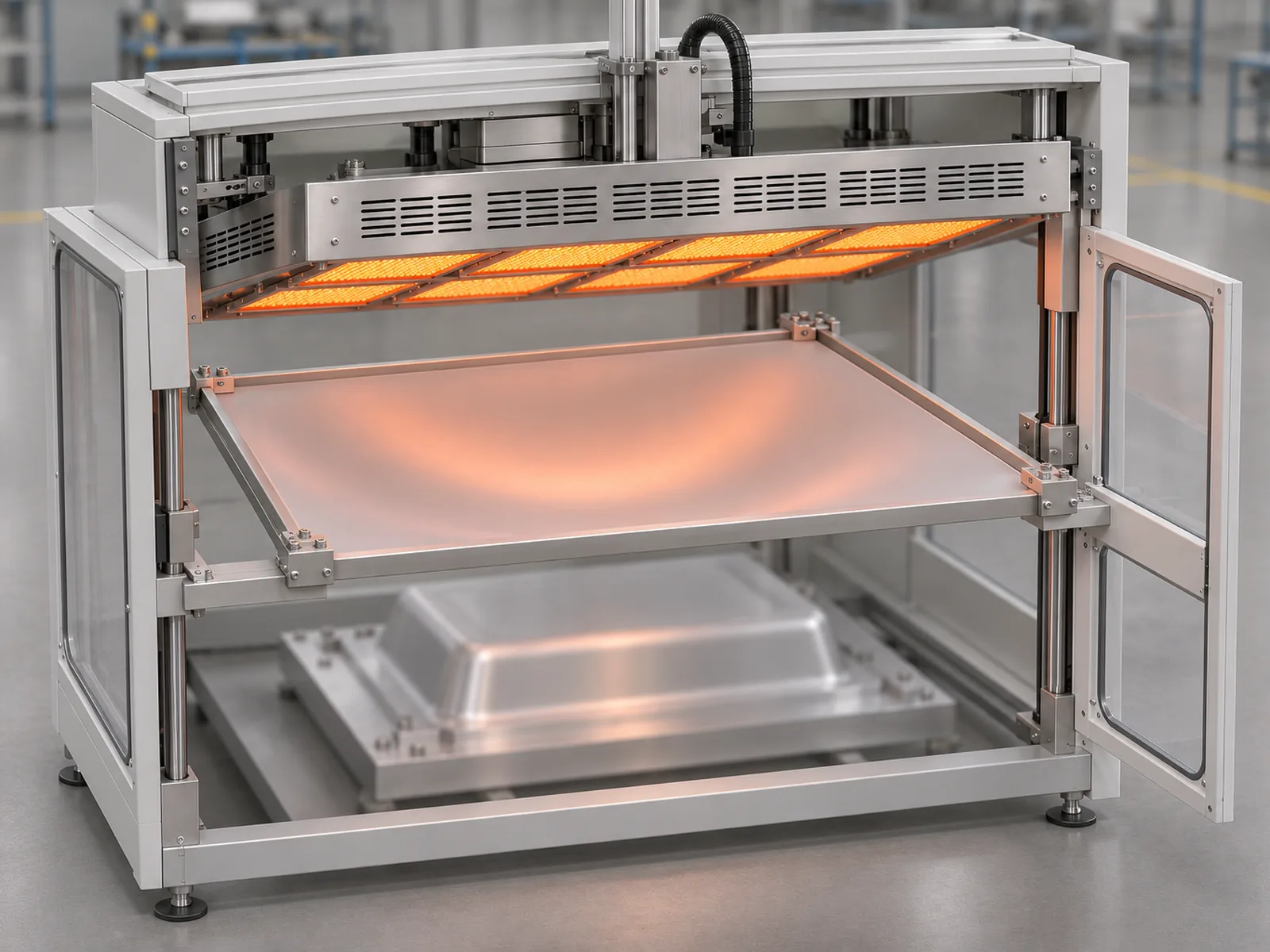
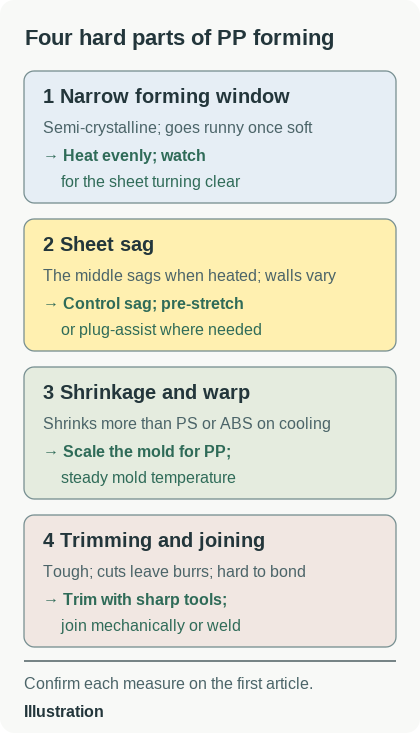
ABS and PS are amorphous materials: they soften gradually as they heat, so their forming range is wide. PP is semi-crystalline. It stays fairly stiff until it nears its melting point, then turns soft and runny quickly, and the sheet sags visibly under its own weight.
One public vacuum forming guide lists a recommended forming temperature of 150–180 °C for PP and a recommended mold temperature of 90 °C. 1 The same guide notes that translucent PP turns clear when it reaches its plastic state, within a band of about 10 °C, which makes it a useful indicator of forming temperature. 1 In practice this means PP needs more even and more stable heating, and the operator has to watch for the moment the sheet goes clear.
Sag causes two problems. First, the middle of the sheet touches the mold before the rest, so the walls come out uneven. Second, if the sag is too deep, the sheet can wrinkle or fold onto itself. The usual measures are to limit the sheet area, zone the heaters and, where needed, pre-stretch the sheet or use a plug assist so that it stretches evenly before it meets the mold.
PP comes in two main families, homopolymer and copolymer. Copolymer PP has a slightly wider forming window and better impact strength at low temperatures, so it is common for packaging inserts and handling parts. Homopolymer PP is somewhat stiffer, but harder to form and more brittle in the cold. The specification should say which family to use.
Unlike PC and PETG, PP absorbs almost no moisture, so the sheet usually needs no drying before forming, which saves a step. Color and filler, however, change how PP heats. Black sheet absorbs heat quickly, natural and light colors more slowly, and sheet filled with talc or similar fillers sags less. When the color or grade changes, confirm the heating time and temperature again rather than carrying over the settings from the last batch.
The larger the sheet, the more it sags. A mold that runs well on a small sheet may need sheet support or zoned heating on a large one. State the outside dimensions of the part and the number of parts per sheet at the quoting stage, so the right line can be chosen.
Deep forming: estimate the thinnest wall, then choose gauge and line
The deeper the part, the more the sheet stretches, and the deep corners and the tops of bosses end up thinnest. Sagging PP stretches even less evenly, so for a deep PP part, estimate the thinnest wall first and work back to the starting gauge.
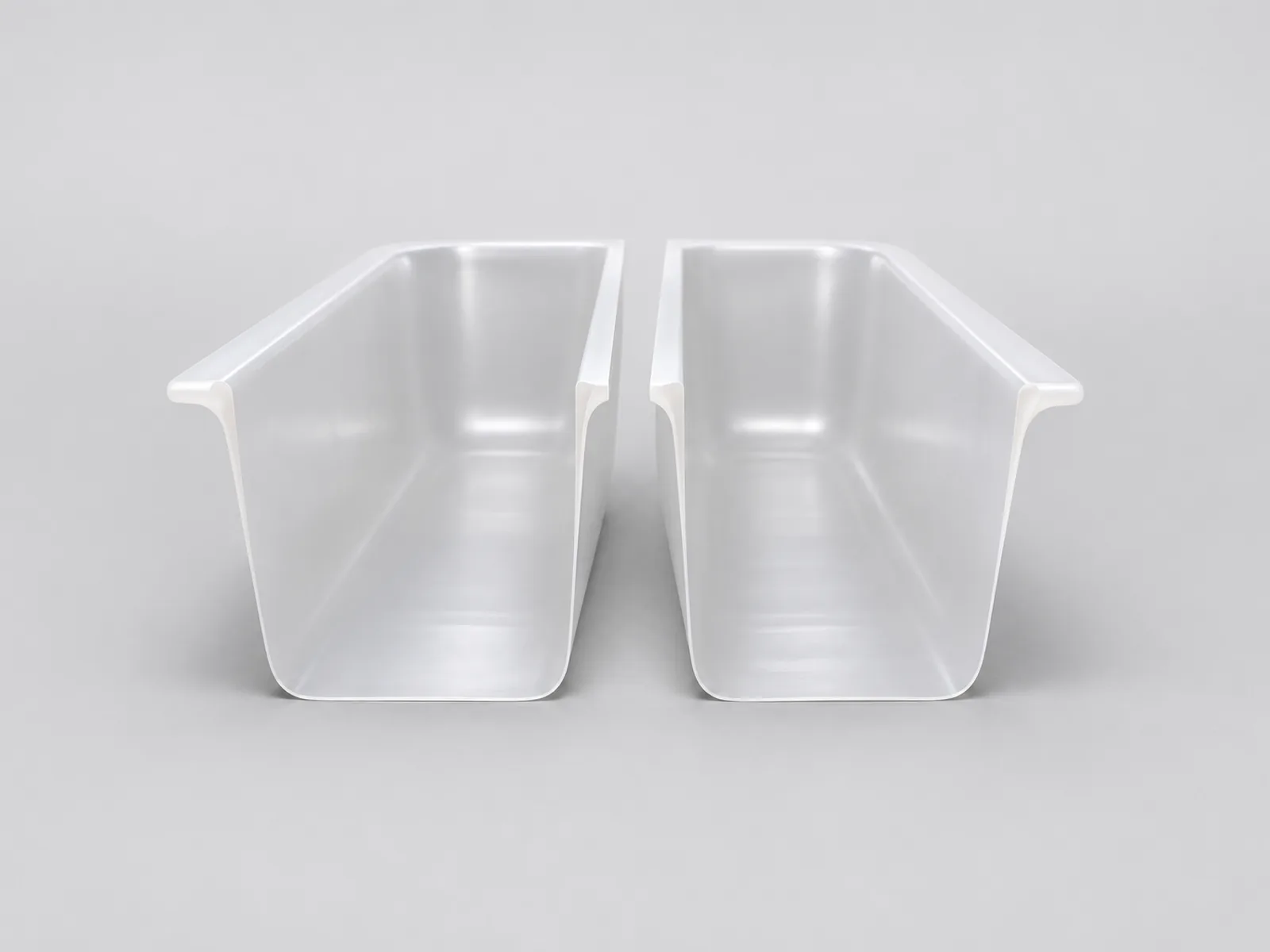
For heavy-gauge housing-type parts, FUNYO uses a starting point of about one third of the starting gauge for the thinnest deep-corner wall, then confirms it by first-article thickness measurement. Where PP sags markedly, the thinnest wall can come out thinner still. Measure the key spots on the samples, then decide whether to use a thicker sheet, change the radii or add a plug assist.
Here is an estimate as an example. For a heavy-gauge housing-type part that needs a finished wall of 1 mm in the deep corners, the one-third starting point means a starting gauge of at least 3 mm. If the PP sags markedly, go up one gauge or add a plug assist, and let the first-article measurement decide. A gauge worked out this way is for quoting and sampling only, not a guaranteed value.
Choose the line by depth and gauge. FUNYO's thin-gauge trays reach a forming depth of 120 mm, which suits thinner PP inserts and trays. Deeper and thicker parts go to heavy-gauge forming, up to 2600 × 1600 × 600 mm per part.
Do not give only the starting gauge in the specification. State the minimum finished wall at key spots, such as support faces, deep corners and the areas around mounting holes. Agree on the measuring method and points before the first article, so that supplier and buyer judge from the same set of numbers.
Shrinkage and warp: mold scaling, mold temperature and measuring conditions
PP shrinks much more than ABS or PS as it cools. For heavy-gauge housing-type parts, FUNYO uses tool shrinkage starting points of ABS 0.5–0.7% and PP 1.5–2.0%, corrected after the first article. PP shrinks about three times as much as ABS, so a PP part formed on a mold scaled for ABS comes out noticeably undersize.
As an example, a part 1000 mm long, at the 1.5–2.0% starting point, comes out about 15–20 mm shorter than the mold in PP, while in ABS at 0.5–0.7% it is only about 5–7 mm shorter. The difference is more than 10 mm, so a mold cannot simply be switched from ABS to PP. Rescale it for PP and correct it from first-article measurements.
Uneven shrinkage causes warp. Large flat PP parts and long narrow ones warp most easily: the side against the mold cools first and the other side later, and internal stress bends the part. The measures are a stable mold temperature and even cooling, ribs or a slight crown on flat areas, and cooling the part on a fixture so it sets in shape.
The dimensions of a formed PP part keep changing for some time after forming. For the first-article inspection, agree on how long the part rests after forming and at what temperature it is measured, so both sides measure under the same conditions. Long parts are also more sensitive to ambient temperature, so state the measuring temperature.
For mating faces with tight tolerances, form first and then CNC trim or drill, so the post-machining controls the tolerance rather than relying entirely on forming shrinkage. For more on shrinkage and warp, see thermoforming shrinkage and warpage.
Trimming and joining: burrs, holes, bonding and welding
PP is tough, so it does not chip at the trim line the way PS does, but it tends to leave strings and burrs. Trim with sharp tools at a suitable speed and feed. Burrs increase noticeably as the tool dulls. When thin-gauge parts are die cut, set the die clearance for PP.
Thin-gauge PP trays and inserts are mostly die cut, which is fast and suits high volumes. Heavy-gauge PP parts are mostly CNC trimmed and drilled, which suits small batches and complex shapes. The two methods leave different burrs and reach different accuracy, so the specification should state the trim line, the hole position tolerance and the allowed burr height to give inspection a clear basis.
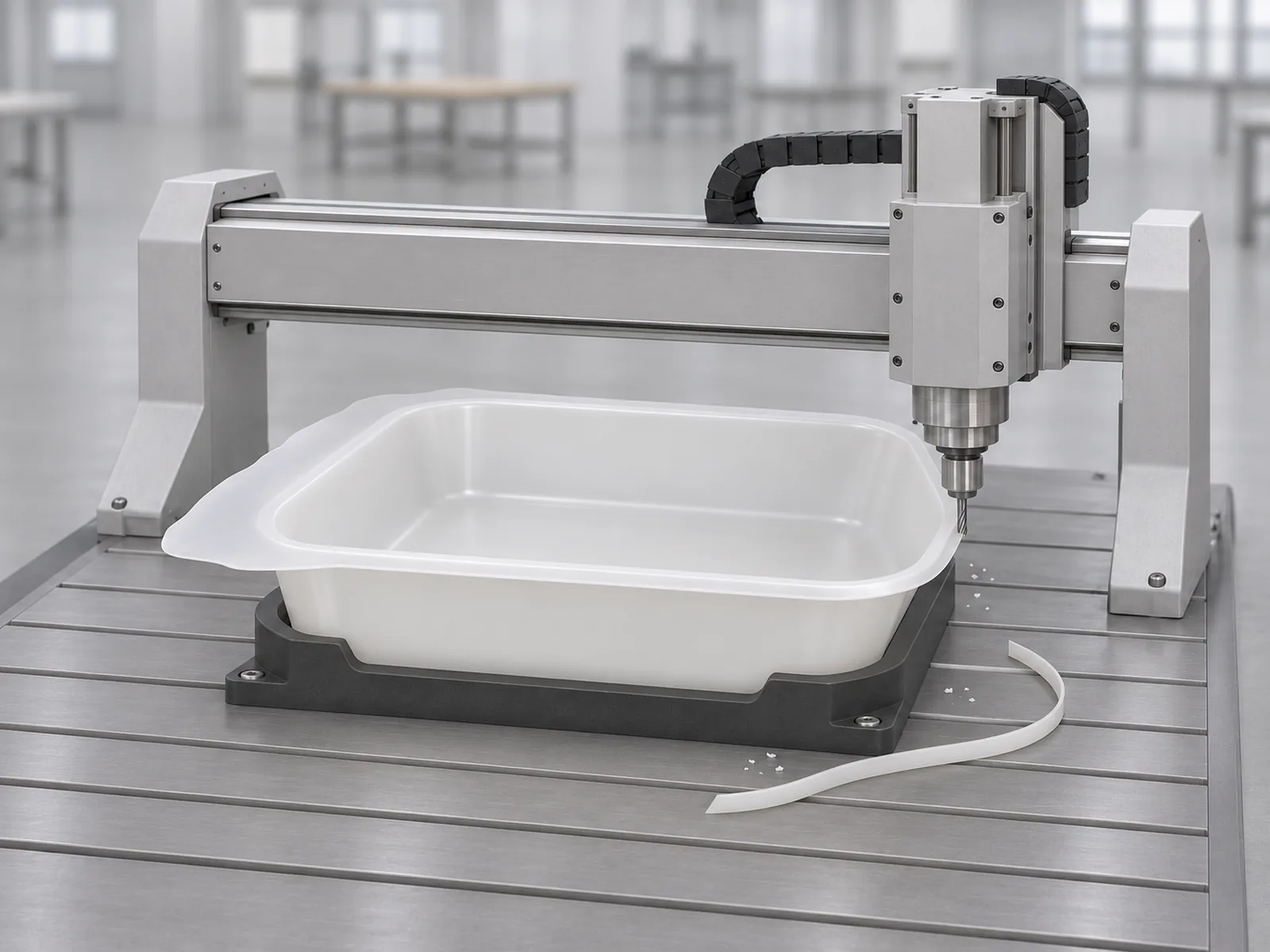
Drilling and tapping have to allow for PP being fairly soft. Self-tapping screws strip easily and loosen after repeated assembly, so metal inserts, through bolts with washers, or snap fits are common. Leave enough distance between holes and the trim line so the edge does not tear under load.
PP has low surface energy, so ordinary adhesives and paints adhere poorly. Where bonding, painting or printing is needed, apply a surface treatment such as flame, corona or primer, and verify adhesion on samples. For structural joints, prefer screws, snap fits and rivets, or hot-air and hot-plate welding. For more trimming methods, see trimming thermoformed parts.
How to write the specification: grade, gauge, color and inspection
Write the specification for a PP thermoformed part as clauses that can be inspected. The table lists the usual items.
| Item | How to write it | Why |
|---|---|---|
| Material family | Homopolymer or copolymer PP; whether regrind is allowed | Affects forming, impact strength and batch consistency |
| Functional requirements | ESD, weathering, flame retardancy and similar | Confirm the sheet and its test data first, then sample |
| Starting gauge | Sheet thickness and tolerance | Drives unit price and the thinnest wall |
| Minimum wall | Minimum finished wall at key spots | The first article is measured at these spots |
| Color | Natural, black or a specified color plaque | Color changes heating as well as appearance |
| Dimensional measurement | Resting time, measuring temperature, datums | Makes both sides' results comparable |
| Joining method | Inserts, snap fits, welding or bonding | Sets hole positions and surface treatment |
For functional requirements such as ESD, weathering or flame retardancy, confirm per project whether a suitable PP sheet and test data exist, then verify on samples. Do not assume that general-purpose PP has them. Color is no evidence of ESD performance: black PP must also be accepted on test results.
When is PP thermoforming the wrong choice?
For panels that need high gloss, transparency or a fine appearance, ABS, PC and PETG are better; PP has limited surface gloss and clarity. For parts that must be painted, printed or bonded over large areas, the surface treatment PP needs adds steps and risk, so compare other materials first.
Large flat parts with tight tolerances that cannot take ribs or a crown carry a high warp risk in PP; consider ABS or a change of design. For parts that need a flame rating, first confirm that a suitable PP sheet and test data exist before deciding on PP.
Next step: send a drawing or sample and describe the service conditions
Drawings can be STEP, IGES, DWG or PDF; without a drawing, photos and dimensions are enough to start. Also describe the service conditions: which chemicals the part touches, whether it ships in the cold, whether it enters a cleanroom or an ESD protected area, and the annual volume. FUNYO responds within 4 hours of receiving the information and provides a suitability assessment and comparison quote within 2 working days. A thin-gauge mold costs about RMB 1,000 and a heavy-gauge mold about RMB 10,000, quoted by size and structure.
For FOSB and other semiconductor packaging inserts, see FOSB PP inserts. To compare thermoforming sheet materials, see the thermoforming materials guide.