An FOSB is the front-opening box used to ship 300 mm wafers out of the wafer plant. SEMI M31 specifies the front-opening shipping box (FOSB) that wafer suppliers use to ship 300 mm wafers to their customers. 1 SEMI M31 also states that the FOSB is meant for shipping, not for use inside IC manufacturing processes. 1 At dispatch, the FOSB goes into a protective bag and then into a corrugated carton, with one formed insert below it and one above it to hold it in the middle. Those two parts are the PP inserts this guide is about.
An insert looks like plain packaging, yet it decides how a knock on the carton reaches the FOSB. Load the wrong spot and the door can loosen or the flange can get scuffed; get the clearance wrong and the box slides around in the carton. The sections below follow the order a packaging or sourcing engineer writes a specification in: structure, material, forming, cleanliness and testing. FUNYO has produced thin-gauge thermoformed trays since 2013, and every capability figure below comes from FUNYO's current lines.
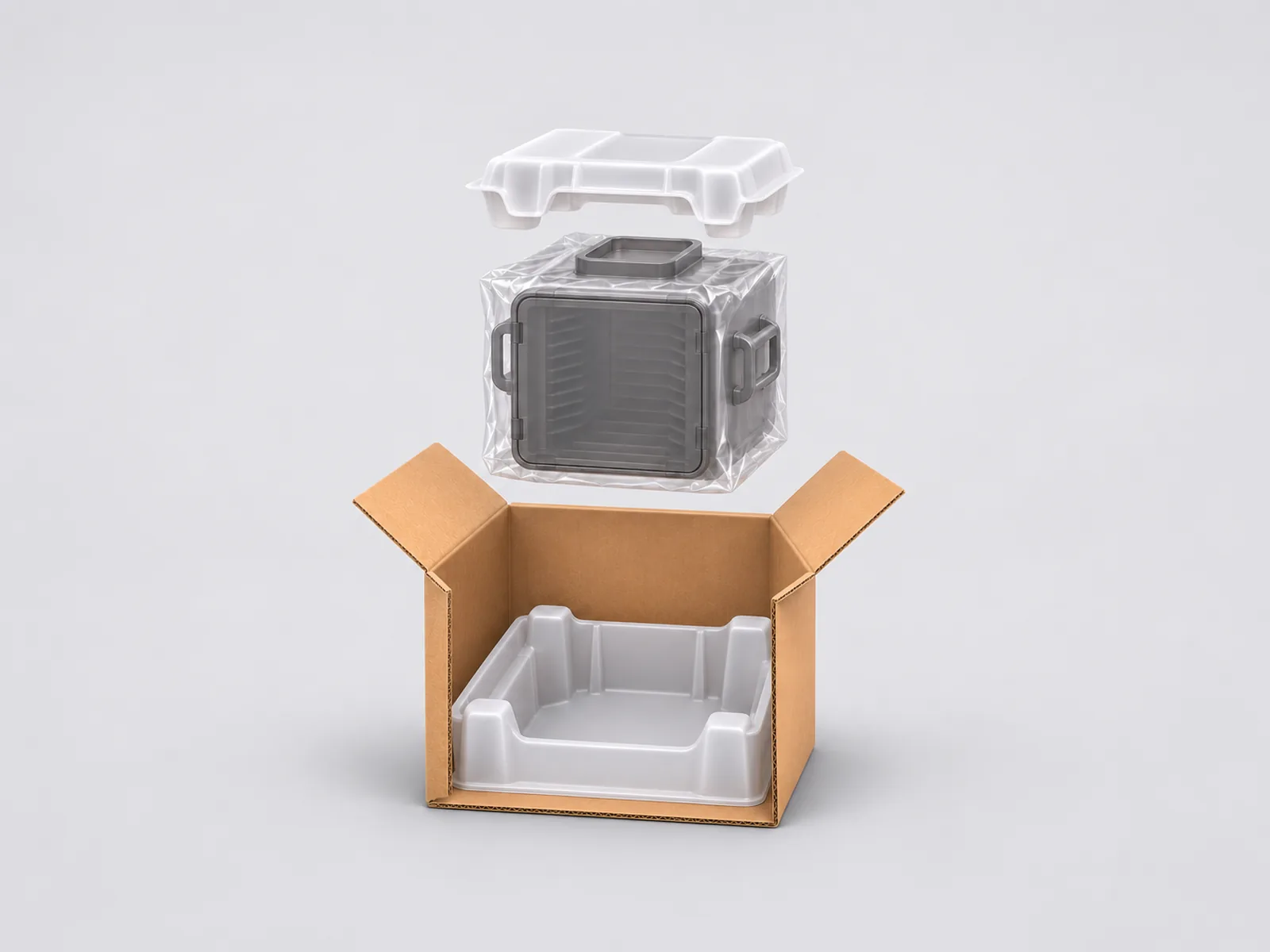
An insert does three jobs in the carton: locate, cushion and separate
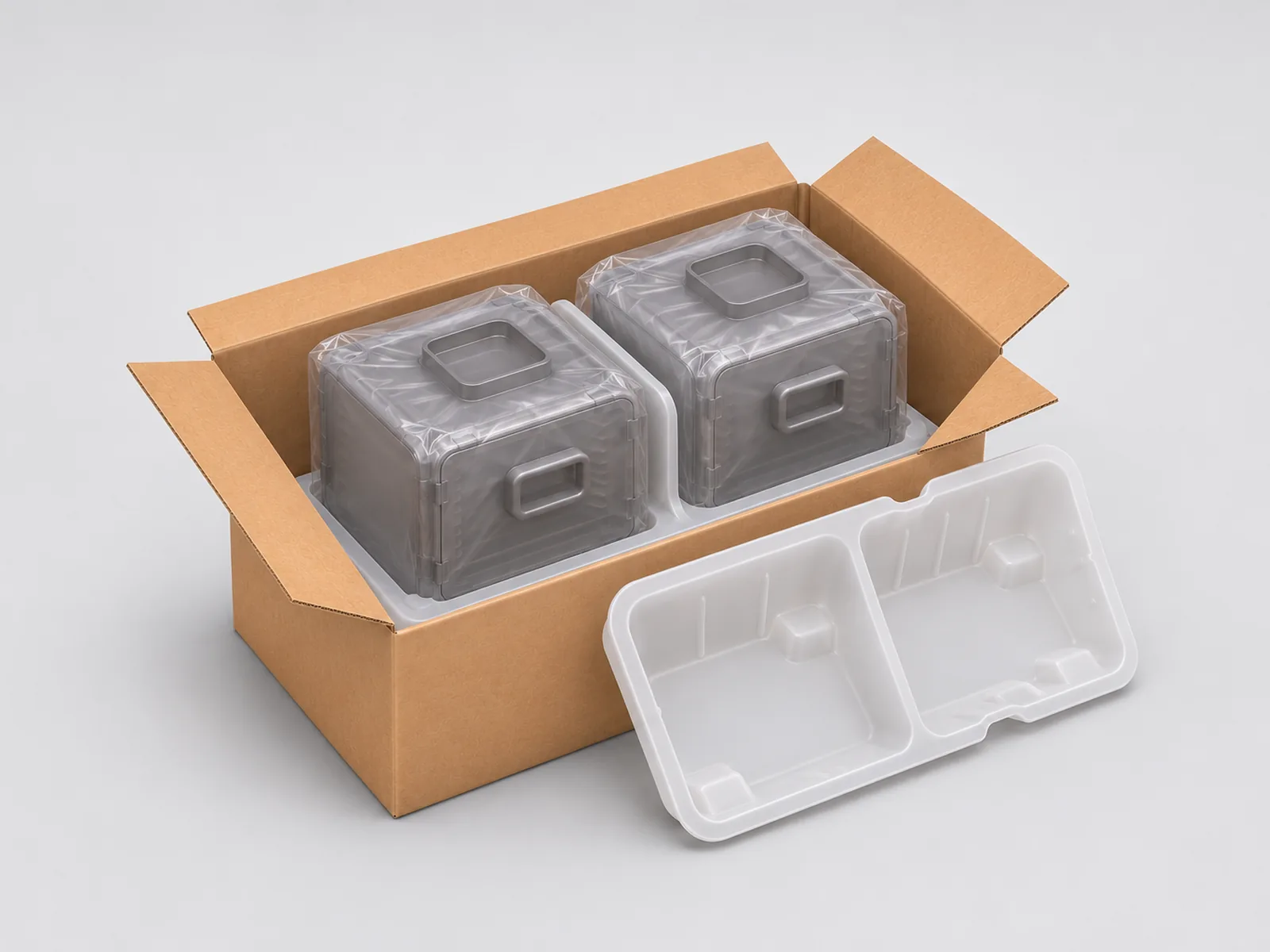
Start with the size and weight of the box itself. The public datasheet of one common 300 mm FOSB lists a capacity of 25 wafers and outside dimensions of 332.77 mm deep, 389.52 mm wide and 336.93 mm high. 2 That FOSB weighs 4.6 kg empty and 7.8 kg full. 2 The same datasheet gives the two-pack secondary packaging as 680 × 415 × 365 mm. 2 In other words, one carton often holds two boxes, and the insert must also keep them apart.
| Job | Insert feature | What the specification should state |
|---|---|---|
| Locate | Side walls and locating ribs | FOSB outline, bag thickness, allowed play |
| Cushion | Support pads and outer rim | Drop height, test standard, acceptable damage |
| Separate | Divider between the two boxes | Boxes per carton, minimum gap between them |
| Handle | Finger notches, opening direction | Manual or automated handling, lift-out direction |
A knock travels from the carton to the insert, and from the insert's support pads to the FOSB shell. The position and size of the pads decide where the load lands; everywhere else the insert keeps a gap. The outer rim sits against the carton wall, so the whole insert cannot slide, and it takes the first hit when the carton wall deforms.
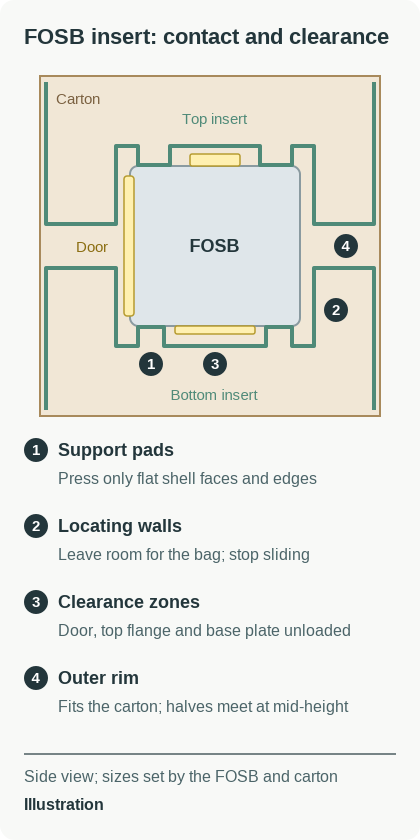
Splitting the halves: contact faces, clearance zones and hand room
The two halves usually meet around mid-height of the FOSB: the bottom insert carries the base and lower half, the top insert holds the top and upper half. A split near mid-height keeps the two depths similar, so the forming conditions are similar too; when the outline is symmetrical, it is worth checking whether one mold can make both halves.
Contact should go on flat, stiff areas of the shell and on its edges. The door, the top flange and the base plate are the interfaces between the FOSB and automated equipment, so they get clearance, at most a light locating touch, and never carry impact. A loaded door can upset its seal and its opening; a scuffed flange or base plate can affect docking at the customer's tool. Exactly where to touch and where to clear is confirmed point by point on the customer's FOSB sample or model.
| Area | Suggested treatment | Reason |
|---|---|---|
| Flat top and bottom shell areas | Support pads | Take vertical impact |
| Four vertical shell edges | Locating walls | Stop movement front to back and side to side |
| Door | Clearance | Protect the seal and opening |
| Top flange and base plate | Clearance | Automation interfaces; avoid scuffing |
| Side handles | Finger room | Easy loading and unloading |
Size the clearance for the bagged box. The protective bag has thickness and bunches up at the seal, so a pocket sized for the bare FOSB may refuse the bagged one. State the bag material and number of layers in the specification, and try the first article with a real bagged FOSB.
The inserts themselves also travel to the customer's packing line. Empty inserts nest one inside another and take far less space, but nesting depends on wall draft and stacking steps; nested too tightly, they jam and have to be prised apart one by one. FUNYO uses an anti-nesting tester to check trays for sticking when stacked, so the nesting design is confirmed at the sample stage, and the specification then states the count per stack and the packaging.
Why PP is the usual choice: toughness, low shedding, recycling
Common FOSB insert materials are PP thermoformed sheet, PS or PET thermoformed sheet, foam and molded pulp. Look first at how many times the insert will be loaded, whether the cut edges shed, and how it will be recycled, then at unit price. For a comparison of cushioning materials by cost and testing, see semiconductor shipping cushioning.
| Factor | PP thermoformed | PS or PET thermoformed | Foam | Molded pulp |
|---|---|---|---|---|
| Repeated loading | Tough, resists cracking | More brittle, cracks on impact | Springs back, slowly compresses | Recovers poorly |
| Shedding | Low once edges are finished | Cut edges chip | Cut faces shed particles | Fibers come loose |
| Locating accuracy | Molded, repeatable | Molded | Cut, moderate | Molded, wider variation |
| Recycling | Single material, easy to sort | Single material | Depends on foam | Recyclable |
PP's difficulty is in forming. Heated PP has a narrow forming temperature window, the sheet sags easily, and it shrinks more after forming than PS or PET. The mold has to be scaled for PP and corrected from first-article measurements, and the trim must be kept clean, because PP's toughness tends to leave burrs on the cut. FUNYO's heavy-gauge line lists PP among its sheet materials, and PP is also among the common thin-gauge materials. For more on forming PP, see PP thermoforming.
PP sheet comes in two main families, homopolymer and copolymer. Copolymer PP keeps its impact strength better in the cold, which matters for winter or air freight; homopolymer is somewhat stiffer. Natural and black are the usual colors; black by itself gives no ESD protection, so where ESD matters, choose an ESD-grade sheet and accept it on test results.
Deep forming: check the depth first, then pick thin- or heavy-gauge
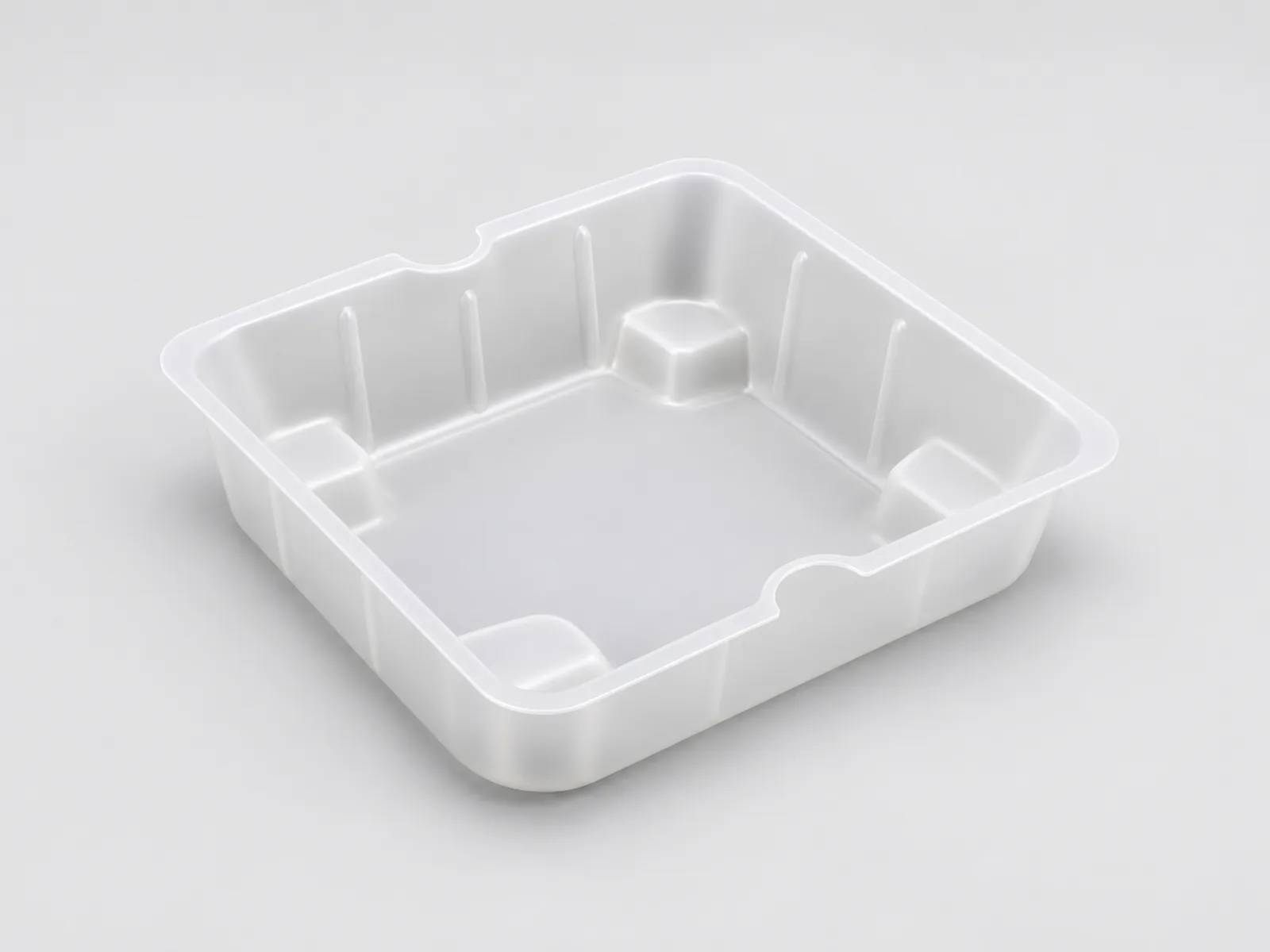
Each insert wraps part of the FOSB, and its depth is set by the split line, the rim height and the divider height. That depth decides which line makes it.
FUNYO's thin-gauge trays reached a maximum forming depth of 120 mm in 2025–2026; thin-gauge trays are formed in a Class 10,000 cleanroom and suit inserts within that depth and in thinner sheet. Deeper inserts, or thicker sheet, are assessed for heavy-gauge forming, where FUNYO's maximum part size is 2600 × 1600 × 600 mm.
In deep forming the sheet stretches, and the deep corners and the tops of the support pads end up thinnest. A specification that gives only the starting sheet gauge is not enough: state the minimum finished wall at key spots, such as the pad tops and deep corners, and measure those spots on the first article. Pads and walls need draft and radii, or the part is hard to release and the wall thickness spreads even more unevenly.
Wall thickness on a formed PP insert is easy to check: an ultrasonic gauge reads it without cutting, and a sectioned sample shows the whole profile. Agree on the method and the measuring points before the first article, so that supplier and buyer read the same numbers.
In a two-pack insert the divider between the pockets is one of the deepest and most stretched features. Look at its height, width and draft together; where needed, make the divider a separate part or change the carton layout.
Write cleanliness and ESD requirements for the packing area
The insert touches the FOSB's bag and shell, not the wafers, but packing often happens in a cleanroom or an EPA. Write the insert's cleanliness and ESD requirements for that packing area.
For cleanliness, particles come mainly from the trimmed and die-cut edges and from the insert's own packaging. State edge deburring, the cleaning method before shipment, the number of packaging layers and where the pack is opened. FUNYO's thin-gauge Class 10,000 cleanroom of 1,500 m² and its Class 100 wash room of 50 m² were built in 2016 and serve thin-gauge tray forming and cleaning.
For ESD, the ESD Association's published ANSI/ESD S541 chart classifies conductive resistance as <10⁴ Ω, dissipative as ≥10⁴ and <10¹¹ Ω, and insulative as ≥10¹¹ Ω. 4 The public ANSI/ESD S541 guidance calls for low-charging, conductive or dissipative packaging inside an EPA. 5 When the insert is packed in an EPA, the specification should name the target class, the test surface and the temperature and humidity. Permanent-ESD thermoformed trays have been a main FUNYO product since 2014; color is no proof of ESD performance, so acceptance goes by test results.
Drop and vibration tests: define damage before testing
An insert is proven only with a real box inside a sealed carton. ISTA 2A covers individual packaged-products of 68 kg (150 lb) or less, prepared for shipment. 3 On the datasheet figures above, two full FOSBs weigh about 15.6 kg, and with inserts and carton the pack stays well inside that range.
ISTA 2A asks the shipper to decide before testing what counts as product damage and how much damage, if any, is acceptable. 3 For FOSB inserts this can be a short list: no cracked shell, no loose door, no wafer movement in the box, no split insert, and a carton that may deform but must not burst. Write it before the test and judge each item after it.
Some customers return cartons and inserts for reuse. PP inserts can make several trips when they are checked for cracks and cleaned between uses; state the expected number of trips in the specification so that the sheet gauge can be chosen for it.
| Order | Test | What to look at |
|---|---|---|
| 1 | Fit check | Bagged box goes in and out smoothly; gaps are even |
| 2 | Drop | Shell, door and insert after face, edge and corner drops |
| 3 | Vibration | Whether the box moves and whether the pads wear |
| 4 | Stacking | Whether the insert deforms and how top load is carried |
Load the test FOSB with test wafers to the real weight, because an empty box understates the impact. After the test, open the FOSB to check wafer positions and new particles, then remove the inserts and look for dents or cracks at the pads and divider.
FUNYO has a drop tester for simulating tray drops and refining designs, so samples can be compared in-house first; formal tests follow the standard and laboratory the customer names.
When is a PP thermoformed insert the wrong choice?
For a few one-off cartons that will never repeat, cut foam is faster and needs no mold. When the customer's specification already names foam or another material, or the outer pack is a rigid returnable case with built-in cushions, keep to that design.
When the insert's depth or size exceeds the line's range, or a two-pack divider is too deep and stretched, change the structure first, for example by making the divider a separate part, splitting one insert into two or changing the carton layout, and only then decide whether thermoforming fits.
Next step: send the FOSB model, insert photos and carton size
You can start without a drawing. Send the FOSB model, photos of the current insert and the carton size, or mail us a sample set to measure. FUNYO responds within 4 hours and gives a suitability assessment and comparison quote within 2 working days.
For the information an RFQ needs and how sampling and testing are scheduled, see the FOSB insert RFQ and sampling checklist. For writing cleaning and cleanliness requirements, see cleanroom tray cleanliness specifications, and for more tray and insert work, see trays and liners.