Choose by the part. Specify the process.
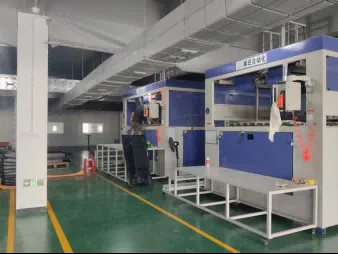
Thin-gauge and heavy-gauge thermoforming both shape heated sheet; the choice depends on the part’s function, handling, assembly and acceptance requirements. FUNYO has produced trays since 2013 and forms heavy-gauge sheet up to 15 mm, with 8–10 mm commonly used for housings.
Choose by what the part must do
Thin-gauge and heavy-gauge thermoforming both turn heated sheet into a shaped part, but the purchasing questions are different. A tray that locates small electronic components during the next manufacturing operation needs a different assessment from a machine cover that stays on installed equipment. Begin with the part's job, the surfaces that contact another item and how the part is handled. Do not start by treating every tray as disposable or every large plastic shape as an equipment housing.
FUNYO has produced thermoformed trays since 2013 and also supplies the five families of housings, covers, panels, trays or liners, and displays or light box faces. These are useful ways to organize an inquiry because each family directs attention to a different interface. For a precision tray, describe the component, pocket contact and downstream process. For a housing or cover, describe the frame, the visible face and maintenance access. For a liner, describe the container and the part it protects. Those details give thickness selection a purpose rather than making thickness itself the complete specification.
Separate starting sheet from the finished part
The confirmed heavy-gauge capability includes sheet up to 15 mm, with 8–10 mm commonly used for housings. The confirmed maximum single part is 2600 × 1600 × 600 mm. These limits describe capabilities to assess, not a statement that every maximum can be combined in every geometry. A finished part still needs room for its forming details and trimming allowance. The drawing, material and intended structure determine whether a particular combination can be accepted.
Starting sheet thickness and finished-wall thickness are different items in a project specification. Forming changes the distribution of material, so an initial sheet value does not prove the thickness at a corner or in a deeper area. For a tray, consider the pocket and its contact with the carried component; for a shell, identify the mounting and assembly areas. Ask the manufacturing review to address the locations that matter to the application. Numerical tolerances and local wall requirements should be agreed against the actual design and verification method rather than copied from an unrelated tray or housing.
Comparison and selection table
| Question | Thin-gauge tray assessment | Heavy-gauge part assessment |
|---|---|---|
| Primary use | Locating and protecting components; next-process requirements | Housings, covers, panels, handling trays or liners |
| Starting specification | Component, pocket layout, handling and cleanliness | Part envelope, sheet, mounting and service access |
| Confirmed FUNYO reference | Tray production since 2013 | Sheet up to 15 mm; housings commonly 8–10 mm |
| Verification focus | Fit, contact, handling, cleanliness and ESD as agreed | Formed shape, trimmed interfaces and application requirements |
Define load, contact and repeated handling
A handling tray should be described by its contents and the way it moves through the process. Provide the component shape, contact areas, load arrangement and any surfaces that must remain untouched. Explain whether an operator lifts the tray directly, places it into another container or uses it between manufacturing steps. These are requirements to evaluate; a material name or a photograph alone does not establish an acceptable load or service life. Do not assume that a thicker sheet answers every handling question.
For a reusable tray or liner, list cleaning, storage and repeated-use conditions. State whether trays need to stack or separate without disturbing the contents, and show any associated box or rack. If the supplier proposes a test, agree what it represents and what constitutes acceptance before treating the result as evidence. FUNYO's existing tray information discusses anti-nesting, handling and drop checks as application topics, but the chosen method and acceptance conditions still belong to the project. The same discipline applies to a cover that is repeatedly removed during service: describe the use rather than inventing a performance claim.
Treat room conditions and part cleanliness separately
FUNYO has class 100 DI-water washing, a class 10,000 cleanroom and a laser particle counter. These are confirmed facilities and equipment. They are not a numerical cleanliness specification for every delivered tray, and a room classification should not be written as if it were the particle limit on a part. The next manufacturing process needs its own agreed requirements, verification approach and packaging conditions. This distinction matters for electronic, semiconductor and optical component handling.
Describe what must be protected, the surfaces of concern and what happens after unpacking. Agree how a tray is cleaned, transferred, protected and accepted for the intended process. A washing step is not the whole handling route if contamination can be introduced later during storage or transfer. Request project-specific records where they are part of the agreement, and keep the test conditions with the results. A measured value without a defined method, sample condition or acceptance requirement is not enough to demonstrate suitability for a different customer's process. This is a specification discussion, not a claim that one cleanliness method fits all applications.
Specify ESD requirements independently of color
A black tray is not, by its color alone, evidence of antistatic or conductive performance. FUNYO's tray material information distinguishes ordinary, antistatic and conductive options and requires an agreed test range and conditions. For this project, antistatic grades are sourced and sampled according to the requirement. Begin by identifying the component's handling needs and the customer's required verification method. Do not replace that information with a generic request for an ESD tray or with an assumption based on an existing product image.
Where the tray will be washed, the existing FUNYO material guidance calls for ESD verification again after washing. The purchasing brief should therefore state the intended washing and use sequence, not only the condition at first receipt. Confirm the exact grade and the sample used for approval, and keep electrical requirements separate from dimensional fit and cleanliness requirements. Passing one of those assessments does not establish the others. If the customer has not yet defined an acceptance range, identify that as a decision to resolve before production approval rather than supplying an invented number.
Plan forming, trimming and equipment interfaces
A formed sheet is only one stage of a part that must fit equipment or carry components. FUNYO has three-axis and five-axis CNC routers for forming tools and for trimming, holes and slots. For a housing or cover, the drawing should identify the trimmed edges and mounting interfaces that govern assembly. For a tray or liner, show the relationship between the formed pockets, the carried part and the external container. Tool access and the intended datum arrangement belong in the manufacturing review.
Changes to openings can sometimes be evaluated through CNC programs and fixtures while retaining the same formed outer shape. That is relevant to equipment panels and covers with model-specific interfaces. It should not be generalized into a promise that every tray pocket, shell depth or split line can be changed without tooling work. Mark which formed surfaces are unchanged and which features require revision. Make the relationship between the approved sample, drawing revision and intended model visible in the inquiry documents. The purpose is to define a repeatable part interface, not merely to select a forming category.
Use a sample plan that follows the application
The sample plan should answer the questions raised by the actual part. For a precision tray, those may include component fit, contact surfaces, handling, ESD behavior and the agreed cleanliness requirements. For a housing, they may include assembly with the frame, opening positions, appearance and access for service. These are evaluation topics, not published acceptance results. The required conditions and records must be agreed before a sample is treated as evidence for production approval.
Identify who supplies the carried component, frame or mating part, and who approves each aspect of the sample. Separate a material swatch from a formed and trimmed sample, because approval of color alone does not confirm geometry or handling. State any restrictions on photography or public use so that a project image is not later presented as an authorized case without consent. Keep requirements that are still being decided distinct from those already approved. A clear review record lets the next order reference the right configuration without assuming that another component or another cleaning process was covered by the same approval.
Send the information needed to compare routes
To request a route assessment, send a drawing or photograph, outside dimensions, a description of the carried component or equipment, annual demand and the first-order quantity. Add load and handling requirements for trays; add mounting, visible faces and maintenance access for housings and covers. State material preferences together with the conditions that motivated them. Special grades, cleanliness and electrical requirements need their own explanation so that the supplier can identify the samples and information needed for review.
FUNYO responds in 4 hours and provides an applicability assessment and an injection-molding comparison quote in 2 working days. This review begins the project discussion; it does not replace the later agreement on drawings, material and acceptance. Choose the related product family that matches the part's function, and use the thin-gauge capability information for precision clean trays. The annual-agreement tooling evaluation for about 3,000 housing parts is a separate housing condition, not a general promise for trays. Process selection becomes reviewable when the part's duty, interfaces, material, quantity and approval requirements appear together in the brief.