FOSB insert RFQs often stall at step one. The buyer writes "we need a PP insert", the supplier asks for the FOSB model, carton size, sheet and quantities, and several emails later a quote finally appears. This guide lists what an RFQ needs, explains how to check the size chain, the order sampling should follow and what a quote is made of, and ends with a downloadable checklist.
For the insert's structure, material and test methods, see FOSB PP inserts; this guide covers purchasing and project planning only. FUNYO accepts STEP, IGES, DWG, PDF or photos, and without drawings, photos plus dimensions are enough to start.
Start without a drawing: FOSB model, insert photos and samples
Many FOSB insert projects are a change of supplier or a repeat order, with parts in hand and no drawing. The fastest start then needs three things: the FOSB brand and model, photos of the current insert, and the carton's inner size.
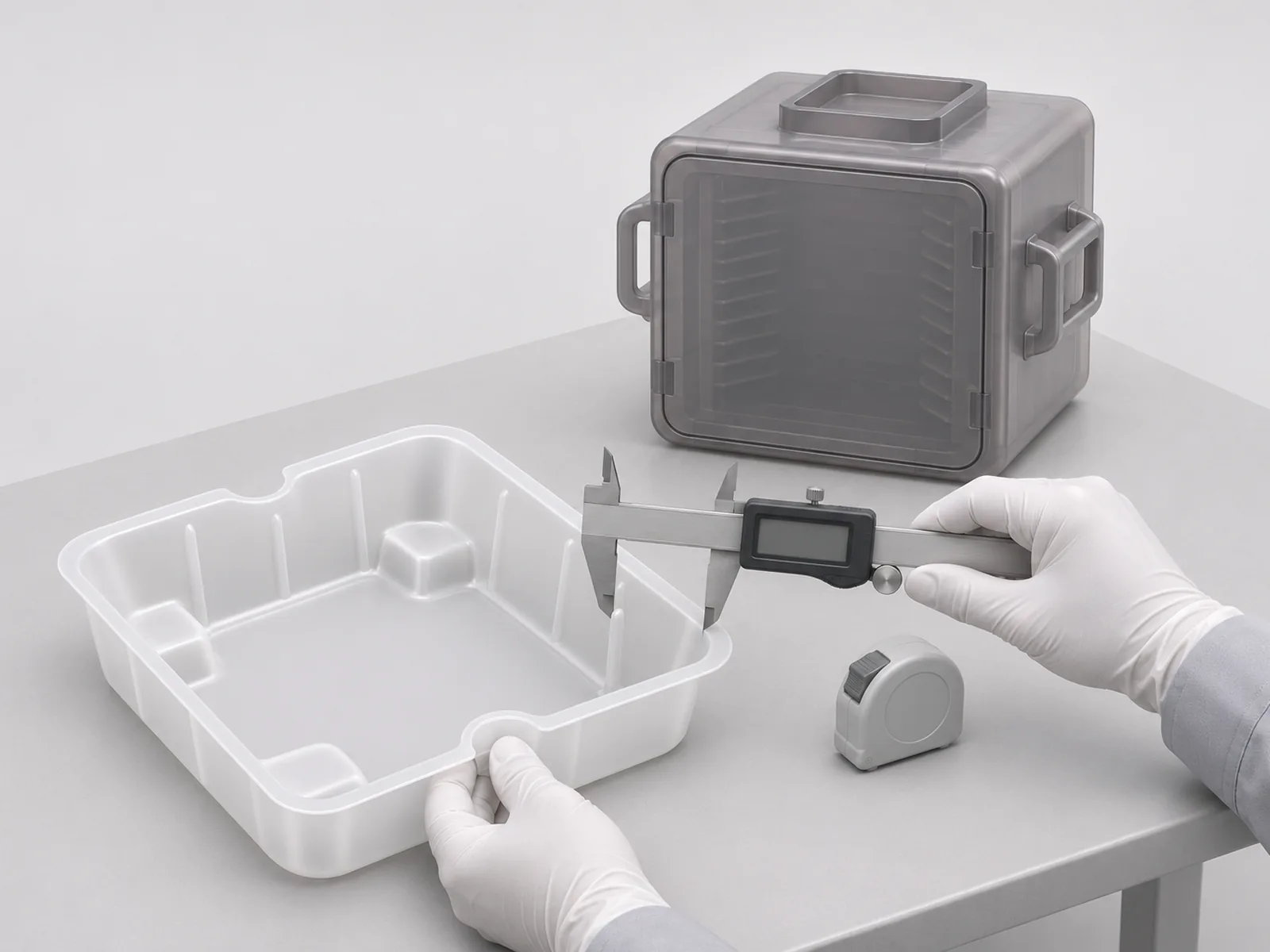
Take these photos: front and side views of both the top and bottom insert, the FOSB sitting in the bottom insert, and close-ups of the support pads, locating ribs and divider, with a ruler in every shot. Even lighting and a clean background help more than a high pixel count.
If you can ship samples, send one set of top and bottom inserts and an empty FOSB. We measure the parts, model the insert and check the contact points against the real box. If you have the inserts but no FOSB, still give the FOSB model, because outlines and interface positions differ from model to model.
When one insert has to take several FOSB models, list them all. The pocket is then designed around the envelope of all the outlines, and contact points go on flat faces the models share; if the models differ too much, two inserts are often simpler than one.
The size chain: check FOSB, bag, insert and carton together
The insert sits between the FOSB and the carton, so sizes are checked layer by layer from the inside out. Take one common 300 mm FOSB as an example; its public datasheet lists outside dimensions of 332.77 mm deep, 389.52 mm wide and 336.93 mm high. 1 The same datasheet lists the two-pack secondary packaging at 680 × 415 × 365 mm. 1
| Dimension | Who provides it | How to write it |
|---|---|---|
| FOSB outline | Customer gives model or box | State the model; attach sizes for modified boxes |
| Protective bag | Customer | Material, layers, seal position |
| Insert pocket | Supplier designs | Bagged size plus clearance |
| Insert outline and rim | Supplier designs | Carton inner size minus fit allowance |
| Carton inner size | Customer or box maker | Inner size, not outer size |
Corrugated cartons are looser than plastic parts, and inner sizes vary even within one carton specification. State the carton's inner size and tolerance, design the insert rim to the lower limit, and let the rim's flex take up a larger box. When the customer buys cartons separately, try the first article in the actual carton in use.
Decide early whether each carton holds one FOSB or two. A two-pack halves the number of cartons and labels, but the insert grows longer, needs a divider and moves to a larger tool; a single-box insert is smaller and quicker to tool. State the choice in the RFQ, or ask the supplier to quote both.
PP keeps changing size for a while after forming. Agree on the time after forming and the temperature for first-article measurement, so that both sides measure under the same conditions and their records compare.
Write sheet, ESD and cleanliness terms that can be inspected
The sheet clause has four items: PP homopolymer or copolymer, color, starting gauge and minimum finished wall. Starting gauge drives the unit price; minimum finished wall decides whether the insert survives impact, so write both. Tie the minimum wall to specific spots, such as pad tops and deep corners, and measure those spots on the first article.
Also state whether recycled PP is allowed. Many semiconductor customers ask for virgin sheet so that cleanliness and ESD behavior stay consistent from lot to lot; if recycled content is acceptable, say how much and how each lot is identified.
The ESD clause names the target class, the test surface and the temperature and humidity during testing. It is needed when packing takes place inside an EPA; for use only in an ordinary packing area, it can be left out. If unsure, describe the packing environment first, let the supplier suggest a class, and confirm it with the customer's quality team.
The cleanliness clause covers the cleaning method, packaging layers, count per stack and where packs are opened. Inserts ship nested, and the count per stack affects both shipping volume and ease of use, so confirm it at the sample stage. If the customer needs material declarations, list them in the RFQ so they are not chased just before production.
Sampling order: measure, tool, first article, pack test
Sampling an FOSB insert runs in four steps: measuring and modeling, tooling, first article and pack testing. Keep a record of each step and confirm it before moving on.
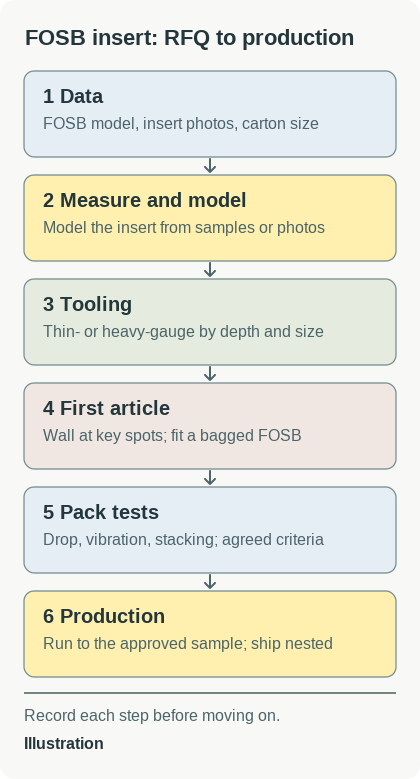
The line is chosen by depth and size. FUNYO's thin-gauge trays reach a maximum forming depth of 120 mm, and inserts within that depth are made by thin-gauge forming. Thin-gauge tray tooling takes as little as 8 hours to tool and sample for parts within 500 mm, and is typically 2 days' work. A single-box insert is usually within 500 mm; a two-pack insert approaches the carton's 680 mm length, so its tooling time is set by design. Deeper inserts go to heavy-gauge forming, where tooling takes about 1–3 weeks.
The first article does two jobs: measure the wall at the agreed spots, and fit a real bagged FOSB. During the fit check, see that the box goes in and out smoothly, that the gaps are even all round, and that the door and flange have clearance. FUNYO uses an anti-nesting tester to check trays for sticking when stacked, so the nesting design is confirmed at the first-article stage too.
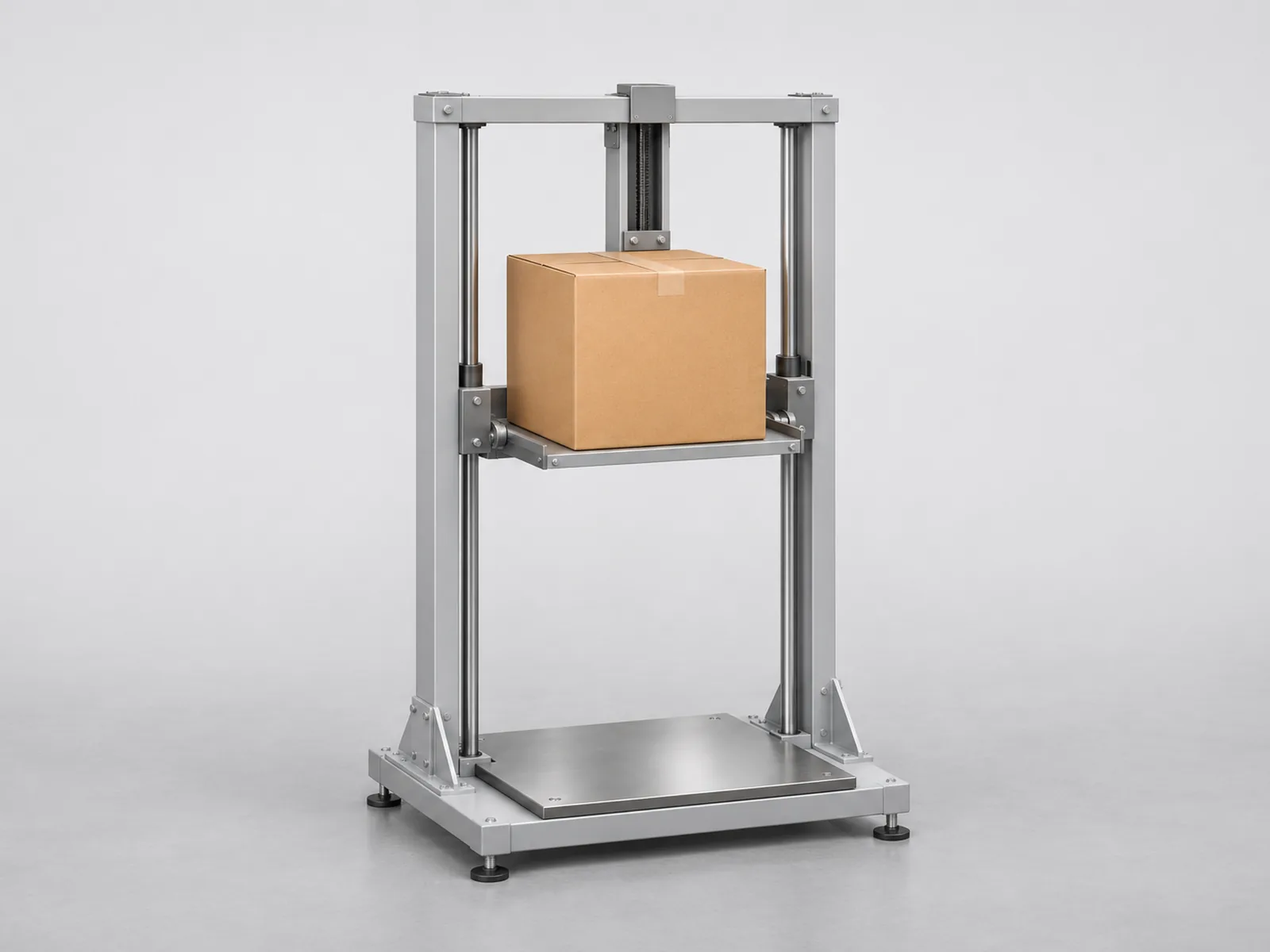
Pack testing follows the standard the customer names. ISTA 2A applies to individual packaged-products of 68 kg (150 lb) or less, prepared for shipment. 2 The ISTA 2A overview also suggests considering the ISTA 3A procedure when the pack may travel by small-parcel delivery. 2 Put the procedure, drop heights and damage criteria in a document both sides sign off before testing.
When a test fails, start with where the damage appeared. A dent in the shell means the support pads need a new position or area; a box that moves in the carton means the clearance or rim needs changing. After a tool change, repeat the first article and the test, record each round's change and result, and run production to the last approved version.
| Stage | Deliverable | Approved by |
|---|---|---|
| Measuring and modeling | Insert model and size table | Customer approves contact and clearance |
| Tooling | Forming mold and trim fixture | Supplier internal check |
| First article | Wall records and fit photos | Customer approves sizes and fit |
| Pack testing | Test report | Customer judges against agreed criteria |
| Production | Parts to the approved sample | Both sides accept to specification |
Take a single-box insert as an example: with complete data, FUNYO gives a suitability assessment and comparison quote within 2 working days; thin-gauge tooling is typically 2 days' work; pack testing starts after first-article measuring and fitting, on the schedule of the laboratory the customer names. Pack tests usually need one insert set per drop orientation plus a spare, so size the trial run accordingly.
A quote has four parts: tooling, unit price, packing and testing
When comparing suppliers, split each quote into four parts: tooling, insert unit price, packing and freight, and testing. Comparing unit price alone hides the other three.
| Part | What it covers | What drives it |
|---|---|---|
| Tooling | Forming mold, trim fixture | Size, depth, one mold for both halves or not |
| Unit price | Sheet, forming, trimming | Sheet type and gauge, developed area, trim method |
| Packing and freight | Nested packing, cartons, freight | Count per stack, packaging layers, destination |
| Testing | Pack tests | Standard, laboratory, number of runs |
A FUNYO thin-gauge mold costs about RMB 1,000 and a heavy-gauge mold about RMB 10,000, quoted by part size and structure; with stable volumes and order batches, free tooling can be negotiated per order.
When you line up several quotes, ask each supplier to state the starting gauge, the minimum finished wall and the count per stack. A small gauge difference moves the unit price noticeably, and a quote without a minimum wall may simply be a thinner insert. Settle tooling ownership, modification charges and who arranges testing at the quote stage as well.
Send the checklist and ask for a line-by-line reply
Fill in the checklist below, send it with the sample photos and ask the supplier to answer each line. The last column is for your project's conditions.
| Item | What to provide | Why it matters | Your project |
|---|---|---|---|
| FOSB model | Brand and model, or one empty box | Outline and interface positions differ by model | |
| Current insert | Photos of both halves, or a sample set | Measured dimensions save a redesign | |
| Carton | Inner size, material, boxes per carton | Sets the insert outline and divider | |
| Protective bag | Material, layers, seal position | Sets the pocket clearance | |
| Contact and clearance | Areas that may carry load and areas to clear | Protects the door, flange and base plate | |
| Sheet | PP homopolymer or copolymer, color, starting gauge | Affects impact strength and cost | |
| Minimum wall | Minimum finished wall at pad tops and deep corners | The first article is measured at these spots | |
| ESD | Target class, test surface, temperature and humidity | Needed when packing inside an EPA | |
| Cleanliness and packing | Cleaning method, packaging layers, count per stack | Controls edge particles and shipping volume | |
| Transit test | Test standard, drop height, damage criteria | Acceptance agreed before testing | |
| Quantity | Annual use, first order, returnable or not | Sets the tooling plan and unit price | |
| Lead time | Dates needed for samples and first order | Schedules tooling and testing |
Download the FOSB insert RFQ checklist. When quotes come back, first check that the contact and clearance, minimum wall and transit test lines are all answered, then compare prices.
When should you hold off on tooling?
For a few cartons that will never repeat, cut foam is simpler and needs no mold. When quantities are still unclear and you only want to check sizes, make one or two fit-check pieces first to confirm clearance, then decide on tooling. Fit-check pieces can be 3D printed or cut from foam; they confirm clearance and loading direction only and are not used for drop testing.
Thin-gauge trial runs start from 50 pieces and production from 500. If annual use is clearly below that and orders will not repeat, compare the total cost of foam or other packaging before choosing thermoforming.
Next step: send the checklist with samples
Send FUNYO the completed checklist, insert photos and the FOSB model, and samples if you can. We respond within 4 hours and give a suitability assessment and comparison quote within 2 working days.
If you already have drawings and want to compare suppliers, see also the thermoforming RFQ checklist and what drives a thermoforming quote.