Why can the same drawing produce very different quotes?
A useful thermoforming RFQ defines the delivered part, rather than sending a model and asking for a price. Group the brief into part definition, quantity, material and environment, appearance and finishing, acceptance, and packing and delivery. This gives suppliers the same basis for identifying work and returning assumptions alongside their prices.
A shell taken straight from a forming tool and a shell with a trimmed perimeter, mounting holes and protected appearance surfaces involve different work. A low forming price can sit beside a separate machining charge. Another quotation may include that machining, a fixture and inspection. Compare the deliverable and the responsibility for each operation before comparing the totals.
Put tooling ownership in the initial request. Ask who keeps the tool, how revisions are authorized, what maintenance is included and what happens at the end of supply. Describe requested painting, printing or assembly as separate scope lines for suppliers to answer. Give each line an owner, a quotation basis and a clear output.
Which drawings, models and photographs should you send?
Send a controlled drawing revision together with a model and an explanation of the assembly function. 方宇(FUNYO)accepts STEP, IGES, DWG, PDF or photographs. When a drawing is unavailable, photographs plus dimensions provide a starting point. Include views of the inside, mating interfaces and the parts that surround the proposed shell, rather than relying on the appearance view alone.
Mark overall length, width and depth, the controlled assembly faces, critical holes and the visible surface. State the units used in each attachment. If a model and drawing differ, identify which controls the quotation and resolve the discrepancy before approving tooling. A screenshot can explain an interface while the dimensioned file defines it.
For feasibility review, FUNYO's maximum heavy-gauge part is 2600 × 1600 × 600 mm (102.4 × 63.0 × 23.6 in). Starting sheet is up to 15 mm (0.59 in), with housing sheet commonly 8–10 mm (0.31–0.39 in). Record the required finished wall separately from the starting sheet, because forming redistributes material around the shape.
Include a file list in the email and use the same revision identifier on the quotation request, drawing and sample approval. If a feature is still open, name the decision needed and its owner. That lets engineering respond to a defined question while purchasing keeps the price comparison attached to a stable baseline.
Which quantity belongs in the quotation?
Provide annual demand, the opening order and expected lifetime purchases separately. Annual demand helps frame the supply arrangement; an opening order defines an immediate batch; lifetime purchases affect how tooling investment is compared. State whether each figure is a committed order, a forecast or a planning scenario. A forecast can be revised without silently changing the original quotation basis.
Also describe expected design changes. A revised display opening may change machining, a fixture or the formed geometry. Ask the supplier to distinguish the reusable work from the work that needs revision. Tooling and fixture costs are allocated across production quantity, so the quantity basis belongs beside the tooling assumptions.
Keep process-specific order policies separate. FUNYO thin-gauge trial runs start at 50 pieces and thin-gauge production at 500 pieces. The minimum order for a heavy-gauge part is confirmed by project. Identify the process beside a quantity in your comparison sheet so that a tray purchasing condition stays attached to thin-gauge work.
If procurement expects several releases, ask whether pricing applies to each release or to a contracted cumulative quantity. Record what happens when the forecast changes. This exposes the commercial basis of a unit price and helps prevent purchasing from comparing a firm batch with a price built around an uncommitted lifetime forecast.
How should material and service conditions be specified?
Describe the environment before settling the sheet specification. State indoor or outdoor use, expected temperatures, cleaning chemicals, handling conditions and any required material evidence. Where the requirement comes from an equipment specification, include the relevant document and acceptance responsibility. A resin family name alone leaves the application conditions open.
FUNYO evaluates ABS, PC, PVC, PETG and PP for heavy-gauge work. Use that list to begin a material review, then identify the grade and evidence required by the actual application. Separate functional needs from preferences: appearance, transparency, impact behavior and chemical contact may point to different questions for the material supplier and forming engineer.
Tell the supplier which surface controls appearance and which interfaces control assembly. If the wall needs to remain adequate around a deep feature, identify that region on the drawing. Ask for the proposed starting sheet and the sample measurement plan together. This connects material purchasing to the formed part that will be accepted.
How do you define appearance and secondary operations?
Separate the appearance specification from the machining and assembly scope. Mark visible surfaces, texture direction, color references and surfaces protected during handling. Describe how appearance will be approved, such as an agreed sample under a defined viewing arrangement. This gives both parties something more repeatable than an adjective in an email.
FUNYO uses three- and five-axis CNC for tooling, trimming, deburring, holes and slots. For the finished shell, identify the datum edges and mounting relationships that the machining should establish. An opening's size, its position relative to the frame and the visible gap around a screen are different requirements; list the relationship that drives acceptance.
Add painting, printing, supplied hardware and assembly requests as individually answered lines. Ask for inclusion, exclusion or a separately priced option, together with the party responsible for the output. Keep a reference image and a controlled requirement in separate attachments so that an attractive reference does not quietly become the inspection standard.
What should acceptance, packing and delivery include?
Agree on sample approval and inspection before comparing production prices. Identify critical dimensions, the datum system, measurement state, records to retain and who signs the sample decision. Separate a dimensional result from an appearance approval. When either changes, issue a clear revision and identify the quantity affected.
Packing protects the same surfaces that the drawing and sample define. State whether parts travel individually, nested or on supports, and identify contact areas that need protection. Include handling at the receiving site, the delivery address and the party arranging transport. Large shells can occupy substantial packing space even when the part itself is light.
For international procurement, write the selected Incoterms® 2020 rule and its named delivery place into the RFQ. Incoterms® 2020 define buyer and seller responsibilities in international trade.1 Keep the selected rule and location together in the supplier's reply, alongside the currency and the explicitly included packing and transport scope.
Use this field list as the quotation baseline
The webpage shows the English fields, instructions and blank input column. Each downloadable language version also carries the Chinese and Japanese field names, so the same request can move between purchasing teams. The response cells stay blank for your project. Keep the completed sheet with the controlled attachment list and supplier replies.
| Field (English) | Instructions | Your input |
|---|---|---|
| Project and use | Describe the component function and equipment. | |
| Part and supply scope | List the purchased components and supplied state. | |
| Drawing revision and files | List filenames, revisions and the controlling document. | |
| Models and drawings | Attach models, dimensioned drawings or photographs with dimensions. | |
| Envelope and sheet | State units and separate starting sheet from finished-wall requirements. | |
| Assembly datums and interfaces | Mark critical fits, locating faces and mounting points. | |
| Visible surfaces and references | Identify visible faces, color references and approval method. | |
| Annual demand | Give quantity, units and whether it is committed or forecast. | |
| Opening order | State the opening batch and release schedule. | |
| Lifetime quantity | Record expected total purchases and program assumptions. | |
| Revision plan | Identify open features and the design-freeze decision. | |
| Material requirements | Separate resin family, grade requirements and evidence. | |
| Service environment | Describe exposure, temperature, chemicals and handling. | |
| Appearance finish | Specify texture, color, references and acceptance state. | |
| Secondary operations | List trim, holes, slots and other requested operations separately. | |
| Assembly and supplied hardware | Identify hardware, assembly requests and intended responsibilities. | |
| Inspection and records | Define datums, measurement state, critical features and reports. | |
| Sample approval | Name approval criteria, decision owners and open questions. | |
| Packing and protection | Describe contact, support, nesting and receiving conditions. | |
| Delivery terms | State place, schedule, trade rule and transport responsibility. | |
| Quotation lines | Request separate tooling, samples, production, delivery and options. |
Copy this plain-text request into your email
Replace the empty fields with project information and attach the controlled files. Keep the requested scope in the message even when it also appears in an attachment, so the receiving engineer can identify the decisions being requested.
Please assess the following scope and reply by line:
Project and use: []
Part and supply scope: []
Drawing revision and files: []
Models and drawings: []
Envelope and sheet: []
Assembly datums and interfaces: []
Visible surfaces and references: []
Annual demand: []
Opening order: []
Lifetime quantity: []
Revision plan: []
Material requirements: []
Service environment: []
Appearance finish: []
Secondary operations: []
Assembly and supplied hardware: []
Inspection and records: []
Sample approval: []
Packing and protection: []
Delivery terms: []
Quotation lines: []
Attachment list: []
Selected rule and named place (Incoterms® 2020): []
Identify inclusions, options, tool ownership and open questions.
What should appear in the supplier's reply?
A comparable reply identifies the drawing revision, proposed material, supply scope and open decisions before presenting its price. Look for separate tooling and recurring charges, quantity conditions, inspection and packing provisions, and the assumptions behind any optional operations. A supplier can answer an incomplete field with a question; record that question in the same comparison sheet.
FUNYO responds within 4 hours and provides a suitability assessment and comparison quotation within 2 working days. Use the initial exchange to establish the file baseline and the questions that need engineering review. Record sample approval and production release as subsequent decisions with their own inputs, owners and agreed schedule.
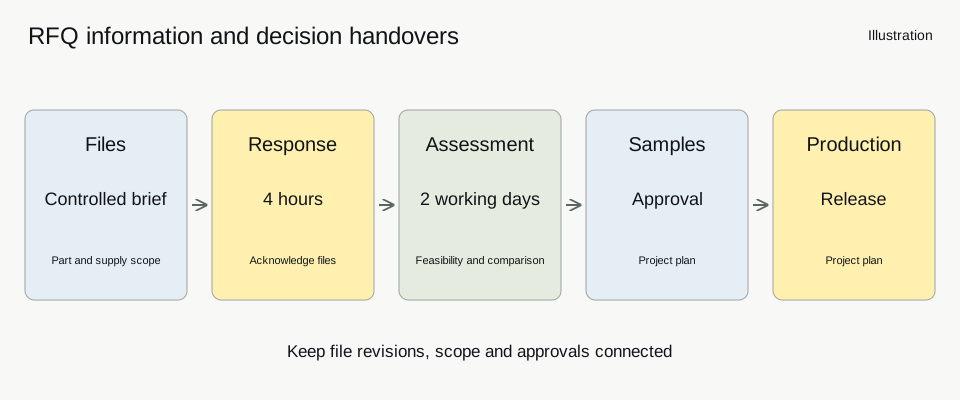
When replies arrive, normalize scope before asking for a price revision. A separate fixture or packing line may explain an apparent difference. Ask each supplier to answer the same updated brief and retain the previous version, so the reason for a changed total remains visible to the person approving the purchase.
When should you review another process before sending a thermoforming RFQ?
Review injection molding or sheet metal first when the functional requirement already points strongly to those routes. A small, stable part with dense details on both faces deserves an injection-molding assessment. A load-bearing or shielding requirement centered on a metal structure deserves a metalworking assessment. Identify the structural component separately from any appearance cover.
Use the thermoforming versus injection-molding break-even guide to compare matched delivered scopes and lifetime demand. That calculation helps decide which routes merit quotations. A request to compare processes should state the functional requirement and allow each route an appropriate structure, while keeping acceptance and delivery equivalent.
What should you do before sending the RFQ?
Send the completed field list, a controlled attachment list and a short list of open engineering decisions. Ask suppliers to reply against each scope line, then compare their inclusions and assumptions before negotiating the total. Return any revised requirement to every supplier using the same document revision.
Use the large-part tolerance guide to prepare datums and inspection conditions, and the thermoforming materials guide to organize service requirements. Send the brief through the project inquiry entry with the drawing revision, quantity basis and decisions that need review.