Why do 500-part and 1,000-part rules give different answers?
The useful threshold belongs to a defined part and a matched quotation scope. Heavy gauge thermoforming heats sheet, shapes it against a tool, and finishes the openings and perimeter afterward. Injection molding puts more of the final geometry into a mold cavity. Work moves between tooling and secondary operations, so the two quotations often combine different upfront investments with different unit costs.
Part count alone leaves out size, depth, appearance and attachment details. A curved equipment enclosure and a small cover with numerous bosses can have the same annual demand and different manufacturing economics. Treat a published volume rule as a question to investigate, then replace it with the costs of the actual drawing revision. Annual volume is also different from the number of parts made over the program's entire life.
FUNYO forms heavy-gauge parts up to 2600 × 1600 × 600 mm (102.4 × 63.0 × 23.6 in). Starting sheet can be up to 15 mm (0.59 in), with housings commonly using 8–10 mm (0.31–0.39 in). State starting sheet and required finished wall separately on the drawing, then match trimming, openings and assembly interfaces in the supply scope before comparing tooling and secondary-operation charges.
Freeze the comparison before requesting prices: drawing revision, material requirements, acceptable finished part, inspection scope and delivery point. Identify who supplies any specified surface treatment, assembly or shipping service. Including a cost category in an RFQ is a request for a scoped response, rather than a statement that FUNYO supplies every operation in that category.
What belongs in fixed cost and delivered unit cost?
Break-even quantity is the cumulative number of accepted delivered parts at which the two total-cost lines meet. Use T for thermoforming, I for injection molding, F for one-time expense, v for delivered unit cost and N for cumulative quantity. Allocated fixed cost per part falls as quantity increases; variable spending accumulates with each delivered part.
C_T(N) = F_T + v_T × N
C_I(N) = F_I + v_I × N
N_BE = (F_I − F_T) ÷ (v_T − v_I)
This form is useful when injection molding has the higher fixed cost and thermoforming has the higher delivered unit cost. If one route is lower on both measures, its cost line stays below the other for positive quantities. Equal unit costs remove the denominator's meaning: compare fixed expense instead. A negative answer or division by zero is a signal to review the scenario, not a purchase recommendation.
Fixed cost can include tooling, sample work, gauges, dedicated fixtures and initial engineering. Delivered unit cost should consistently include material, forming, trimming and openings, any agreed surface work, packaging and freight. Check whether a quoted line already includes another category. If tooling is recovered inside the unit price, record the recovery quantity and the price that applies afterward rather than counting the same tool twice.
The following CNY amounts are an example, not a quote. The webpage shows inputs and calculated values; the download includes formulas for recalculation.
| Item | Thermoforming | Injection molding |
|---|---|---|
| Tooling (CNY) | 15000 | 160000 |
| Samples (CNY) | 2500 | 6000 |
| Gauges and fixtures (CNY) | 2500 | 14000 |
| Material (CNY/part) | 100 | 75 |
| Forming (CNY/part) | 40 | 25 |
| Trimming and holes (CNY/part) | 35 | 5 |
| Surface work (CNY/part) | 0 | 0 |
| Packing and freight (CNY/part) | 25 | 15 |
| Expected revisions (events) | 2 | 2 |
| Cost per revision (CNY) | 5000 | 20000 |
| Annual demand (parts/year) | 1000 | 1000 |
| Life (years) | 3 | 3 |
| Base one-time cost F (CNY) | 20000 | 180000 |
| Delivered unit cost v (CNY/part) | 200 | 120 |
| One-time cost with revisions (CNY) | 30000 | 220000 |
| Lifetime quantity (parts) | 3000 | 3000 |
| Total with revisions (CNY) | 630000 | 580000 |
| Break-even with revisions (parts) | 2375 |
What do two hypothetical quotations for the same housing show?
The first scenario crosses at 2,000 parts before design revisions are included. Assume a 1200 × 800 × 300 mm (47.2 × 31.5 × 11.8 in) equipment housing. One-time costs are CNY 20,000 for thermoforming and CNY 180,000 for injection molding. Delivered unit costs are CNY 200 and CNY 120 respectively.
N_BE = (180000 − 20000) ÷ (200 − 120) = 2000 parts
At 1,000 delivered parts, the totals are CNY 220,000 and CNY 300,000. At 2,000 parts, both totals reach CNY 420,000. The comparison covers the listed supply scope; payment conditions, inspection requirements and acceptance of the packaged part remain separate purchasing checks.
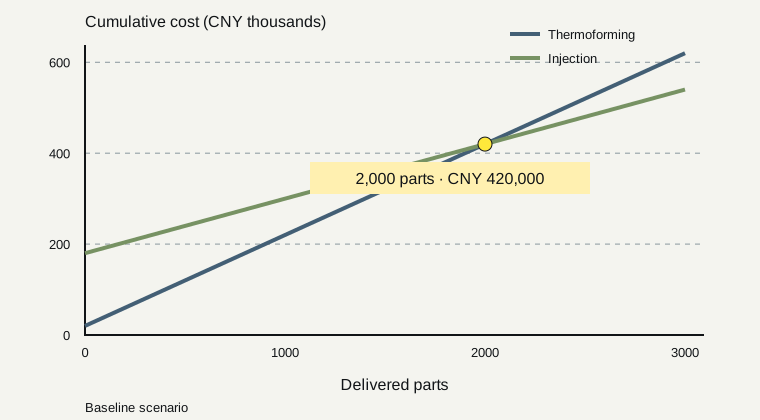
For the second scenario, add an opening requirement to both suppliers' scopes and request revised prices. Suppose trimming and openings rise from CNY 35 to CNY 75 per thermoformed part, and from CNY 5 to CNY 25 per injection-molded part. Keep the other example inputs unchanged. Delivered costs become CNY 240 and CNY 140, moving the crossover to 1,600 parts. Both quotations now refer to the revised part; comparing a revised scope against an old scope would obscure the reason for the change.
Keep both calculation records alongside their drawing revisions. The useful result is the relationship between scope and quantity. Removing the assumptions and repeating “thermoforming below 2,000” would turn a project calculation into another unsupported general rule.
How do revisions, lifetime demand and timing move the result?
Change one assumption at a time so that a reviewer can explain the result. First, add two anticipated design revisions to the first scenario. Assume CNY 5,000 per thermoforming revision and CNY 20,000 per injection-molding revision. Revised fixed costs become CNY 30,000 and CNY 220,000. With the original CNY 80 unit-cost difference, break-even moves to 2,375 parts. These revision charges are hypothetical inputs as well.
Next, connect annual demand to program life. A forecast of 1,000 parts per year over three years gives 3,000 cumulative parts. Including the assumed revisions, total spending becomes CNY 630,000 for thermoforming and CNY 580,000 for injection molding. If the program ends after 1,000 parts, run that smaller quantity through the model. The anticipated full-life allocation is no longer the relevant average cost.
Then separate tool construction from the launch schedule. FUNYO heavy-gauge tooling takes about 1–3 weeks, compared with about 6–10 weeks for comparable injection tooling. These are tooling periods, rather than complete delivery lead times. Drawing approval, sample inspection, revisions and transport need their own schedule entries. Launch planning starts with those dependencies, not simply the day a tool is completed.
A buyer may also model the value of time explicitly. If the buyer assumes a four-week delay at CNY 2,000 of lost net contribution per week, the scenario cost is CNY 8,000. Add that amount only to the delayed route. Applied to the first scenario, an injection-only timing allowance moves the crossover to 2,100 parts. Avoid counting the same period once as early-launch benefit and again as delay loss.
Store a baseline, revision case, volume case and timing case. That record identifies which assumption changes the decision and who supplied it. Staged tooling approval can then follow evidence of demand instead of treating the entire forecast as a firm order.
How should tier prices and a tooling agreement enter the model?
Determine whether a price tier applies only to additional units or reprices every unit in a qualifying batch. An incremental tier is accumulated segment by segment. An all-units price requires a fresh total for the qualifying batch. Material utilization, machine cycle and trimming method can affect the delivered price, so the quotation should identify its quantity basis.
Consider another independent hypothetical tier schedule. For the first 1,000 parts, assume CNY 200 per thermoformed part and CNY 140 per injection-molded part. Additional units cost CNY 180 and CNY 110. With the original CNY 160,000 fixed-cost difference and revisions excluded, the first segment absorbs CNY 60,000. The remaining CNY 100,000 is recovered at CNY 70 per additional part. The mathematical intersection is about 2,428.57 parts; compare complete-part totals starting at 2,429.
FUNYO housing projects with annual demand of about 3,000 pieces and an annual supply agreement can apply for a tooling-fee waiver evaluation. The quotation and agreement should identify approved waived charges, purchasing obligations, tool ownership and settlement terms. Enter those approved charges in the cost comparison.
To illustrate the spreadsheet treatment, suppose only the first scenario's CNY 15,000 tool line is waived. The CNY 5,000 combined sample and gauge allowance remains. Injection fixed cost stays at CNY 180,000, so the crossover becomes 2,187.5 parts. Ask separately about revision expense, tool maintenance and settlement if purchases fall short of the agreed quantity.
A quotation with a lower upfront payment can still produce a higher cumulative cost when its delivered unit charge is larger. Compare the agreement's full cash schedule and ownership terms, then revisit the calculation whenever the forecast or drawing changes.
When should injection molding move to the front of the review?
Review injection molding early when the design is frozen, lifetime volume is substantial, and the geometry needs many bosses, clips, controlled features or appearance requirements on both faces. More units can absorb the fixed investment. Once secondary brackets, trimming and assembly are included, a lower thermoforming tool price alone does not settle the comparison.
Thin-walled small parts, high production-rate requirements and standardized interfaces also justify an injection-molding review. This is a way to order feasibility work, rather than a blanket claim about either process. Match the actual geometry, appearance requirements, material and acceptable capital commitment, then use sample evidence before approving the route.
If electrical shielding, structural loading or joining to a metal assembly dominates the requirement, include sheet metal or another suitable process in the engineering review. Resolving the use conditions first prevents repeated price negotiation on a route that does not address the functional need.
What should go into the next RFQ?
Send the same calculation sheet and drawing revision to both suppliers, with a clear definition of delivered scope. Enter annual demand, first release and lifetime forecast separately. Distinguish firm orders from forecast quantities, and identify appearance surfaces, mounting interfaces, inspection and packaging requirements.
Resolve blank quotation lines before calculating a threshold: tool ownership, samples, gauges, trimming, packaging and freight all need an owner. Calculate the baseline intersection, then rerun revision, lifetime and timing cases. Keep uncertain inputs visible as scenarios. When the quotation validity period ends or the design changes, refresh the inputs before authorizing tooling.
FUNYO heavy-gauge tooling costs less than one tenth of a comparable injection mold for the same part scope. That statement concerns tooling expense, rather than delivered part price or total program cost. FUNYO responds within four hours and provides a suitability assessment and comparison quotation within two working days. Include starting-sheet and finished-wall requirements so that the discussion covers both the geometry and its cost consequences.
Download the break-even calculation sheet. Read the earlier thermoforming and injection-molding comparison, then review heavy-gauge capability and housings and enclosures before sending matched RFQs.
Use the thermoforming RFQ checklist and trilingual template to send the same scope to each supplier.