When semiconductor parts, wafer boxes and equipment modules ship, the cushioning inside the carton usually falls into three groups: PP thermoformed inserts, foam (polyethylene foam, EPP, polyurethane and others) and molded pulp. All three can work. They differ in how accurately they locate the product, how many particles they shed, how they handle ESD, whether they can be reused, and what they cost once spread over each shipment.
This guide first explains how to choose by what is being protected and where the carton is packed, then compares the three materials on location, cushioning, particles, recycling and cost, and finally explains how to run a comparison test in the same carton. FUNYO set up its thermoforming division in 2013 and has produced thin-gauge trays since 2013. The FUNYO capability figures below all come from its current lines.
Start with what is being protected: parts, wafer boxes or modules
Cushioning is not chosen on its own. First look at what goes in the carton, where it is packed and where it is unpacked.
| What is protected | Usual requirement | Look at first |
|---|---|---|
| Wafer boxes (FOSB and similar) | No load on the door or flange; no shifting in a drop | Location, particles, cleanroom packing |
| Precision parts and carriers | Each part held in place, no contact between parts | Pocket accuracy, easy loading, ESD |
| Equipment modules, board assemblies | ESD protection; limit movement and shock | ESD class, cushioning travel, weight |
| Spares and service parts | Small quantities, many batches, mixed sizes | Whether a mold pays off; reuse across parts |
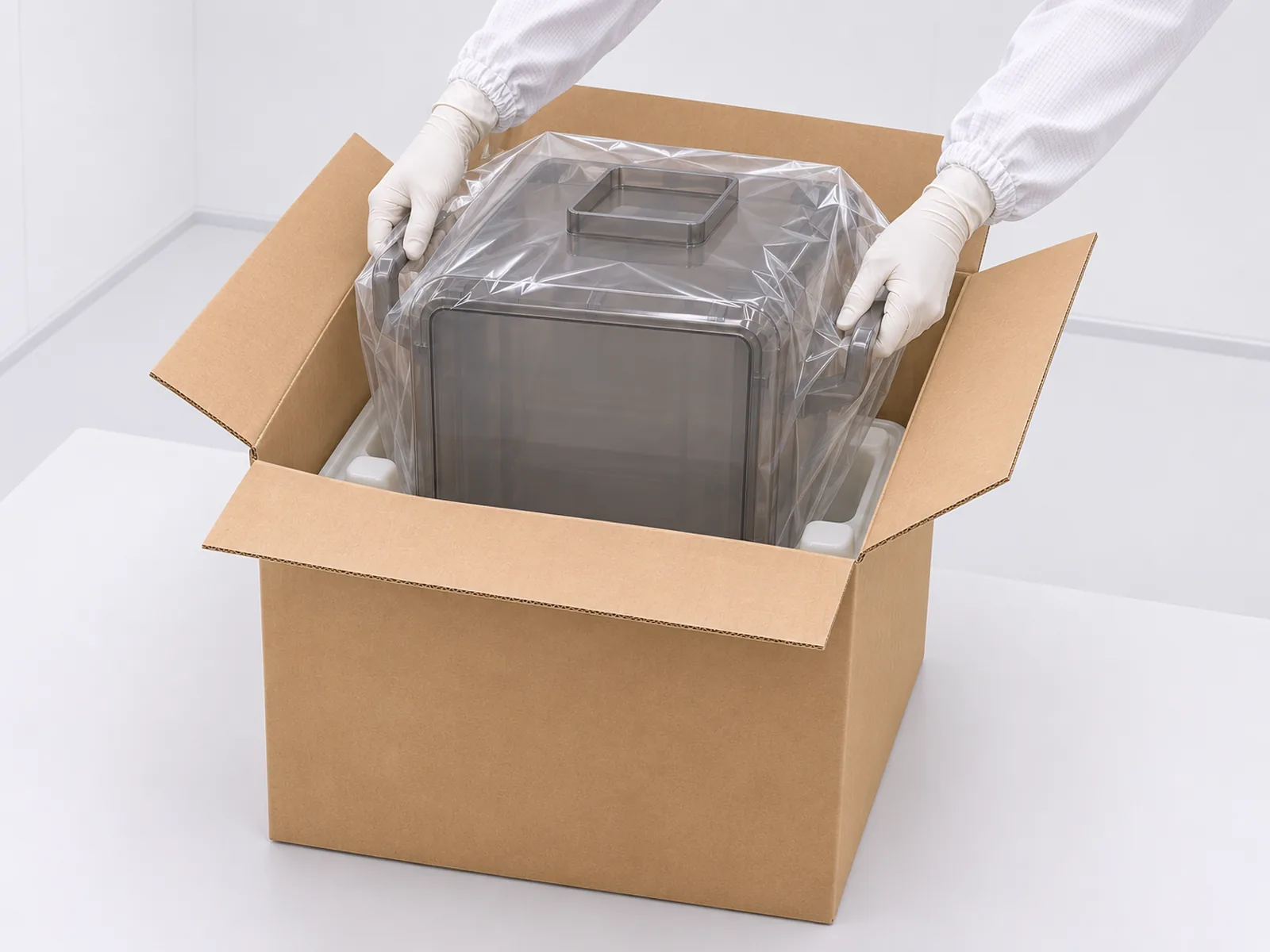
Wafer boxes are the most clearly defined case. SEMI M31 specifies the front-opening shipping box (FOSB) that wafer suppliers use to ship 300 mm wafers to their customers. 1 The wafers are already supported inside the box, so the carton cushioning has one job: hold the whole box in the carton so it does not shift in drops and vibration and nothing presses on the door or flange. For how FOSB inserts are designed, see FOSB PP inserts.
Parts and modules are different. The cushioning touches the product directly, and it sets each part's position, spacing and loading direction. Here location accuracy and ESD matter more than cushioning travel.
The shipping mode matters as well. Air freight brings low temperatures and pressure changes; sea freight and long road trips bring humidity and long periods of vibration; small-parcel courier brings many drops in random directions. The same cushion behaves differently in each, so state the shipping mode, route and any transfers in the RFQ.
How the three materials compare: location, cushioning, particles and recycling
The three materials work in different ways. Foam absorbs shock by compressing. A PP thermoformed insert locates the product with formed pockets, pads and walls, and cushions by deflecting its structure under impact. Molded pulp is also formed in a mold, but its fiber structure does not recover well once crushed.
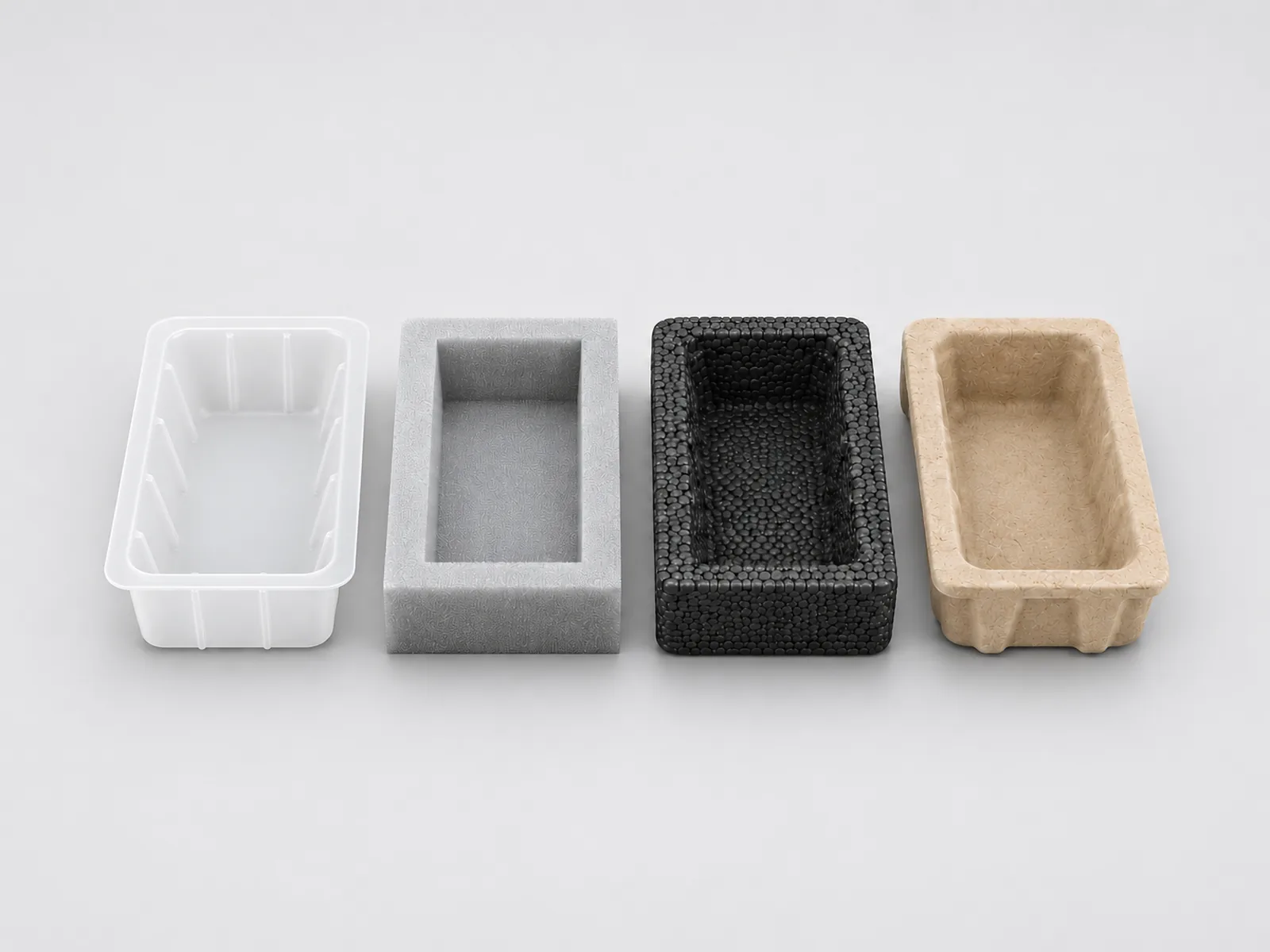
| Item | PP thermoformed | Foam | Molded pulp |
|---|---|---|---|
| Location accuracy | Formed in a mold; repeatable | Cut or molded; moderate accuracy | Formed in a mold; wider size variation |
| How it cushions | Structural deflection; support points can be designed | Material compression; recovers well | Structure crushes; recovers poorly |
| Reuse | Tough; suits repeated trips | Gradually takes a set | Usually single use |
| Particles | Few once edges are finished | Cut faces shed particles | Fibers shed easily |
| ESD | ESD-grade sheet available, accepted on test | ESD-grade foams exist | Generally not used in an EPA |
| Moisture | Not affected | Generally not affected | Loses strength when damp |
| Mold | Needed; thin-gauge molds cost little | Not for cut foam; needed for molded foam | Needed |
| Recycling | Single material, easy to sort | Depends on the material | Recyclable |
The table shows general patterns; grades within each group differ widely. EPP, for example, withstands repeated compression better than polyethylene foam and can be reused, and ESD foams also come in several grades. Name the exact material when comparing, not just "foam".
Cushioning also takes up space. Foam needs enough thickness to absorb a drop, which can enlarge the carton. A PP insert holds the product with relatively thin walls, but it needs room around the pockets to deflect. The carton size then affects freight cost and how many cartons fit on a pallet, so compare the outside carton dimensions of each option as well, not only the cushion itself.
The materials can also be combined. A common approach uses a PP insert for location and pockets, with foam pads under the base or at the corners to absorb shock. Another uses a clean PP insert as the inner layer and molded pulp or foam as outer cushioning. For combined solutions, state where each layer is packed and unpacked, so materials that shed particles stay out of the cleanroom.
Cleanliness and ESD: where the carton is packed sets the requirement
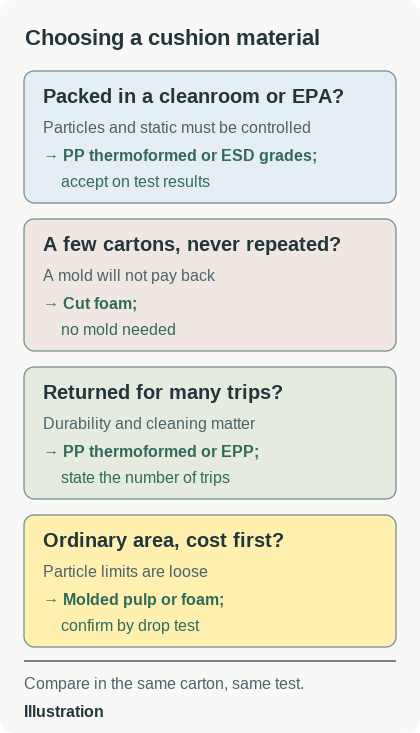
Whether the cushioning enters a cleanroom or an EPA (ESD protected area) sets the particle and ESD requirements. Outer cushioning that is packed and unpacked only in an ordinary warehouse can have looser requirements. Inner cushioning packed in a cleanroom or EPA has to be chosen for particles and ESD.
Particles come from cut edges and from the material itself. Foam cut faces and pulp fibers both shed easily. On a PP thermoformed insert, particles come mainly from the trimmed and die-cut edges, and they drop markedly with deburring, cleaning before shipment and clean packing. FUNYO's thin-gauge Class 10,000 cleanroom of 1,500 m² and its Class 100 wash room of 50 m² were built in 2016. Its in-house designed DI-water wash line is 20 m long with an effective width of 950 mm, combining washing, air knives and drying. For how to specify cleaning and clean packing, see cleanroom thermoformed trays.
ESD Association's published ANSI/ESD S541 chart classifies conductive resistance as <10⁴ Ω, dissipative as ≥10⁴ and <10¹¹ Ω, and insulative as ≥10¹¹ Ω. 2 The public ANSI/ESD S541 guidance calls for low-charging, conductive or dissipative packaging inside an EPA. 3 The specification should therefore state the target class, the test surface and the ambient temperature and humidity, and acceptance should rest on test results.
Permanent-ESD thermoformed trays have been a main FUNYO product since 2014. Color is no evidence of ESD performance: black thermoformed parts and pink foam both need test results. ESD properties from surface coatings or migrating additives can change with time and cleaning, so for cushioning that circulates for a long time, state a validity period or retest interval in the specification.
Cost per shipment: mold, unit price and number of trips
Comparing unit prices alone often leads to the wrong choice. To compare cushioning cost, add the mold, the unit price, the number of trips, return or cleaning costs and storage volume, and convert the total into a cost per shipment.
PP thermoforming needs a mold, but thin-gauge molds are inexpensive. A FUNYO thin-gauge mold costs about RMB 1,000 and a heavy-gauge mold about RMB 10,000, quoted by part size and structure; with stable volumes and order batches, free tooling can be negotiated per order. With a mold of about RMB 1,000 and 2,000 sets a year, the mold adds about RMB 0.5 per set. PP inserts nest when stored, so empty inserts take little space, which keeps freight and storage low on return trips.
Cut foam needs no mold and suits small quantities and frequently changing sizes. Molded foam needs a mold, usually costing more than a thin-gauge thermoforming mold. Molded pulp has a low unit price, but it is usually single use and its strength has to be reassessed if it gets damp.
Volume also decides the solution. FUNYO thin-gauge trial runs start from 50 pcs and production from 500 pcs. When annual volume is clearly below that and orders do not repeat, cut foam is often cheaper overall. When volume is high and inserts make many trips, PP thermoforming has the advantage once the cost is spread over each shipment.
| Cost item | How to calculate |
|---|---|
| Mold | Mold cost ÷ total quantity over the mold's life |
| Unit price | Cushion unit price ÷ number of trips |
| Return and cleaning | Return freight and cleaning cost per trip |
| Storage | Empty volume; whether parts nest |
| Scrap | Replacement rate after damage or compression set |
Comparison testing: same carton, same test method
Cushioning materials can only be compared in the same carton, with the same product and the same test method. Change the carton size or the test procedure and the results are no longer comparable.
ISTA 2A covers individual packaged-products of 68 kg (150 lb) or less, prepared for shipment. 4 ISTA 2A asks the shipper to decide before testing what counts as product damage and how much damage, if any, is acceptable. 4 Before testing, therefore, write down the pass criteria: how far the product may move, which spots must not be loaded, and how particles and appearance are checked. Then test every option against the same criteria.
Bring the samples to the same condition before testing as well: whether the cushions were cleaned, whether they were conditioned at the actual temperature and humidity, and whether the cartons come from the same batch. Carton strength depends heavily on humidity, and cartons from different batches or with different moisture content can change the result more than the cushioning does.
FUNYO has a drop tester for simulating tray drops and refining designs, and an anti-nesting tester to check trays for sticking when stacked. Samples can be compared in-house first; formal tests follow the standard and laboratory the customer names. Record each option's test result, unit price, cost per shipment and packing time, and decide on all of them together.
When is PP thermoforming the wrong cushioning choice?
For a few one-off cartons that will not be repeated, cut foam is faster and needs no mold. For heavy equipment that needs a lot of shock absorption, the structural deflection of a thin-gauge insert is not enough on its own; use foam or EPP as the main cushion and a thermoformed insert for location.
For outer cushioning that never enters a cleanroom or EPA, has no particle requirement and is driven by cost, molded pulp or foam is often more economical. Where the customer specification already names a material, or the outer pack is a rigid returnable case with its own lining, follow the existing solution.
Next step: send product and carton details
Send the product drawing or photos, the carton size, the quantity per carton, the shipping mode and the annual volume. Drawings can be STEP, IGES, DWG or PDF; without a drawing, photos and dimensions are enough to start. Also say whether packing happens in a cleanroom or EPA, and which ESD class and test standard apply. FUNYO responds within 4 hours of receiving the information and provides a suitability assessment and comparison quote within 2 working days.
FUNYO's thin-gauge trays reach a forming depth of 120 mm, which suits most cushioning inserts and divided trays; deeper parts are assessed from the drawing. For how to prepare an RFQ, see the FOSB insert RFQ checklist; for forming PP, see PP thermoforming.