Amusement ride car shells and styling parts, fitness equipment motor hoods and guards, and the main shells of leisure equipment are mostly large curved plastic parts made in modest numbers. At a few dozen to a few thousand units a year, injection tooling does not pay off, while hand-laid fiberglass struggles to keep every part the same, so heavy-gauge thermoforming is often the right fit.
This guide covers the parts, the division of work, joining large parts, where people touch the equipment, sheet materials and volume, in that order, and explains how to design and buy these housings in heavy-gauge thermoforming. FUNYO makes heavy-gauge thermoformed housings and does CNC machining; the FUNYO capability figures below all come from its current lines.
Which parts suit heavy-gauge thermoforming
On amusement and fitness equipment, the parts that suit heavy-gauge thermoforming are mostly show parts and covers, not load-bearing structures.
| Equipment | Suitable parts | Watch for |
|---|---|---|
| Amusement rides | Car shells, body styling parts, decorative covers, control box housings | Splitting large curves; color to plaque |
| Indoor fitness equipment | Motor hoods, base guards, handrail covers, control panels | Many openings, machined to the accessory drawings |
| Outdoor fitness equipment | Guards, decorative caps, sign panels | Sun aging, impact |
| Leisure and entertainment equipment | Main upper and lower shells, display styling parts | Joining shells, location |
What these parts share is large size, many curves and annual volumes in the hundreds to thousands. Heavy-gauge thermoforming suits mid- to large-size parts at hundreds to a few thousand pieces a year; tooling takes about 1–3 weeks and costs less than 1/10 of comparable injection tooling (tooling cost only).
The amusement industry has long used fiberglass for styling parts. Fiberglass suits very large, one-off or very low-volume shapes, but hand lay-up varies in thickness and surface from part to part and needs sanding and painting. Heavy-gauge thermoforming forms every part on the same mold, with the color in the sheet, which suits shapes that are produced again and again. For the comparison, see thermoforming vs fiberglass enclosures.
Product families are common as well: a ride maker may offer several car versions, or a fitness brand several models on one frame. When versions share most of the shape and differ only in openings or trim, one mold can form them all, with version-specific openings CNC machined afterwards; see multi-model covers.
What the shell does, and what the machine is responsible for
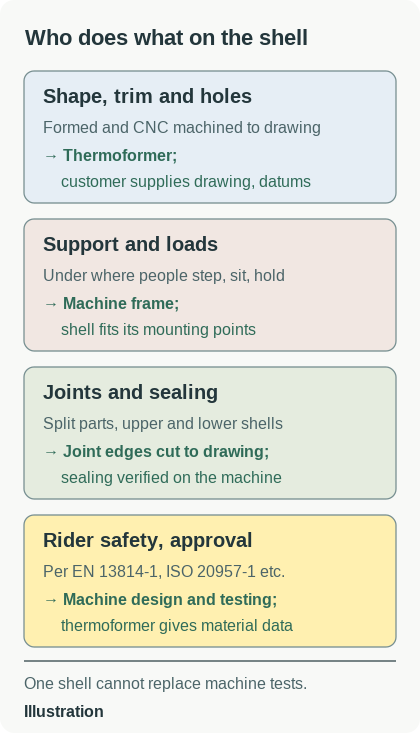
Amusement rides and fitness equipment carry people directly, and the safety requirements for the complete equipment are strict. A thermoformed shell provides only shape and appearance; loads, rider safety and standards testing belong to the machine frame and the equipment maker.
EN 13814-1:2019 sets minimum requirements for the safe design, calculation, manufacture and installation of mobile, temporary or permanently installed amusement machinery and structures. 1 ISO 20957-1:2024 specifies general safety requirements and test methods for indoor stationary training equipment. 2 EN 16630:2015 specifies general safety requirements for the manufacture, installation, inspection and maintenance of permanently installed, freely accessible outdoor fitness equipment. 3
These standards apply to the complete equipment. The thermoformer forms, trims and drills to the drawing and supplies material data, first-article reports and samples to help the equipment maker complete verification; a single shell cannot replace the machine's design calculations and testing. Agree the division of work before quoting so acceptance has a clear basis. A simple split: shape, openings, color and joint edges are the thermoformer's responsibility to the drawing; the frame, mounting points, load calculations, machine testing and approval are the equipment maker's; material data, first-article reports and samples come from the thermoformer for use in machine verification.
Large parts: size, splitting and joining
FUNYO's heavy-gauge parts go up to 2600 × 1600 × 600 mm, from 6–15 mm sheet, with housings typically 8–10 mm. Most fitness equipment shrouds and the car shells of small and mid-size rides can be formed in one piece within that range.
Larger styling parts are split into upper and lower or left and right shells, formed separately and joined. Put the split line on a styling line, a color break or somewhere out of sight; fix the joint edges, locating pins and fastening holes before tooling, and trial-fit them on samples. For splitting and joining methods, see oversized thermoformed parts.
Deep, narrow shapes also call for splitting. For heavy-gauge housings, an areal draw ratio of ≤3:1 is the design starting point; above that, revise the geometry or split the part first, confirmed on the first article. The more the sheet stretches, the thinner the deep corners and the more likely stretch marks show on the surface.
After forming, parts are CNC trimmed and drilled to the drawing. FUNYO's 3-axis and 5-axis CNC machines are used for mold making, trimming and deburring formed parts, and machining holes and slots; mounting holes, light openings and viewing windows on curved faces are all machined from the same datums.
Large parts also need planning for shipping, installation and service. Rides are often assembled on site, so split parts must fit in crates and through doors, and the shell needs adjustment room against the frame. After years in operation, damaged shells need replacing; thermoforming molds can be stored long term and used to make single replacement parts as needed.
Where people step, sit and hold
Mark on the drawing every place people will touch: where they will step, sit, hold or bump. Those places need a frame or support underneath; the thermoformed shell provides the shape and must not carry the load on its own.
Fix the shell's mounting points and support spacing on the frame before tooling. For heavy-gauge housings, keeping hole edges at least 2× the starting gauge from the trim line and from the start of a radius is the design starting point, confirmed on the first article; loaded mounting holes can take metal inserts or washers to spread screw loads.
Large flat areas that need stiffening can take ribs. For heavy-gauge housings, the rib starting point is a rib height no greater than its base width, a base width of at least 3× the starting gauge and a root radius of at least the starting gauge, confirmed on the first article. Give edges and corners generous radii so hands and bodies do not catch on them, which also improves impact resistance.
Choose fastening by load and access: screws and inserts for access covers that come off often, bonding for decorative parts that never come off. For fastening options, see fastening thermoformed parts.
Sheet and color: indoor, outdoor and clear parts
FUNYO's heavy-gauge forming can evaluate ABS, PC, PVC, PETG and PP. For indoor fitness equipment and indoor amusement equipment, ABS is the most common: it is stiff, easy to machine and its color can be matched to a plaque.
Outdoor fitness equipment and rides must allow for sun aging. Shells in direct sun use a weather-resistant grade or a sheet with a weather-resistant cap layer, confirmed per project against sheet and test data and verified with aging tests on samples; color, gloss and impact performance each get their own pass criteria. See outdoor thermoformed enclosures.
Clear viewing windows and light covers can be evaluated in PC or PETG. Where a flame rating is required, confirm the sheet grade and its test data first and then sample per project; general-purpose sheet should not be assumed to meet it.
Cleaning and wear in use matter too. Gym equipment is wiped down for sweat and disinfected daily, and amusement equipment is often hosed down. A fine texture on the show face makes scratches and fingerprints less visible; for draft and appearance approval of textures, see textured thermoforming.
Confirm color as a set. Rides often use bright colors, and large and small parts or different sheet batches can differ, so compare a set of samples under the same light before fixing the color standard.
Volume and tooling: prototypes, first batch and annual demand
A common pattern in amusement and fitness equipment is one or two prototypes for a trade show or trial operation, followed by small batches to order. Heavy-gauge tooling takes about 1–3 weeks, against about 6–10 weeks for comparable injection tooling; making prototype shells from the thermoforming mold means styling changes are also quicker than changing a steel tool.
Tooling is quoted by part size and structure; a heavy-gauge mold costs about RMB 10,000. With a mold of about RMB 10,000 and 500 pieces a year, the mold adds about RMB 20 per part. Projects at hundreds to a few thousand pieces a year spread the tooling cost easily; at lower volumes, compare the total cost with fiberglass, sheet metal and other options.
Samples and first article: fit first, then fix the appearance standard
When the first article arrives, check shape, openings and key dimensions against the drawing, then trial-fit it on the prototype frame: do the mounting holes line up, are the split lines even, and is there support under every contact point? Fix what the trial fit shows with a local mold change or a new CNC program, then make a second round of samples.
Once the appearance samples are approved, they become the color and appearance standard for later batches. When the equipment maker runs machine tests, the shells are supplied in the approved sample condition; later changes to sheet, color or process are notified first and then verified.
Which parts should not rely on a thermoformed shell alone?
Seat frames, safety restraints, load-bearing brackets and counterweight structures that carry riders cannot rely on a thermoformed shell; they need a metal frame or dedicated structural parts. Thermoformed parts can serve as covers over those structures.
Small parts at tens of thousands a year and parts that need fine detail on both sides suit injection molding better. Very large, closed, hollow parts can be compared against rotational molding and other processes.
Next step: send the shape, frame and use conditions
Send drawings or photos: STEP, IGES, DWG or PDF; without a drawing, photos and dimensions are enough to start. Also state the equipment type, the shell's outside dimensions, annual demand and first batch, indoor or outdoor use, where people touch the equipment and how the shell mounts to the frame. FUNYO responds within 4 hours of receiving the information and provides a suitability assessment and comparison quote within 2 working days.
| Information | What to include |
|---|---|
| Equipment and part | For example: ride car shell, treadmill motor hood |
| Size | 3D model or outside dimensions, with show faces marked |
| Volume | Prototype quantity, first batch, annual demand |
| Environment | Indoor or outdoor, sun exposure, flame rating |
| Contact and loads | Where people step, sit or hold; frame mounting points |
| Appearance | Color, texture, whether the part is split and joined |
If you already have a fiberglass, sheet-metal or injection-molded design, send it too. We quote against the same drawings so you can see which parts are better made by thermoforming.