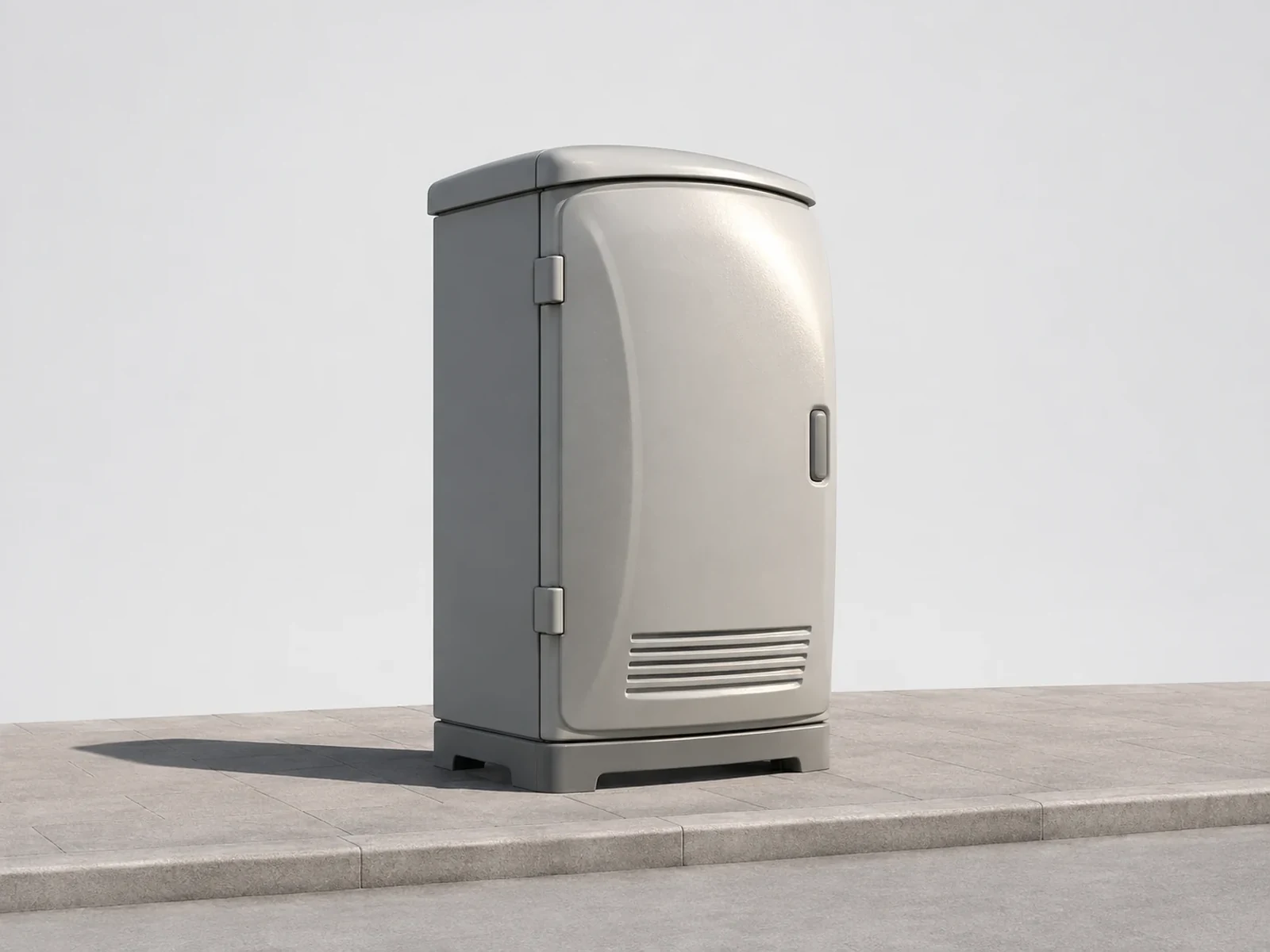
An outdoor thermoformed enclosure is a housing or cover that lives outside in sun and rain: an EV charger shell, a battery storage cabinet, a roadside equipment cabinet or a machine guard on construction equipment. A sheet that lasts ten years indoors can yellow, lose gloss, chalk and even crack on a cold morning after one or two summers in direct sun. The cause is how the material handles ultraviolet light; the forming process has little to do with it. This guide explains how to choose material and color for outdoor enclosures by sun exposure, how to write the verification method, and ends with an outdoor enclosure specification sheet.
FUNYO heavy-gauge thermoforming forms single parts up to 2600 × 1600 × 600 mm (102.4 × 63.0 × 23.6 in) from sheet 6–15 mm (0.24–0.59 in) thick in ABS, PC, PVC, PETG and PP, and fits medium and large housings built at a few hundred to a few thousand units a year. Weather-resistant grades for outdoor use are purchased per project and confirmed on samples.
Define where the enclosure sits and how much sun it gets
How demanding the weathering requirement is depends on orientation and shading. A drawing note that only says "outdoor use" leaves the supplier guessing which material you need.
| Location | Sun exposure | Material requirement | Verification focus |
|---|---|---|---|
| Top and front in direct sun | Full sun and rain | UV-stabilized grade or capped sheet | Color difference, gloss, impact |
| Shaded sides and back | Partial sun | UV-stabilized grade, or decide by sample comparison | Color difference |
| Behind glass or semi-outdoor | Daylight through glass | Standard grades usually work | Color comparison |
| Indoor | Almost no sun | Standard grade | Appearance inspection |
A practical rule: when the top of a machine is in full sun and the sides are shaded, you can switch only the sun-facing covers to a weather-resistant grade. Switching everything is simpler but costs more material. Write the orientation of each cover into the specification so the supplier can quote both options and you can see the price difference.
Name the installation region as well. The same material ages at very different speeds in a high-sun, high-UV region and in a cloudy, rainy one. For a product sold into several regions, either specify the material for the harshest region or stock materials by region.
What matters for each type of outdoor equipment
Different outdoor machines age in different places, and each needs different lines in the specification.
| Equipment | Typical site | Most exposed area | Specification focus |
|---|---|---|---|
| EV charger | Parking lots, roadsides, service areas | Top, front and display window | UV-stabilized grade, non-yellowing window, impact |
| Battery storage cabinet | Industrial parks, rooftops | Top and sun-facing side | UV-stabilized grade, color, drainage |
| Construction machinery | Building sites, mines | Top of guards and impact-prone sides | Impact after weathering, heat, separate parts |
| Agricultural machinery | Fields, open-air parking | Canopy and guards | Weathering, washing off mud |
| Roadside cabinet | Roadsides, telecom sites | Doors and top | Color consistency, appearance life |
A practical rule: if the machine stands in the open without shade for long periods, write every exposed face as direct sun. If it spends most of its time under cover and only works outdoors, write the requirements for shaded outdoor use and confirm them with a sample comparison. Water and dust protection ratings come from the machine's sealing design; the enclosure material is responsible for staying intact and color-stable as it ages.
What UV does to a thermoformed enclosure
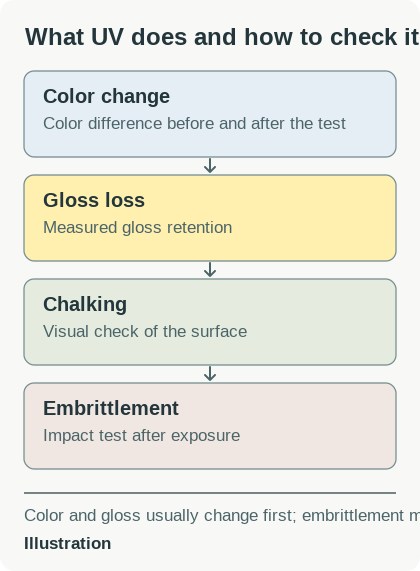
Ultraviolet light causes four main changes: color change, gloss loss, chalking and embrittlement. The first two affect appearance; the last two affect use.
Color change is noticed first: light colors turn yellow and dark colors fade toward gray. Gloss loss makes a shiny surface look dull. Chalking leaves a powder on the surface that rubs off on your hand. Embrittlement lowers impact resistance, which shows most clearly in cold weather, typically as a crack after a light knock in winter.
A practical rule: when the enclosure is likely to be knocked in service, as with machine guards on construction equipment or roadside cabinets, impact performance matters more than color, so include an impact test after weathering in the verification. For purely cosmetic panels, color difference and gloss are the main criteria.
Each of these changes can be measured. Color difference is read with a colorimeter against an unexposed reference, gloss with a gloss meter at an agreed angle, and impact with the test method named in your equipment standard. Writing the measurement next to each change turns a vague request for weather resistance into criteria a supplier can quote against.
Choose between standard grades, UV-stabilized grades and capped sheet
For enclosures in direct sun, use a UV-stabilized grade or a coextruded sheet with a weather-resistant cap layer over a standard base.
| Approach | Suits | Watch for |
|---|---|---|
| Standard grade | Indoor and shaded positions | Changes color fairly quickly in direct sun |
| UV-stabilized grade | Enclosures in direct sun | Higher material cost; purchased per project |
| Capped sheet with a weather-resistant layer | Outdoor enclosures with high appearance demands | The cap layer must face the show surface |
| Painting after forming | Special colors | Needs a separate painting step |
The cap layer on a coextruded sheet is thin. Forming stretches the sheet, so the cap thins at deep corners and heavily drawn areas, and weathering performance there should be confirmed on samples. Clear parts used outdoors need UV-stabilized grades so that yellowing does not cut light transmission; see PC vs PETG for clear parts.
The most direct way to compare two materials is to form a few samples of each on the same tool, cut test pieces from them, weather them together and set them beside unexposed samples. This compares the material in its formed state, which is closer to what you will see on the installed machine than the sheet maker's data alone.
For the material list and the character of each resin, see heavy-gauge sheet materials. For EV charger housings, including protection requirements, see EV charger enclosures: thermoforming, injection molding or sheet metal.
Color affects weathering and surface temperature
Dark enclosures absorb more heat in direct sun and run hotter at the surface; light enclosures show color change more readily.
A practical rule: for dark enclosures, check heat resistance and distortion, especially near heat-producing components. For light enclosures, agree an allowed color difference in the specification. Make all covers on one machine from the same sheet batch and compare them against the color standard under agreed lighting. See textured thermoformed parts for how texture and color standards are approved.
The same color ages at different speeds on different materials. When you change material or sheet supplier, repeat the color and weathering comparison even if the color reference stays the same, and release production only after it passes.
Verify with accelerated tests and real outdoor exposure
Accelerated weathering compares materials within weeks; real outdoor exposure confirms the result. Put both in the verification plan.
ISO 4892-2 exposes specimens to filtered xenon-arc light under controlled temperature, humidity and wetting. 1 The test duration and pass values are set by the equipment standard or agreed between buyer and supplier. The specification should state four things: the test method, the duration, the properties compared and the pass criterion for each.
| Property | How it is compared | How to specify |
|---|---|---|
| Color | Color difference before and after the test | Measuring method and allowed range |
| Gloss | Gloss retention ratio | Measuring angle and retention ratio |
| Impact | Impact test after exposure | Test method and pass criterion |
| Surface | Visual check for chalking and cracks | Viewing conditions and judgment method |
For real exposure, place sample plaques at the installation site and compare them each quarter with unexposed plaques. Once the accelerated test and the outdoor results agree, later sheet batches can be confirmed quickly with the accelerated test alone.
Repeat verification when a machine goes outdoors for the first time, or when the sheet supplier, color or gauge changes. If the same material, color and gauge already have a record of outdoor use, that record can be cited to shorten the test program. Keep the exposed plaques and the test report with the drawing revision, so a later batch can be compared against the same reference.
Design details that affect weathering
Standing water, stress concentrations and thin walls make aging show up sooner, so deal with them during design.
Give top surfaces a drainage slope to avoid standing water. Limit deep draws on sun-facing faces, because heavily stretched areas are thinner and crack sooner once weathered. Use slotted or oversized mounting holes with washers to allow for thermal expansion and keep stress off the hole edges; fastening options are covered in thermoformed machine covers and guards.
A practical rule: make the areas most likely to be knocked, or most exposed to sun, separate parts so that one damaged panel can be replaced on its own. See splitting and joining oversized parts.
The joint between a clear viewing window and the enclosure is one of the most common trouble spots outdoors. The two materials expand by different amounts in heat, so give the fixing points room to move and leave the seal design to the machine designers. Give the inside corners of window openings a generous radius as well, so the stress that builds up over many hot and cold cycles is spread out.
Put the requirements on an outdoor enclosure specification sheet
Collect the requirements above in one table, send it with the drawings and ask the supplier to answer line by line. The last column is for your equipment's conditions.
| Item | Why it matters | How to specify | Your equipment |
|---|---|---|---|
| Site and orientation | Sets the sun exposure | Region, orientation and shading | |
| Exposure of each cover | Lets you choose material by face | Mark sun-facing and shaded faces | |
| Material type | Weather-resistant grades cost more | Standard grade, UV-stabilized grade or capped sheet | |
| Color and standard | Dark colors run hot; light colors show change | Color reference and physical standard | |
| Allowed color difference | Color change appears first | Measuring method and allowed range | |
| Gloss retention | Gloss loss affects appearance | Measuring method and retention ratio | |
| Impact performance | Weathered plastics become brittle | Test method and pass criterion | |
| Accelerated weathering test | Compares materials within weeks | Test standard and duration | |
| Outdoor exposure | Confirms the accelerated test | Exposure site and comparison interval | |
| Structure and drainage | Standing water and thin walls speed aging | Drainage slope and sun-facing wall rules | |
| Annual and first-lot quantity | Sets how the material is purchased | Annual demand and first lot |
Download the outdoor enclosure specification sheet. When replies come back, check that the material type, the verification method and the pass criteria are all stated before you compare prices.
Which outdoor parts should be metal or made another way?
Areas with long periods of high heat and strong UV that also carry load are safer in metal with a corrosion-resistant coating. Enclosures that need a special color and long outdoor life can be compared against painting after forming or other processes.
Many outdoor machines combine processes: a metal frame carries the load while thermoformed covers provide appearance and protection. See thermoforming vs sheet metal enclosures and thermoforming vs fiberglass (FRP).
Next, send the installation site, the cover models and the color requirement to FUNYO and mark the faces in direct sun; we will recommend materials by exposure and confirm them on samples. FUNYO responds within 4 hours and returns a feasibility review with a comparative quote within 2 working days.