Specify flame-retardant thermoforming sheet as an exact material-and-geometry combination. Start with the product requirement, locate the relevant grade, color and thickness in its records, and confirm the thin regions after forming. A purchase order that simply says flame-retardant plastic leaves different people to decide the material, appearance and documentation scope. A shared request makes those decisions visible before the sheet and tooling are ordered.
Read UL 94 classifications with their test method
The UL 94 vertical method determines the V-0, V-1 and V-2 classifications.1 Its V test uses a 50 W, 20 mm flame with 2 × 10 s applications per specimen. The values below are UL 94 test criteria. Read the complete set for the classification required by the product.
| UL 94 V criterion | V-0 | V-1 | V-2 |
|---|---|---|---|
| Burning time after each application to an individual specimen | ≤10 s | ≤30 s | ≤30 s |
| Total burning time across 10 flame applications | ≤50 s | ≤250 s | ≤250 s |
| Burning plus afterglow after the second application | ≤30 s | ≤60 s | ≤60 s |
| Flaming drips ignite cotton | No | No | Yes |
| Burning reaches the clamp | No | No | No |
In the UL 94 vertical test, total burning time across 10 flame applications is ≤50 s for V-0 and ≤250 s for V-1 and V-2. Both V-0 and V-1 exclude flaming drips that ignite cotton; V-2 permits ignition in that criterion. Individual burning time, combined time, afterglow and cotton ignition are separate checks. Looking only for drips leaves the time criteria unresolved.1
The UL 94 5V test uses a 500 W, 125 mm flame. The official page describes its flame as approximately five times that used for V-0, V-1, V-2 and HB. In the UL 94 5V test, 5VA sheet specimens must remain without holes, while 5VB permits hole formation.
| UL 94 5V criterion | 5VA | 5VB |
|---|---|---|
| Burning plus afterglow after the fifth application | ≤60 s | ≤60 s |
| Flaming drips | Excluded | Excluded |
| Hole formation in a sheet specimen | No | Yes |
For UL 94 HB horizontal burning, the rate is ≤40 mm/min for specimens 3–13 mm thick and ≤75 mm/min below 3 mm; extinguishing before the first mark also qualifies for HB.1 Choose the horizontal burning-rate criteria when HB is specified, and the applicable V or 5V table when a vertical test is required. Keep the complete classification in the purchase specification. The 5V flame and hole criteria belong to that method, so the names alone are an incomplete basis for ordering materials by suitability.
Separate the material record, the component and the equipment assessment
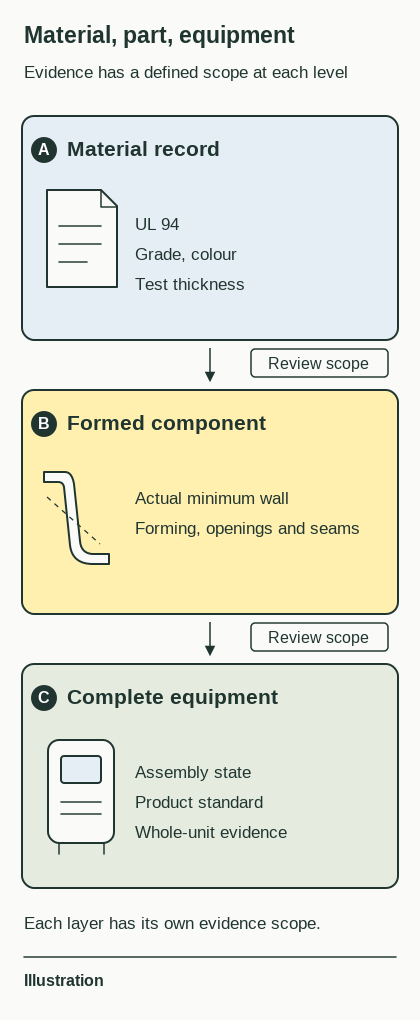
UL 94 rates the ignition characteristics of plastic materials.2 Equipment assessment also considers the applicable product standard, internal layout, heat sources, structure and electrical design. A material record supplies part of the selection evidence. The component drawing still needs its wall regions, openings, attachments and installation state defined so the material choice can be connected to the equipment design.
Assign responsibilities at the beginning of the project. The sheet supplier provides the exact designation and supply documents. The forming and machining stages retain the material identity and sample condition. The equipment manufacturer and its assessment organization determine the product route. This division also makes the quotation scope clearer: material procurement, forming, sample measurement, testing and document preparation are separate activities that need named owners.
For charging equipment, bring the mounting arrangement, internal heat sources and service environment into that discussion. The EV charger enclosure manufacturing guide helps organize interfaces and operating conditions. Starting from the product requirement gives the material search a defined purpose, before the enclosure shape or its thin regions are frozen into a tool design.
| Decision | Evidence to use | Action |
|---|---|---|
| Select a material | Exact grade, color and tested thickness | Choose a combination covered by the entry |
| Validate a component | Drawing, actual wall and installation state | Measure the first article and submit the sample |
| Assess equipment | Product standard and internal arrangement | Assign the product tests to the responsible party |
Check thickness at the thinnest formed region
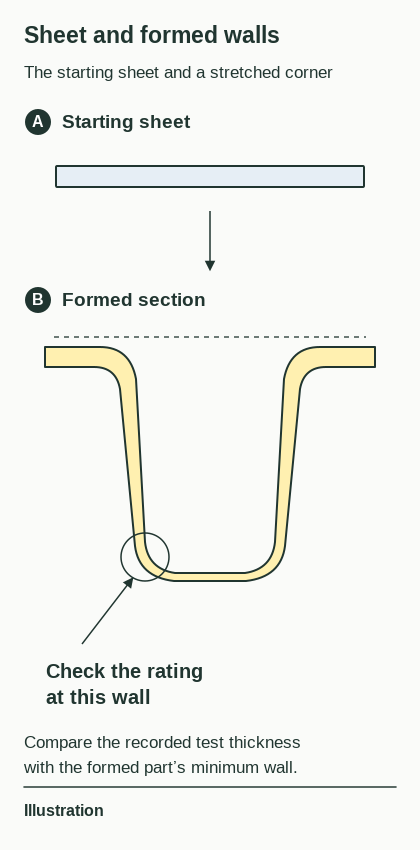
The rating's thickness conditions come from the relevant material record. Thermoforming draws a hot sheet over a tool, so deep corners, sidewalls and local recesses can finish at different wall thicknesses. Record the incoming sheet gauge separately from the thickness of the broad face and the thinnest corner. The gauge on the incoming sheet label describes the starting stock.
For typical heavy-gauge housings, estimating the thinnest deep-corner wall at about 1/3 of starting gauge is a design starting point, confirmed by first-article thickness measurement. Use that estimate to identify regions needing attention early. After forming, measure the agreed sections and compare the actual thin regions with the selected material record. Keep the grade, forming direction and measurement locations with those results.
FUNYO uses starting sheet up to 15 mm (0.59 in), with housings commonly using 8–10 mm (0.31–0.39 in). Specify the finished thin-wall regions and measurement method separately on the drawing. The heavy-gauge design guide connects corner geometry, depth and material distribution so a change in sheet selection can be assessed together with the proposed shape.
Match the exact grade, color and thickness to the documents
The Yellow Card lists tested safety and performance properties of plastics, providing information for UL 94 material selection.3 The records are listed in UL Product iQ. Request the full grade name, suffix and record identification, then check the original entry. A cropped image that leaves out the grade or thickness column gives the reader too little information to match a supply to its stated conditions.
Compare the material designation, color coverage, thickness and required classification, then connect those details to the sheet supplier's delivery documents. The project needs a traceable relationship between the material record and the sheet supplied. Identify who confirms the sheet's suitability for the application. Bring any difference in color, suffix or finished thin region back to the material and product assessment owners before purchasing a substitute.
If a grade suffix or color falls outside the listed entry, select a covered combination before substitution. If the formed wall is below the listed thickness, change geometry or find a grade covering that wall. Retain the accepted sheet designation and drawing revision for the next purchase.
Compare flame-retardant sheet families using the project conditions
Flame-retardant ABS, flame-retardant PC, PC/ABS and flame-retardant PVC are general industry material categories. Each contains different formulations, colors and processing requirements. Use service conditions, appearance and geometry to narrow the candidates, then select the exact grade with its supporting documents. A polymer family helps direct the search; the supply specification needs the full designation and applicable evidence.
FUNYO evaluates ABS, PC, PVC, PETG and PP for heavy-gauge work; special grades are procured and sampled by project. Put the candidate sheet and requested documents in the same RFQ so procurement, forming and inspection discuss a shared requirement. The thermoforming materials guide provides a broader framework for comparing the confirmed sheet families and their intended use.
If the part includes a transparent window, a light-transmitting area or a controlled color, list those requirements beside the material evidence. A color change can affect the applicable record conditions. Optical appearance also needs observation on a formed sample. The transparent PC versus PETG guide helps organize the optical, structural and environmental conditions behind that comparison.
Confirm appearance and machining with the selected grade
A flame-retardant formulation can affect available colors, texture presentation and processing conditions. Include the visible face, deep corners, trimmed edges and attachment regions in the sample discussion. That allows appearance and wall distribution to be observed together. Relate an approved appearance sample to the drawing so purchasing a named color and accepting the visible formed surface remain connected decisions.
Arrange dust collection, cleaning and inspection around the material and site requirements for trimming. FUNYO uses 3-axis and 5-axis CNC for trimming and deburring, holes and slots. Identify machining areas and cosmetic protection needs in the project review, then confirm the operation using the selected sheet's processing information and the sample results. Retain the distinction between the formed state and the state after machining.
Return a material, color or finishing change to the original functional and documentation requirements. Where another operation creates the surface effect, identify its contact region, added materials and validation responsibility in the agreed scope. The aim is a controlled component version whose sheet, geometry, appearance and evidence continue to refer to the same item through sampling and later supply.
If a trimmed edge remains visible, approve its surface after machining; if it is concealed, prioritize burr removal at installation contacts. Mark that difference on the appearance drawing so the sample and production inspection use the same edge categories.
Prepare a material request with documents and responsibilities
State the target rating, corresponding thickness, product standard, color, exact grade and documents before adding thin-region locations and testing responsibility. The example column below describes how to write the request without inventing a grade or a rated thickness. The downloadable CSV shares the webpage fields and leaves the project-entry column blank for the buyer, designer and product assessment owner.
| Item | What to specify | Example wording | Project entry |
|---|---|---|---|
| Target rating | State the material classification required by the product | Enter the target classification from the product requirement | |
| Applicable thickness | Identify the thickness conditions to be checked | Use the applicable thickness from the material record | |
| Product standard | Name the equipment or component assessment basis | Identify the product standard and relevant requirement | |
| Color | Use an identifiable color or controlled sample | Supply to the approved color or appearance sample | |
| Exact grade | Retain the complete supplier designation and suffix | Supply the approved full grade designation | |
| Documents | List original records and delivery documentation | Provide the matching material record and batch information | |
| Thinnest formed wall | Locate thin regions and first-article measurement areas | Measure and record the thin regions shown on the drawing | |
| Testing responsibility | Identify sampling, commissioning and reporting parties | Provide samples and reports under the agreed responsibility | |
| Service environment | Describe heat sources, exposure and contacting media | Describe the actual application conditions | |
| Appearance | Identify visible surfaces, texture and color sample | Check the shown visible areas against the approved sample | |
| Processing and change | Define trimming, finishing and substitution approval | Recheck records after a material or process change |
FUNYO responds within 4 hours and provides a suitability assessment and comparison quote within 2 working days. Send the enclosure drawing, visible surfaces, service conditions and documentation needs together. Retain the full pages and identifying details of any existing material records. The housings and enclosures product page describes the corresponding part scope to use alongside the completed request.
Change material or geometry when the record and application conditions diverge
If the target color, thin region or use conditions fall outside the applicable candidate record, compare another documented grade, revise the deep corner or reallocate the component's function. Assessing the geometry and material together can make the finished wall and evidence conditions easier to align. The material and product assessment owners establish the appropriate testing route for the revised combination.
Next, put the target classification, color and minimum formed wall into the request table. Attach the full material entry and the drawing. Approve the sample using identified wall measurements, an appearance sample and the agreed test evidence. On substitution, identify the changed grade, color or wall before updating the affected approvals.