Thermoformed interior parts for RVs and special vehicles are heavy-gauge ceilings, side panels, wheel arches, floor plinths, locker doors, washroom modules and dashboard trims found in motorhomes, camper conversions, ambulances, delivery vans and other special vehicles. These vehicles come in many models, each built in small numbers and restyled often, and their interior parts must be light and good-looking while standing up to vibration on the road, temperature swings in the cabin and daily cleaning. This guide covers which interior parts suit thermoforming, how to handle weight and flame requirements, how to prevent rattles, what temperature cycling demands and how several models can share one mold, and ends with an interior part specification sheet you can download.
FUNYO heavy-gauge thermoforming forms single parts up to 2600 × 1600 × 600 mm (102.4 × 63.0 × 23.6 in) from sheet 6–15 mm (0.24–0.59 in) thick in ABS, PC, PVC, PETG and PP, and fits medium and large parts built at a few hundred to a few thousand units a year. Molds take about 1–3 weeks, and openings and trimming after forming are cut on 3-axis and 5-axis CNC machines.
Which interior parts suit thermoforming
Thermoforming pays off most on interior parts that are large, curved and shared across many models: big curves form in one piece, tooling is inexpensive and restyling is quick.
| Part | Thermoforming advantage | Watch for |
|---|---|---|
| Ceilings and side panels | Large curved areas in one light piece | Mounting gaps to the body, rattles |
| Wheel arches and floor plinths | Shapes follow the body, hard-wearing, easy to clean | Reinforce where they are kicked or stood on |
| Locker doors and panels | One shape shared across models | Thicken where hinges and latches mount |
| Washroom modules and shower trays | One piece with no seams, easy to clean | Water tightness, slip resistance, drainage |
| Dashboard and console trims | Curved shapes, CNC-cut openings | Openings change with the trim level |
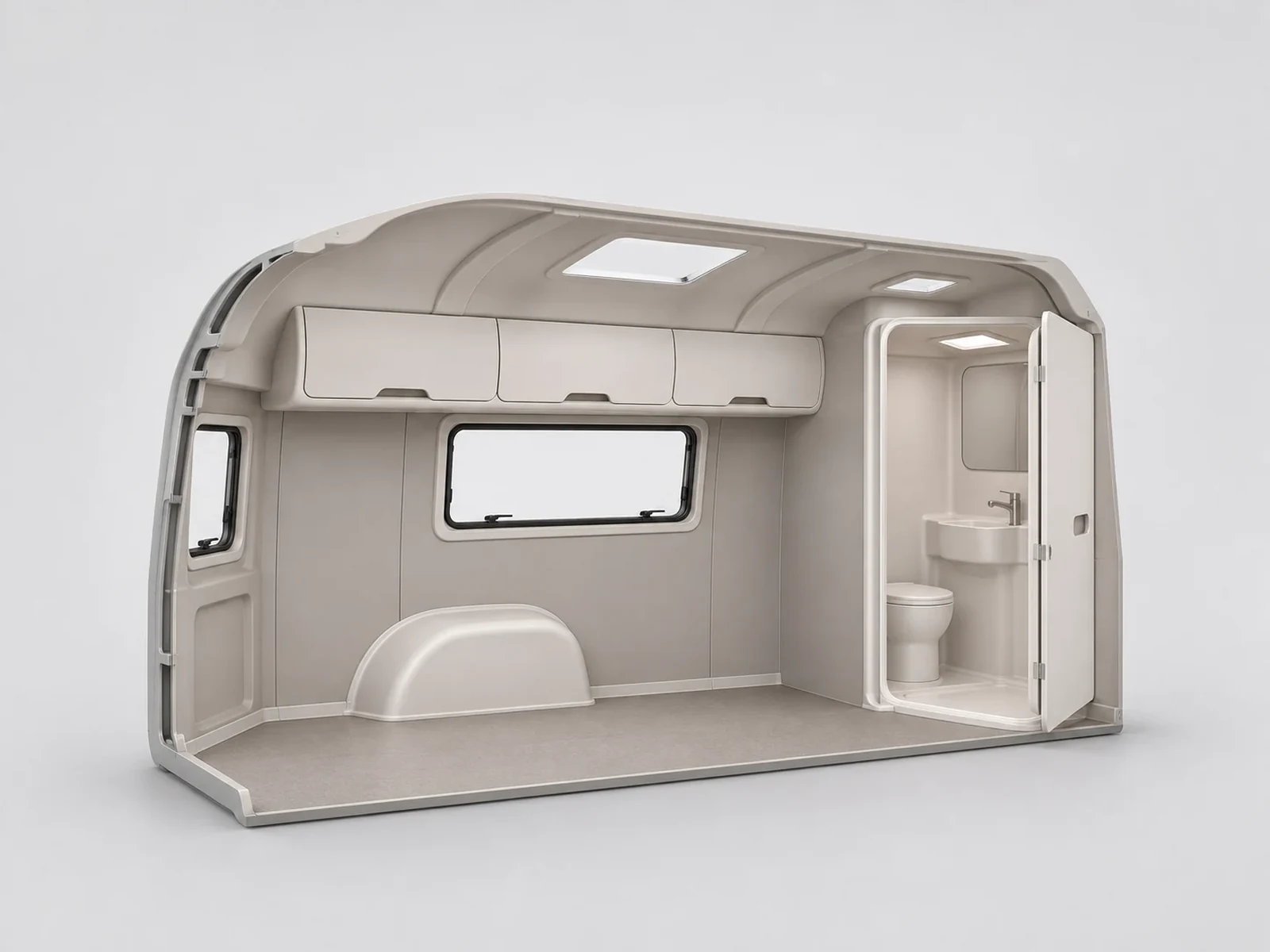
A practical rule: favor thermoforming when parts are large, models are many and annual demand per model runs from hundreds to thousands. For very small, high-volume parts with complex shapes, such as clips and small covers, compare injection molding.
Light weight: setting gauge and structure
Vehicle interiors are sensitive to weight, so gauge has to balance stiffness against mass. Heavy-gauge thermoforming uses 6–15 mm (0.24–0.59 in); thinner interior parts are confirmed per project.
When stiffness falls short, ribs, flanges or returns on large flat areas save more weight than thickening the whole part. Large ceilings and side panels can be formed in several pieces with the joints hidden under trim strips or seams; see splitting and joining oversized parts. The link between gauge and stiffness is covered in heavy-gauge sheet thickness.
A practical rule: parts that are stood on or knocked, such as floor plinths and wheel arches, get extra gauge or ribs where the load falls. Purely decorative ceilings and side panels can use the thinnest gauge that meets appearance and stiffness.
Flame performance: checked against the target market
Burning behavior of vehicle interior materials follows the regulations of the target market and the vehicle maker's requirements. The specification should name the regulation or maker standard to meet, the documents required and the thickness the rating is checked at.
Documentation for the sheet comes from the sheet maker. Forming thins the sheet, so check the thickness in the documentation against the thinnest wall of the formed part, as described in flame-retardant thermoforming materials. Certification of the complete vehicle rests with the vehicle maker or converter, while the thermoforming supplier provides material documents and wall-thickness records of the formed parts.
A practical rule: when vehicles are exported to several markets, choose material for the strictest one, which also keeps spares simple. When they are sold in one market, choose for that market.
Vibration and rattles: the most common interior complaint
Vehicles vibrate constantly on the road, and any looseness or rubbing between an interior part and the body or a neighboring part turns into a rattle. Rattles must be solved at the design and first-article stage, because fixing them after production starts is expensive.
Spread fixing points evenly rather than holding a large panel at a few points; use slotted holes with damping washers to absorb thermal movement and assembly tolerance; and leave gaps between neighboring parts or fit felt or foam tape where they touch. Fastening and inserts are covered in fastening thermoformed parts.
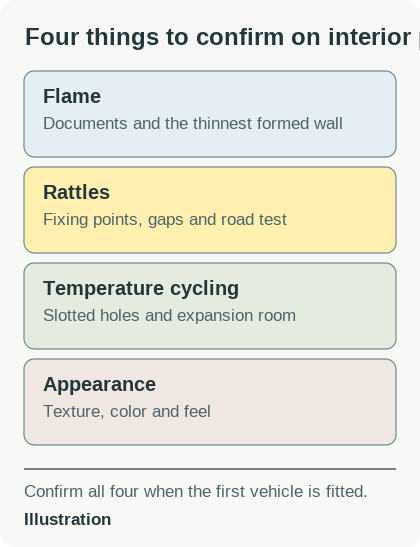
A practical rule: road-test the first vehicle fitted with parts on real roads and confirm it is quiet before production. Repeat the check after the first long trip or the first season of use, because fixings can settle and new rattles may appear once parts have been through heat and cold. For vehicles that often travel rough roads, place fixing points closer together and use locking clips.
Temperature cycling and sun
Cabins get very hot when vehicles stand in the sun and very cold when they are parked outside in winter. Interior parts must survive repeated swings between the two, as well as sunlight through the windows.
Check heat resistance and cold impact when choosing sheet; leave room at mounting holes for thermal movement, especially on long parts; and remember that dark parts absorb more heat and distort more readily. Parts near windows that see long sun exposure need suitably weather-resistant grades; see outdoor thermoformed enclosures. The character of ABS and other common sheets is covered in ABS heavy-gauge thermoforming.
A practical rule: for vehicles sold into hot or cold regions, verify temperature cycling over the local range. For use in mild climates, standard requirements are enough.
Appearance: texture, color and feel
Interior parts sit right in front of passengers and under their hands, so appearance and feel shape the impression of the whole vehicle. Texture hides scratches from daily use and also feels better to the touch.
Approve color against a physical standard and coordinate it with seats, flooring and wood trim, comparing under cabin lighting; make each model's interior parts from one sheet batch. Texture choices are covered in textured thermoformed parts.
A practical rule: parts that are touched and scrubbed often, such as locker doors and washroom modules, need hard-wearing, easy-to-clean surfaces. Decorative ceilings can take a finer texture. Check texture and color both under cabin lighting and in daylight, and approve them only when they work in both.
Washroom modules and shower trays: water, grip and drainage
Thermoformed washroom modules and shower trays for RVs are formed in one piece without seams, so they resist leaks and are easy to clean. They need extra attention on three points: water tightness, slip resistance and drainage.
| Requirement | Approach | How it is confirmed |
|---|---|---|
| Water tightness | One-piece forming with few seams; sealant on the seams that remain | Water test after fitting |
| Slip resistance | Anti-slip texture where people stand | Feel and cleanability checked on samples |
| Drainage | Fall built into the floor, drain openings CNC-cut | Pour water and check for standing water |
| Cleaning | Rounded transitions, no hard-to-clean corners | Wipe tests with the actual cleaners |
A practical rule: vehicles tilt and sway, so build enough fall into the floor for the angles at which vehicles usually stand. Mount washroom modules with damping at the fixing points so long service does not crack them.
Many models, small batches: one mold for several vehicles
RVs and special vehicles come in many models with small numbers of each, so letting interior parts with the same outer shape share one mold, with CNC programs handling the differences, is the most effective way to control tooling cost and lead time.
A heavy-gauge mold costs about RMB 10,000 and takes about 1–3 weeks, and free tooling can be negotiated per order when volumes and batches are stable. Models of different length can be formed at the longest length and trimmed; see one mold, many models. FUNYO accepts STEP, IGES, DWG, PDF or photos, responds within 4 hours and returns a feasibility review with a comparative quote within 2 working days.
A practical rule: when models differ a lot in shape, group them into families by shape with one mold per family. When a restyle only changes openings and mounting positions, a program change is enough.
Installation and after-sales: making field repairs easy
Interior parts often hide wiring, water pipes and equipment, so they must come off for repairs. Planning at the design stage which areas will be opened often saves a great deal of time in assembly and after-sales service.
Make areas that need regular service, such as those near electrics, pumps and valves, into removable service covers with quick-release fasteners or a few screws, and number large ceiling and side panels in fitting order so assembly and replacement follow the same sequence. Manage each model's interior parts by part number and supply spares under the same number, so dealers and service centers order the right part.
A practical rule: where the vehicles' sales regions have few service points, keep common wear parts with the vehicle or at regional warehouses. Where service points are many and ordering is easy, supply spares on demand.
Put the requirements on an interior part specification sheet
Collect the requirements above in one table, send it with the drawings or models and ask the supplier to answer line by line. The last column is for your vehicle's conditions.
| Item | Why it matters | How to specify | Your vehicle |
|---|---|---|---|
| Part list | Decides which parts are thermoformed | Ceilings, side panels, wheel arches, locker doors and so on | |
| Models and quantities | Decides whether molds can be shared | Vehicle models, parts per vehicle and annual demand | |
| Gauge and weight | Balance weight against stiffness | Starting gauge or weight target | |
| Flame requirement | Checked against the target market rules | Regulation or vehicle maker standard and documents | |
| Rattle requirement | The most common complaint in service | Fixing method and road-test requirement | |
| Service temperature | Cabins swing between hot and cold | Maximum and minimum service temperature | |
| Color and texture | Must match other interior materials | Color standard and texture reference | |
| Cleaning | Washrooms and floors are scrubbed often | Cleaners and cleaning method | |
| Installation and repair | Affects assembly time and after-sales | Fitting order and removable areas | |
| Timing and restyling | Vehicle models change quickly | First-lot date and restyling plan |
Download the vehicle interior part specification sheet. You can send the sheet at any stage of completion; the review reply lists the items still missing.
Which vehicle parts should be made another way?
Load-bearing structure and seat frames belong in metal. Small, high-volume parts with complex shapes, such as clips, button bezels and small covers, should be compared against injection molding, and areas that need soft padding use upholstery or fabric. Heavy-gauge thermoforming fits interior parts that are large, curved, shared across many models and built at a few hundred to a few thousand a year.
Many converters combine processes: a metal frame carries the load, thermoformed parts make the ceilings, side panels and locker doors, and upholstery and fabric cover the seats and soft areas.
Next, send the model list, models or photos of the interior parts, target markets and annual demand to FUNYO. We will propose material and gauge for each part and confirm rattles and appearance together when the first vehicle is fitted.