An ABS heavy-gauge thermoformed part is a housing, panel or cover formed from heated ABS sheet and then CNC-trimmed, and it is the most common way to make equipment housings. ABS is easy to work, looks good and costs a moderate amount, but grades differ widely: a general grade fades outdoors, a grade without flame performance will not pass on an electrical enclosure, and the wrong gauge leaves deep corners too thin. This guide explains how to choose the grade, set the gauge, approve surface and color, what to watch before and after forming, and when to switch to another material, and ends with a selection sheet you can download.
FUNYO heavy-gauge thermoforming forms ABS, PC, PVC, PETG and PP in single parts up to 2600 × 1600 × 600 mm (102.4 × 63.0 × 23.6 in) from sheet 6–15 mm (0.24–0.59 in) thick, with 8–10 mm (0.31–0.39 in) common for housings, and FUNYO runs its own ABS and PET/PS sheet production base. For a comparison of all the sheet materials, see heavy-gauge sheet materials.
Why ABS is the most common housing material
ABS strikes a balance between stiffness, toughness, workability and cost that suits most indoor equipment housings. It also takes inserts, adhesives and printed markings well, which keeps assembly and branding simple. These properties also make ABS the material whose price and lead time are easiest to predict on most projects.
| Property | What it means for a housing |
|---|---|
| Balanced stiffness and toughness | The housing holds its shape and survives light knocks |
| Easy forming | Stretches evenly when heated, suiting large and fairly deep shapes |
| Easy trimming and drilling | Clean CNC-cut edges; moving an opening only changes the program |
| Many surface options | Smooth or textured, with colors matched to a standard |
| Printing and labels | Markings, keys and warning labels are easy to apply |
| Moderate cost | Unit prices stay manageable for medium and large volumes |
A practical rule: for indoor equipment housings without special weathering or chemical requirements, ABS is usually the first choice. When parts must be clear, live outdoors long term or face strong chemicals, compare other materials.
Typical applications: where ABS housings are found
ABS heavy-gauge housings appear on equipment across many industries, and each kind of equipment leans on different grades and priorities.
| Equipment | Usual grade | Priorities |
|---|---|---|
| Test and analysis instruments | General or flame-retardant | Matched appearance, flame documents |
| Medical and diagnostic equipment | General or flame-retardant | Resistance to cleaner wipes, matched sets |
| Service and mobile robots | High-impact | Impacts, sensor openings |
| Kiosks and display equipment | General | Appearance, color, texture |
| Outdoor equipment, EV chargers | Capped weather-resistant sheet | Sun, color change, impact |
| Construction machinery cab interiors | General or flame-retardant | Feel, texture, rattles |
A practical rule: the same kind of equipment may need different grades depending on use and mounting position. Telling the supplier the equipment type, the mounting position and the service conditions together brings better advice than writing "ABS" alone. Treat the table as a starting point rather than a rule; the final grade follows the conditions you write on the selection sheet.
Choosing a grade: general, high-impact, flame-retardant, weather-resistant
ABS is a family of materials rather than one. Choosing the right grade for the service conditions does more than simply adding gauge.
| Grade type | Suits | Watch for |
|---|---|---|
| General grade | Indoor cosmetic parts and panels | Lowest cost; unsuitable outdoors or where flame rules apply |
| High-impact grade | Parts likely to be knocked, cold environments | Confirm cold impact at the service temperature |
| Flame-retardant grade | Electrical equipment housings with flame requirements | Check documents against the thinnest formed wall |
| Capped weather-resistant sheet | Housings in direct sun | The weather-resistant layer must face the show surface |
| Other modified grades or alloys | Near heat sources or tougher demands | Confirmed per project |
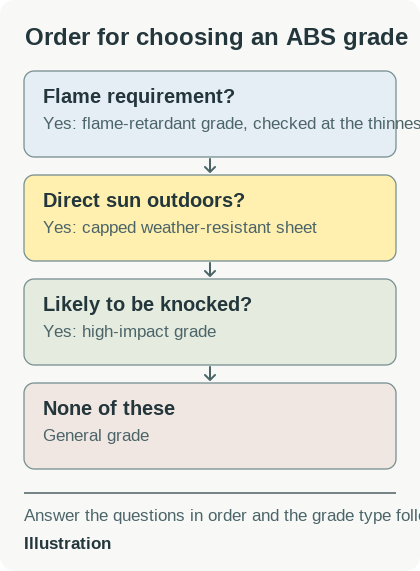
A practical rule: when one housing carries both flame and outdoor requirements, both must be met, so check the documents and the weathered samples together. When only indoor appearance matters, a general grade is enough. If several grades seem to fit, ask for samples of each in your color and texture, because grades can look slightly different even in the same color. Checking flame documents is covered in flame-retardant thermoforming materials.
Gauge: set by size, stiffness and the thinnest wall
Gauge decides stiffness, weight and price. Heavy-gauge thermoforming uses 6–15 mm (0.24–0.59 in), and equipment housings commonly use 8–10 mm (0.31–0.39 in). State the allowed gauge tolerance in the specification as well, so incoming sheet can be spot-checked against it.
Forming stretches the sheet, so estimate the thinnest point at a deep corner at about one third of the starting gauge as a design starting point, and confirm it by measuring the first article. Example: 8 mm (0.31 in) sheet thins to about 2.7 mm (0.11 in) at a deep corner. When stiffness falls short, ribs or flanges on large flat areas save material and weight compared with thickening the whole part. The link between gauge and stiffness is covered in heavy-gauge sheet thickness.
A practical rule: for large housings with many flat areas, add ribs and flanges first. For deep housings with many deep corners, choose a thicker starting sheet or open the radii to keep the thinnest wall where it needs to be.
Surface: smooth, textured and color
ABS sheet comes smooth or in many textures. A smooth finish looks refined but shows scratches and forming marks more readily; a texture hides light scratches from daily use and keeps its looks longer.
Approve color against a physical standard and make each housing set from one sheet batch; write the texture reference and gloss level into the specification and compare every new batch against the same reference. Texture lightens where the sheet stretches most, so check the texture on samples of deep shapes. Texture choices are covered in textured thermoformed parts.
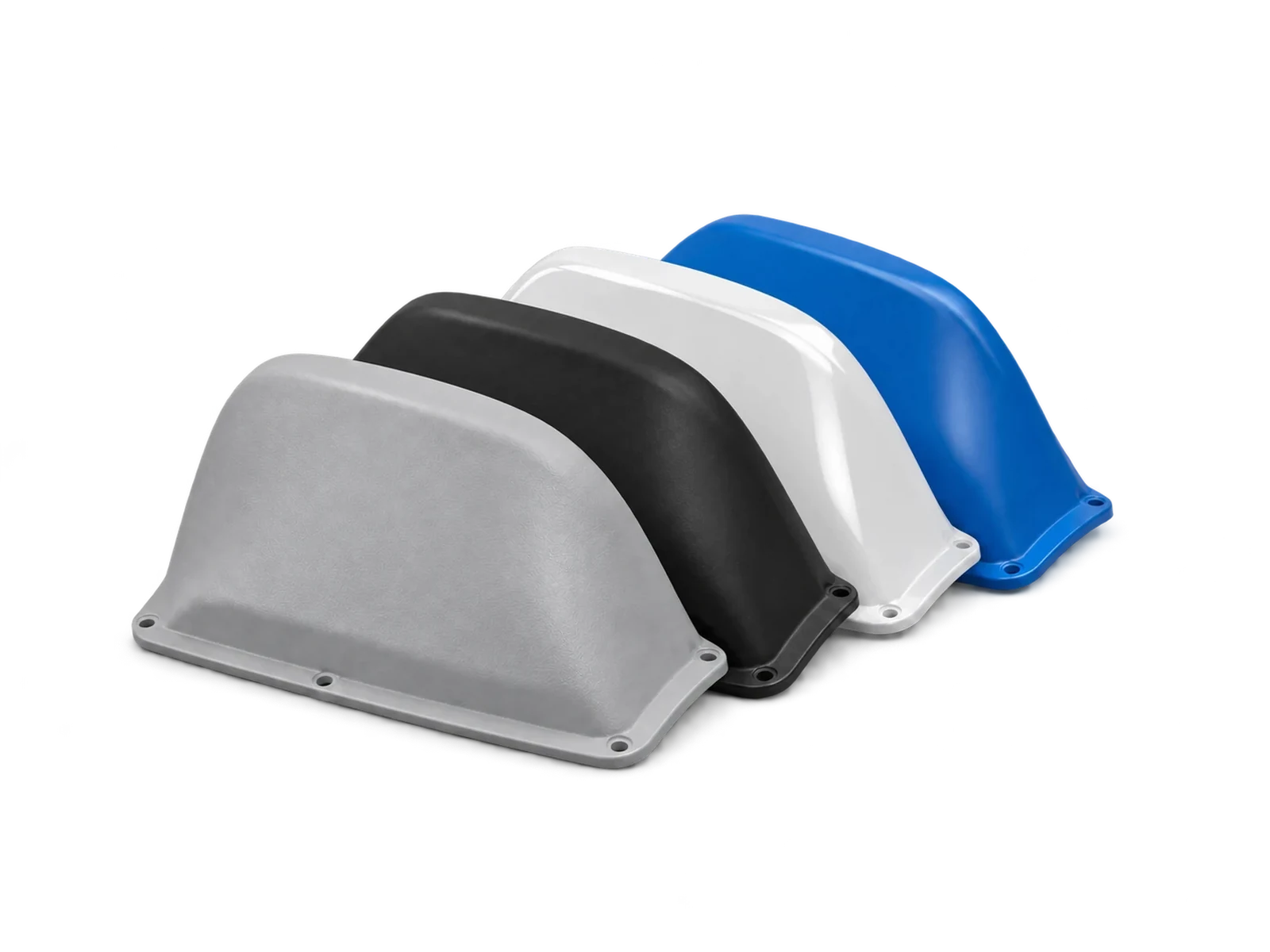
A practical rule: choose a texture for housings that are touched often or scuffed in handling. Smooth finishes suit display panels that are rarely touched, with packing and handling protection written into the specification.
Before and after forming: moisture, cooling and warpage
ABS sheet absorbs moisture from the air, and damp sheet tends to blister when heated for forming, which spoils both appearance and strength. Store sheet sealed and dry, and dry damp sheet as the sheet maker recommends before forming. Ask the supplier how sheet is kept between delivery and forming; covered racks and sealed wrapping are a good sign.
Cooling after forming also affects size and flatness: uneven cooling builds internal stress that leads to warpage. For large flat or asymmetric housings, control cooling through the mold and the process, and check flatness again after trimming. Cooling large housings on a support fixture in their assembled orientation, rather than stacking them loosely, also reduces warpage. Shrinkage and warpage control is covered in shrinkage and warpage in thermoformed parts.
A practical rule: when samples show bubbles, check sheet storage and drying first. When they warp, check cooling and support, and change the design if needed, for example by adding ribs to large flat areas.
Trimming, openings and assembly
ABS trims and drills easily: after forming, CNC machining leaves clean edges, and moving an opening only changes the program. FUNYO uses 3-axis and 5-axis CNC machines to trim and deburr formed parts and to cut openings and slots.
ABS housings are usually assembled with screws, molded-in nuts, clips or adhesive. Use slotted or oversized mounting holes to allow for thermal movement and assembly tolerance, and state the fastening method, because overtightening cracks hole edges. Fastening and inserts are covered in fastening thermoformed parts.
A practical rule: use metal inserts where parts are removed often, so threads do not wear. Where parts are fitted once and left, self-tapping screws or adhesive are fine. For parts that will be printed or labeled after forming, tell the supplier early, because surface cleanliness and handling requirements change. Before bonding, confirm on samples that the adhesive is compatible with ABS, so the joint stays free of whitening and cracks.
Limits of ABS: sun, chemicals and heat
ABS is widely used, but some situations call for other materials. Three limits come up most often: long sun exposure, some chemicals and higher temperatures.
Standard ABS fades and turns brittle in direct sun, so housings in direct sun need capped weather-resistant sheet; see outdoor thermoformed enclosures. Some solvents and cleaners whiten or crack ABS surfaces, so housings wiped often, such as medical equipment, need wipe tests with the actual cleaners; see thermoformed medical device housings. Near heat-producing components, check the temperature at the mounting position against the material's heat resistance. Heat can also come from the sun: dark housings in direct sunlight run hotter than the surrounding air, which matters close to the material's limit.
A practical rule: if the service conditions include any of long outdoor exposure, strong chemicals or elevated temperature, verify that point on samples or compare other materials. Keep the results with the samples, so later sheet batches or a new sheet supplier can be rechecked under the same conditions.
Put the conditions on a selection sheet
Collect the conditions above on the selection sheet, send it with the drawings and ask the supplier to answer line by line. The last column is for your part's conditions.
| Item | Why it matters | How to specify | Your part |
|---|---|---|---|
| Grade type | Sets performance and cost | General, high-impact, flame-retardant or weather-resistant | |
| Flame requirement | Documents are checked at the thinnest wall | Target rating and required documents | |
| Outdoor or indoor | Standard ABS degrades in long sun exposure | Installation position and sun exposure | |
| Impact and cold | Cracking is more likely at low temperature | Minimum service temperature and impact requirement | |
| Starting gauge | Affects stiffness, weight and price | Starting gauge or allowed range | |
| Thinnest wall | Deep corners thin out | Minimum formed wall and measuring points | |
| Surface and texture | Texture hides scratches | Smooth or texture reference | |
| Color standard | Batches must match | Color reference and viewing conditions | |
| Cleaners and chemicals | Some chemicals attack ABS | Cleaners and media the part will meet | |
| Service temperature | Check heat resistance near heat sources | Maximum temperature at the mounting position | |
| Annual and first-lot quantity | Sets how tooling and unit price compare | Annual demand and first lot |
Download the abs thermoforming selection sheet. FUNYO accepts STEP, IGES, DWG, PDF or photos and responds within 4 hours, returning a feasibility review with a comparative quote within 2 working days. A heavy-gauge mold costs about RMB 10,000, suiting housings built at a few hundred to a few thousand units a year.
When should you switch to PC, PETG or PP?
Clear viewing windows and faces need PC or PETG; see PC vs PETG for clear parts. Housings with higher impact and heat demands should be compared in PC, parts in regular contact with chemicals in PP, and long-term outdoor parts where capped sheet is unsuitable in other weather-resistant materials.
Many machines mix materials: the housing in ABS, windows in PC or PETG, and trays that meet chemicals in PP, each part in the material that suits it best. When the choice is unclear, form a few samples on the same mold in ABS and in the candidate material and compare them side by side; that tells you more than any data sheet.
Next, send the housing drawings and service conditions to FUNYO. We will recommend the ABS grade and gauge for your conditions and confirm surface, color and the thinnest wall on samples.