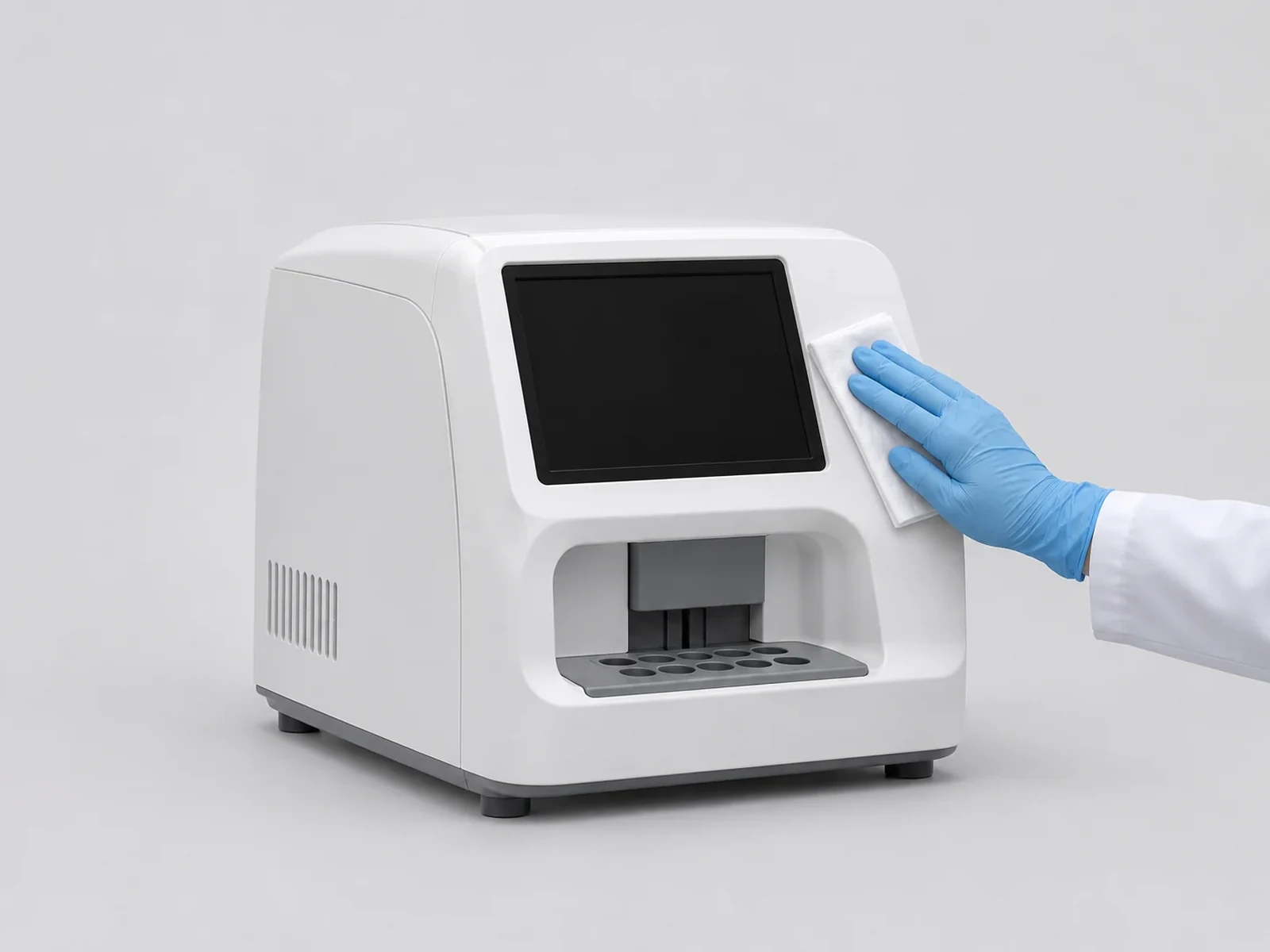
A thermoformed medical device housing is a large cosmetic enclosure for medical or in-vitro diagnostic equipment: the main housing of a chemistry analyzer, the bezel of an imaging system or the side panels of a test instrument. Clinical staff wipe these housings with disinfectant every day, and the usual problems are surface whitening, fine cracks, color change and gloss change. Most of them come from a mismatch between the disinfectant and the sheet, or from areas of high stress left by forming that crack once disinfectant reaches them. This guide shows how to write cleaning conditions into the specification, how to run a wipe test, how to keep a housing set matched in appearance and how to control changes after design freeze, and ends with a specification sheet you can download.
FUNYO heavy-gauge thermoforming forms single parts up to 2600 × 1600 × 600 mm (102.4 × 63.0 × 23.6 in) from sheet 6–15 mm (0.24–0.59 in) thick, with 8–10 mm (0.31–0.39 in) common for housings, in ABS, PC, PVC, PETG and PP. It fits medium and large housings built at a few hundred to a few thousand units a year. Housing material is one part of the whole device's approval; safety and biocompatibility requirements for the device are verified at device level.
Start with the disinfectants, the wiping method and the frequency
Whether a housing survives years of wiping depends on four things: the disinfectant, its concentration, the wiping method and how often it happens. Put all four in the specification first.
The CDC's 2008 Guideline for Disinfection and Sterilization in Healthcare Facilities lists alcohols, hydrogen peroxide, quaternary ammonium compounds and chlorine among the chemical disinfectants for patient-care equipment. 1 Each acts differently on plastics: a sheet that is unaffected by alcohol wipes may whiten under another disinfectant.
| Cleaning condition | What to write in the specification |
|---|---|
| Disinfectant | Product name and active ingredient; list every product that may be used |
| Concentration | In-use concentration, per the product label |
| Method | Pre-wetted wipe, spray and wipe, or another method |
| Contact time | How long the disinfectant stays on the surface |
| Frequency | Wipes per day and years of service |
A practical rule: when the device is sold to many hospitals, each will use its own disinfectants, so list every product that may be used or verify against the harshest combination. A single line saying "resistant to disinfectant wiping" leaves the supplier unable to pick a sheet or design a test.
Wipe tests: compare sheets on formed samples
Run the wipe test on formed samples, which is closer to service than the sheet maker's data. Forming stretches the sheet and leaves stress at deep corners and around mounting holes, and those are the places where fine cracks appear first once disinfectant reaches them.
The method: form a few samples of each candidate sheet, wipe them repeatedly with the disinfectant used in service for an agreed number of cycles, covering flat areas, deep corners and the areas around holes, then inspect color, gloss, whitening and fine cracks. Derive the number of wipes from the expected use. Example: 3 wipes a day for 5 years is about 5,000 wipes; the device maker sets the real number from its own conditions.
| Check | How it is judged | How to specify |
|---|---|---|
| Color | Color difference before and after wiping | Measuring method and allowed range |
| Gloss | Gloss change | Measuring method and allowed change |
| Whitening | Visual inspection of the surface | Viewing conditions and judgment method |
| Fine cracks | Close inspection of corners and hole edges | Magnification and judgment method |
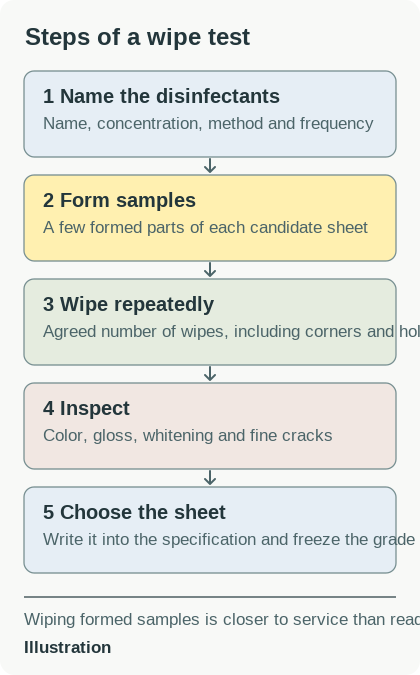
Once a sheet passes, write its grade, supplier and color reference into the specification and freeze them. Later batches can then be spot-checked with the same method. The wipe test can share samples with the color approval: record the sample numbers, the disinfectant and the number of wipes together, so a later re-test runs under the same conditions.
Choose material after testing with your disinfectants
Resins differ in how they tolerate disinfectants, and so do grades of the same resin, so choose material after testing with the actual cleaners rather than on general experience.
FUNYO forms ABS, PC, PVC, PETG and PP. ABS is the most common housing material: stiff, easy to machine and available in many colors. Clear viewing windows usually use PC or PETG; clear parts can be sensitive to some disinfectants and need their own wipe test, and PC vs PETG for clear parts covers the choice. Areas with high chemical exposure can be compared in PP and similar materials, though bonding and printing on them need separate confirmation.
A practical rule: when the housing uses one sheet and the window another, test both against the same cleaning conditions. If one performs poorly, change the grade or move to a more chemical-resistant material and test again. Whitening shows more clearly on dark housings, so include both dark and light samples when the product range uses several colors. The material list is covered in heavy-gauge sheet materials.
Matched appearance: bezels, side panels and controls in one color and texture
A medical housing is often several parts, such as a bezel, side panels, a top cover and a control area, and users notice any difference in color or texture at once, so approve them as a set.
Make one housing set from a single sheet batch, compare color against a physical standard at an agreed light and viewing distance, and include texture and gloss in the standard. Assemble the parts and review seams and color transitions together, then release production after the set is approved. See textured thermoformed parts for texture choices and cosmetic defects and acceptance for judging the surface.
A practical rule: color is hardest to control when the bezel and side panels come from different suppliers, so source the set from one supplier and one sheet batch where possible. If they must be split, give both suppliers the same physical standard and agree how deliveries are compared.
Easy-to-clean design: fewer seams and recesses
Housings wiped every day collect dust and disinfectant residue in seams, grooves and sharp corners, which are also the hardest places to clean. Designing surfaces that are easy to wipe works better than relying on the material alone.
Form large curves and generous radii in one piece to reduce seams; keep the seams you need narrow and even, and confirm them on an assembled sample set. Avoid deep, narrow grooves and sharp inside corners. Put fasteners on the back or hide them, and place vents and filters where they are wiped less often and can be removed for cleaning.
A practical rule: make the control area and other surfaces that staff touch often into continuous large faces. For service covers, confirm the opening direction and removal sequence on samples so that maintenance does not scratch the show surfaces. Labels and printed markings deserve the same attention: have them tested with the same disinfectants, because some inks soften or lift long before the sheet shows any change. Draft, radii and ribs are covered in the heavy-gauge design guide.
After design freeze, give notice and re-verify before any change
Medical devices usually freeze their design before testing and registration. After the housing is frozen, a change in sheet grade, supplier, color, forming or trimming process can affect wipe resistance and appearance, so the device maker should be notified first and production should resume only after verification.
| Change | Possible effect | How it is handled |
|---|---|---|
| Sheet grade or supplier | Wipe resistance, color | Repeat the wipe test and appearance check |
| Color or texture | Matched appearance | Re-approve the color standard |
| Forming or trimming process | Dimensions, stress, appearance | Recheck dimensions and appearance |
| Opening positions only | Assembly | Produce after first-article approval |
List the frozen items and the notice process in the specification so that supplier and device maker work from the same list. The device maker's own design change control follows its quality system. Keep the approved sample set and the wipe-test records with the drawing revision; they are the reference for any later change.
Timing for prototypes and pilot lots
A heavy-gauge thermoforming mold takes about 1–3 weeks and costs about RMB 10,000, which suits the prototype and pilot stages: prototype housings can be ready well before an injection mold, and a shape change during testing costs little time and money.
FUNYO accepts STEP, IGES, DWG, PDF or photos, responds within 4 hours and returns a feasibility review with a comparative quote within 2 working days. Write the prototype quantities and the test and registration milestones into the specification sheet so the housing supplier can plan samples and pilot lots against them. For registration testing, make the housing samples from the frozen sheet grade; samples from a different grade would have to be tested again. Sampling and first-article approval are covered in sampling and first-article approval.
A practical rule: while annual demand is a few hundred units and the shape may still change, use heavy-gauge thermoforming. Once demand is high and the shape has been frozen for a long time, compare injection molding with the thermoforming vs injection molding break-even calculator.
Put the requirements on a medical housing specification sheet
Collect the requirements above in one table, send it with the drawings and ask the supplier to answer line by line. The last column is for your equipment's conditions.
| Item | Why it matters | How to specify | Your equipment |
|---|---|---|---|
| Disinfectants and active ingredients | Each disinfectant acts differently on plastics | List every disinfectant that may be used | |
| Concentration and method | Concentration and contact time change the result | Concentration, wipe or spray, contact time | |
| Wiping frequency | Sets the number of wipes in the test | Wipes per day and years of service | |
| Wipe test method | Formed samples are closer to reality than sheet data | Number of wipes, areas and checks | |
| Pass criteria | Whitening and fine cracks are the most common failures | Criteria for color, gloss, whitening and cracks | |
| Sheet grade and supplier | Changes after freeze need re-verification | Grade, supplier and color reference | |
| Color and texture standard | Bezels and panels must match as a set | Standard reference and viewing conditions | |
| Seams and recesses | They affect how easily surfaces are cleaned | Allowed seams and gaps | |
| Change notice | Control after design freeze | Notice before change and re-verification process | |
| Annual and first-lot quantity | Sets how tooling and unit price compare | Annual demand and first lot | |
| Prototype and registration timing | Housings must keep up with test milestones | Required dates for prototypes and pilot lots |
Download the medical housing specification sheet. When replies come back, check that the disinfectants, the wipe test and the pass criteria are all stated before you compare prices.
Which medical device parts should be made another way?
Parts in direct contact with patients, sterile parts and parts that must survive steam sterilization belong to other processes and approvals. Small parts with fine detail on both sides should be compared against injection molding, and load-bearing frames belong in metal. Heavy-gauge thermoforming fits large, curved cosmetic housings built at a few hundred units a year and wiped often.
Many devices combine processes: a metal frame carries the load while thermoformed housings provide appearance, cleanability and protection. For another example of housing development, see service robot housings from prototype to production.
Next, send the housing models, the list of disinfectants and the wiping method to FUNYO. We will propose candidate sheets for your cleaning conditions and run wipe comparisons on formed samples.