Medical and diagnostic equipment housings are usually made in one of three ways: heavy-gauge thermoforming, injection molding or sheet metal. Clinical chemistry analyzers, in-vitro diagnostic instruments, therapy equipment, medical carts and test instruments are often built in volumes of only a few hundred to a few thousand units a year, and their housings are large. Choosing a process means weighing tooling investment against appearance, cleaning and the cost of design changes.
This guide compares the three processes by annual volume, size, appearance and cleaning, then explains common combinations, how standards and quality systems divide the work, and design starting points for heavy-gauge housings. FUNYO makes heavy-gauge thermoformed housings and does CNC machining; the FUNYO capability figures below all come from its current lines.
Start with three things: volume, size, appearance and cleaning
Before choosing a process, write down three things.
The first is annual volume and the first batch. Tooling takes a very different share of unit cost at a few hundred units a year than at tens of thousands, and when the first batch is a few dozen prototypes, tooling lead time matters too.
The second is size and shape. For large parts such as main top covers, side panels and front bezels, more size and more curvature mean more welding for sheet metal and bigger tools for injection molding, and the cost rises either way. FUNYO's heavy-gauge parts go up to 2600 × 1600 × 600 mm, which covers the housings of most benchtop and floor-standing units.
The third is appearance and cleaning. Medical housings are touched and wiped with disinfectant every day, so fewer seams and dead corners make them easier to clean, and bezels and side panels must match in color and texture as a set. For how to specify cleaning agents and wipe tests, see medical device housings.
Also state where and how the unit is used: on a lab bench, standing on the floor, or pushed along hospital corridors. Mobile units get knocked, so their corners and edges need impact resistance, and the sheet and gauge are assessed against the impact requirement.
How the three processes compare
The three processes differ mainly in tooling investment, suitable volume and the shapes they can make.
| Item | Heavy-gauge thermoforming | Injection molding | Sheet metal |
|---|---|---|---|
| Tooling | Single-sided mold; heavy-gauge tooling less than 1/10 of comparable injection tooling | Steel tool, highest investment | Mostly standard tooling; fixtures for large parts |
| Tooling time | About 1–3 weeks | About 6–10 weeks | Short, by operation |
| Suitable volume | Hundreds to a few thousand pieces a year | Tens of thousands a year | One-offs to medium batches |
| Shape | Large curves and radii in one piece | Finest detail, both sides | Flat panels, bends, boxes |
| Show face | One main show face | Both sides can be fine | Painted finish; lines at bends |
| Seams | Large one-piece faces, few seams | Large parts are split | Curves need welded joints |
| Design changes | Mold changes are quick and cheap | Slow and costly | Drawing changes are quick |
The tooling comparison in the table covers the tooling alone. Unit prices are quoted from the drawing, material and volume and cannot be scaled from the heavy-gauge 1/10 tooling figure.
Material and weight differ as well. Thermoformed and molded housings use plastics such as ABS and PC, with the color in the material, so knocks do not expose a different base color. Sheet-metal housings are strong and conductive, but they need painting, chips expose bare metal, and they weigh noticeably more. For carts, mobile units and housings that are carried by hand, weight is often one reason to choose plastic.
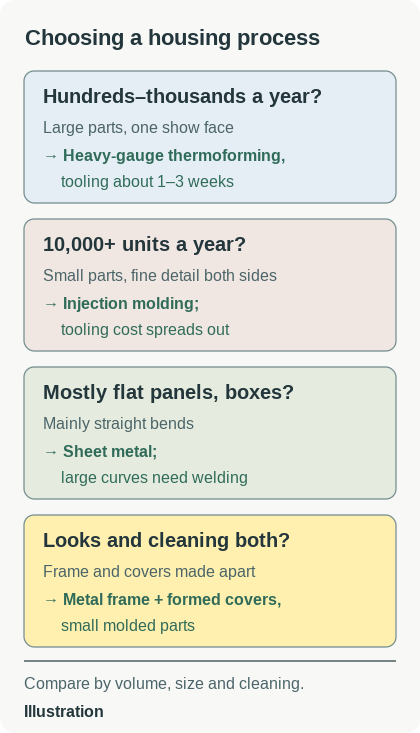
By annual volume: hundreds, thousands and tens of thousands
Splitting annual volume into three bands makes the choice much clearer.
At 100–500 units a year, injection tooling is hard to pay back, while heavy-gauge thermoforming has low tooling cost and tools in about 1–3 weeks, so it is a common choice. Prototypes can also be made from the thermoforming mold, and changing that mold is faster than changing a steel tool.
At 500–3,000 units a year, heavy-gauge thermoforming still fits and injection molding starts to compete, depending on shape and detail. Housing projects of about 3,000 pieces a year with an annual supply agreement can apply for a no-tooling-cost assessment; this is a project assessment, not an automatic entitlement.
Above 10,000 units a year, injection molding usually has the lower unit cost, and small precision housings suit it better. Heavy-gauge thermoforming can still be used, but its unit cost is generally higher; very large parts that would need an oversized injection tool can still be compared from the drawing.
Many models with small volumes each is common in medical equipment. When several models in a series share most of their shape and differ only in openings and panels, one thermoforming mold can form them all, with model-specific openings CNC machined afterwards; see multi-model covers.
A useful exercise is to price the same housing both ways at the expected volume over the product's life, not just the first year. Include tooling, unit price, the likely number of design changes and the cost of each change; for medical products, changes tend to cluster in the first years after launch.
These bands are a general comparison; each project is quoted from the drawing, material and volume. For the cost comparison between heavy-gauge thermoforming and injection molding, see heavy-gauge thermoforming vs injection molding.
A common combination: sheet-metal frame with thermoformed covers
Large medical equipment rarely uses just one process. A common approach uses a sheet-metal frame for strength, grounding and shielding, with thermoformed covers outside for appearance and cleaning, and injection molding for small detailed parts such as front bezels, keypad frames and small covers.
The key to a combined design is a shared mounting datum. The mounting holes, clips and screw positions on the thermoformed covers must use the same datums as the sheet-metal frame. After forming, the covers are CNC trimmed and drilled to the drawing; FUNYO's 3-axis and 5-axis CNC machines are used for mold making, trimming and deburring formed parts, and machining holes and slots.
When thermoformed covers sit next to molded parts, color and texture are confirmed as a set. The two processes use different materials and forming methods, so the same color code can still differ; compare a set of samples under the same light and then fix the appearance standard.
Plan the service path at the same time. Split access covers, filter panels and module openings in disassembly order so that only the needed panel comes off for service, side panels clear their neighbors when removed, and seam gaps are confirmed on a set of samples. For combined metal and thermoformed designs, see thermoforming vs sheet metal enclosures.
Standards and quality systems: the housing supports machine-level testing
IEC 60601-1:2005+A1:2012+A2:2020 sets out basic safety and essential performance requirements that apply generally to medical electrical equipment. 1 These requirements are designed for and verified by the equipment manufacturer at machine level; the housing's material, thickness, openings and structure are set to support that verification, for example the flame rating, mechanical strength and ventilation openings.
So the RFQ should state what the machine needs from the housing: whether a flame rating is required, what impact or pressure the housing must withstand, and which openings have size limits. Flame-retardant sheet is confirmed by grade and test data and verified on samples per project; general-purpose sheet should not be assumed to meet it.
Plan electromagnetic compatibility early too. A plastic housing does not shield on its own. Circuits and modules that need shielding usually rely on the sheet-metal frame, metal shields or conductive coatings, and the openings and seams in the housing are designed together with those parts.
ISO 13485:2016 is the internationally recognized quality management system standard for medical devices. 2 Each equipment manufacturer sets its own system and document requirements for housing suppliers under its quality system, for example material certificates, first-article reports and change notification. State the quality system and documents you need in the RFQ, and they are agreed per project.
Design starting points for heavy-gauge housings
The structural design of a heavy-gauge thermoformed housing can start from the following starting points, each confirmed on the first article.
Draft: for heavy-gauge housings, use male molds ≥3°, ≥5° where side walls exceed 200 mm, and female molds ≥1° as the draft starting point, confirmed on the first article. Male molds suit a show face that uses the sheet's own texture and an inside that must fit a frame; female molds suit an outer surface that needs crisp edges and detail; see male vs female molds.
Radii: use corner and transition radii of at least the starting gauge, preferably 2× the starting gauge (about 16 mm for 8 mm sheet), as the design starting point, confirmed on the first article. Large radii form well and wipe clean, with fewer seams and dead corners.
Gauge: housings typically use 8–10 mm sheet, and deep corners thin out. Specify the minimum finished wall at key spots, and the first article is measured there. For more on structural design, see heavy-gauge thermoforming design; for tolerances, see tolerances for large heavy-gauge parts.
From prototype to production: how the time is spent
Medical housings often change several times between prototype and production. Heavy-gauge thermoforming tooling takes about 1–3 weeks, against about 6–10 weeks for comparable injection tooling. Making prototype housings from the thermoforming mold means that moving an opening or changing a bezel needs only a local mold change or a new CNC program, which costs less time and money than changing a steel tool.
At first-article inspection, check shape, openings and key dimensions against the drawing, run wipe comparisons on formed samples, and keep the approved appearance samples as the standard for later batches. After design freeze, changes to sheet, color or process are notified first and then verified.
Which medical housings are not a fit for heavy-gauge thermoforming?
Small handheld devices at tens of thousands of units a year, housings that need fine detail on both sides, and parts with many small clips, thin ribs and bosses suit injection molding better. Structures that carry loads directly, provide grounding and shielding, or face high temperatures are better in sheet metal or other metal parts.
Patient-contact parts, sterile parts and implantable products are outside the scope of this guide. Their materials and processes are assessed under the medical device regulations that apply to the equipment, not handled as ordinary housings.
Next step: send volume, size and cleaning requirements
Send drawings or photos: STEP, IGES, DWG or PDF; without a drawing, photos and dimensions are enough to start. Also state the annual volume and first batch, the outside dimensions, the cleaning agents and wiping method, and the machine's flame and strength requirements for the housing. FUNYO responds within 4 hours of receiving the information and provides a suitability assessment and comparison quote within 2 working days.
| Information | What to include |
|---|---|
| Volume | Annual volume, first batch, prototype quantity |
| Size | 3D model or outside dimensions, with show faces marked |
| Appearance | Color, texture, gloss; whether it must match molded parts |
| Cleaning | Cleaning agent, concentration, wiping method and frequency |
| Machine requirements | Flame rating, impact or strength requirement, ventilation |
| Assembly | Frame datums, mounting holes, access cover removal |
If you already have an injection-molded or sheet-metal design, send it too. We quote against the same drawings so you can see which parts are better made by thermoforming.