Outsourcing CNC machining of equipment parts and fixtures means an equipment maker hands structural parts, mounting brackets, inspection fixtures, mold parts and the trimming and drilling of thermoformed parts to an outside shop. Custom and automation equipment uses many different parts, each in small numbers, with drawings that change often, so a shop that machines to drawing quickly and inspects reliably has a large effect on the machine's delivery date. This guide covers how part types map to processes, how to write drawings, tolerances and material, how to check machine capability and inspection, and why ordering together with thermoformed parts helps, and ends with an order checklist you can download.
FUNYO was founded in 2004 and has about 80 employees; heavy-gauge thermoforming, thin-gauge thermoforming and CNC machining are all done in-house. Its 3-axis and 5-axis CNC machines are used for mold making, trimming and deburring formed parts, cutting openings and slots, and machining parts to drawing. CNC capability and the equipment list are on the CNC machining and trimming page.
Match each part type to a process first
Different part types call for different processes and machines. Sorting parts by type before you request quotes makes both the inquiry and the quote more precise.
| Part type | Examples | Usual process |
|---|---|---|
| Milled and box-shaped parts | Mounting plates, brackets, bases | Machining centers, with a 4th axis where needed |
| Turned parts | Shafts, bushings, flanges | Turn-mill center, CNC lathes |
| Precise profiles and narrow slots | Punches, locating blocks, odd shapes | Wire EDM |
| Parts needing high flatness | Locating plates, spacers | Surface grinder |
| Small or dense holes | Filter plates, vent holes | Laser drilling |
| Finishing of thermoformed parts | Housing trimming, openings and slots | 5-axis CNC |
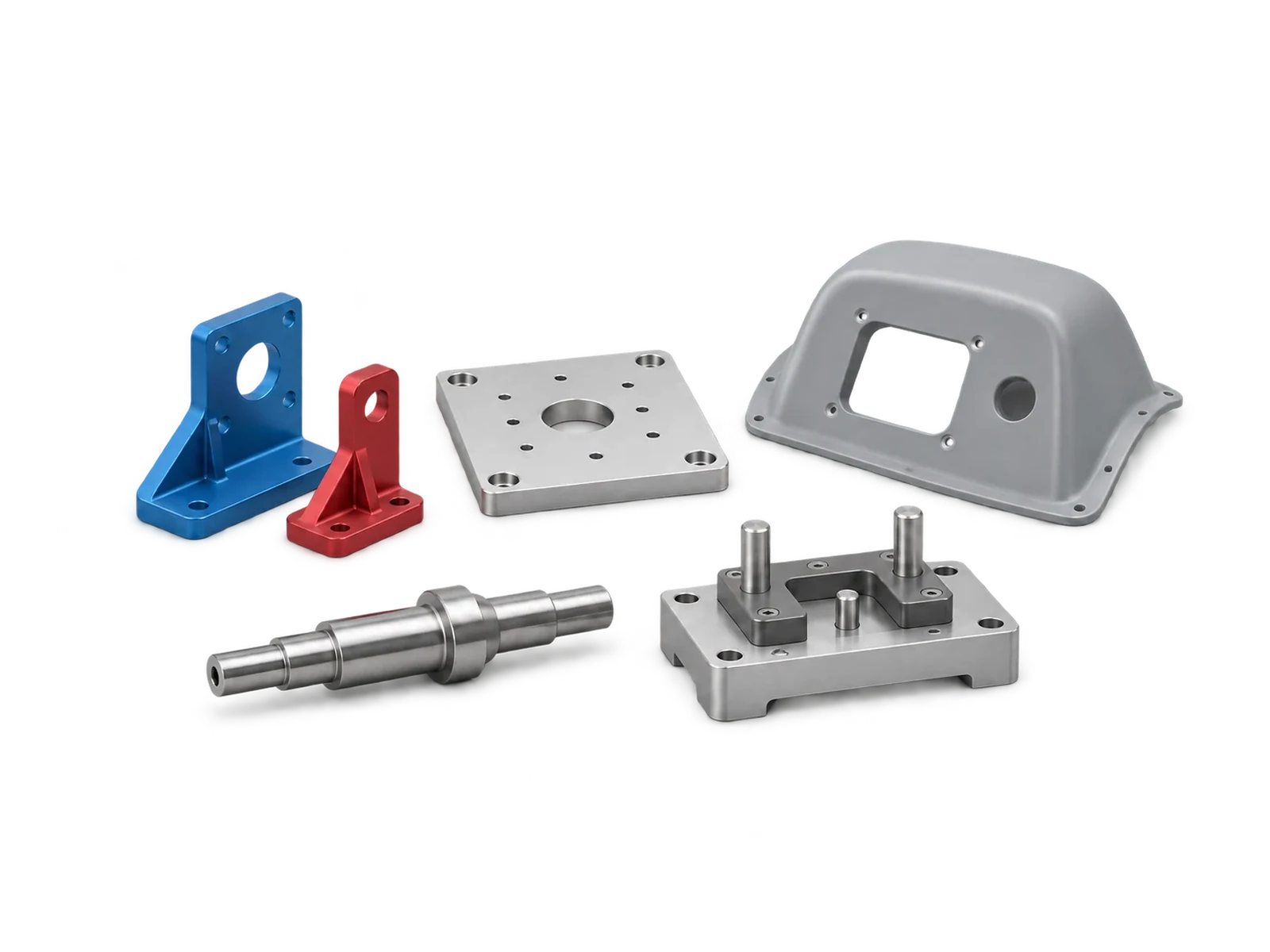
FUNYO's equipment includes machining centers (S500X1, T540S, GRM-850S, T-V1165, MVL-966 and T-7, with a 4th-axis rotary table on the T540S), a CK3100SY turn-mill center, CNC lathes (TCK6050, CKP6146DW, CKP6142DW), medium-speed wire EDM (DK7745CF, DK7763F), plus surface grinders, a milling machine, a drill press, a CNC saw, a tapping machine and a laser drilling machine.
A practical rule: when one part needs both milling and turning, consider turn-mill first to cut the number of setups. Parts that only need simple milling are more economical on a 3-axis machining center. Where a part could go either way, ask the shop to quote both routes; the difference in setups often shows up clearly in the price.
Commonly outsourced parts: fixtures, brackets and mold parts
Custom and automation equipment makers outsource these kinds of parts most often, and each needs attention in a different place.
| Part | Use | Watch for |
|---|---|---|
| Inspection and locating fixtures | Assembly location, dimensional checks | Accuracy of locating faces and pins; the fixture itself needs an inspection report |
| Mounting brackets and connecting plates | Holding sensors, motors and housings | Hole positions and datums, checked together with the housing |
| Machine bases and frame parts | Carrying and connecting | Large sizes; confirm machine travel and fixturing |
| Mold parts and inserts | Thermoforming molds and jigs | Clearances and surface requirements |
| Trimming and openings in thermoformed parts | Finishing housings and panels | Trimming datums and fixtures; programs managed by revision |
| Service spares | Wear parts on equipment | Keep drawing revisions so parts can be repeated later |
A practical rule: when fixtures and brackets will be revised along with the housing, put them on the same order checklist as the housing. When service spares must be supplied for years, agree how drawings and programs are archived. Grouping parts this way also shows quickly which ones a single supplier can cover and which need a specialist.
Writing drawings, tolerances and material
Most rework in outsourced machining traces back to incomplete drawings: tolerances left vague, datums unmarked, material undecided.
Mark datum faces and critical dimensions on the drawing, and give tight tolerances only where they are truly needed, leaving the rest to general tolerances; this lowers both machining and inspection cost noticeably. State the material grade, and when you are unsure, describe the service conditions and ask the shop to advise. State roughness, deburring and any surface treatment. If the 3D model and the 2D drawing disagree, say which one governs. A short note on how the part is used, even a single line, helps the shop choose the right setup and catch tolerance problems early.
A practical rule: when the part mates with others, send the mating parts' dimensions or models too, so the shop can check whether the tolerances make sense for the fit. For parts used on their own, machining to the drawing tolerances is enough.
Checking machine capability
Before ordering, check three things: whether the part fits within the machine's travel, how many axes its shape needs, and what inspection its accuracy calls for.
Ask the shop which machine it plans to use, how many setups it needs and how critical dimensions will be measured. FUNYO's CNC page lists its machine models, so you can make a first check against your part's size and shape. The full supplier audit checklist is in choosing a heavy-gauge thermoforming supplier, and its tooling, CNC and inspection sections apply equally to machine shops.
A practical rule: when a part approaches the machine's travel limit or needs machining on several faces, ask the shop to confirm the fixturing at the quote stage. Small parts machined on one face usually need no extra confirmation. Ask for the shop's machine list with travels at the first inquiry, so you can screen later parts yourself.
Material and surface treatment: what to confirm before ordering
Common materials for CNC parts include aluminum alloys, carbon steel, stainless steel and some engineering plastics. Tooling, machining time and price differ widely between them, so state the material grade in the order for an accurate quote, and confirm per drawing and quantity whether a given material can be machined.
Many parts also need surface treatment after machining, such as anodizing for aluminum or black oxide or plating for steel. State which treatment, color and coating thickness you need, and confirm who arranges it: the shop as part of the order, or you separately. Surface treatment changes dimensions slightly, so where fits are tight, mark on the drawing whether a dimension applies before or after treatment.
A practical rule: for small quantities in common materials, using the shop's stock material shortens lead time. When the material is unusual or needs a material certificate, say so in the order and allow time for purchasing it. Ask for the certificate to ship with the first batch when the part is safety-relevant or audited by your customer.
Inspection, first articles and reports
The quality of CNC parts rests on first-article approval and an agreed inspection method.
Mark the critical dimensions to be inspected on the drawing. When the first article is machined, the shop issues a first-article dimensional report that maps item by item to the drawing. Production starts after first-article approval, with inspection at the agreed sampling ratio and reports shipped with the goods. The first-article approach in sampling and first-article approval applies equally to CNC parts.
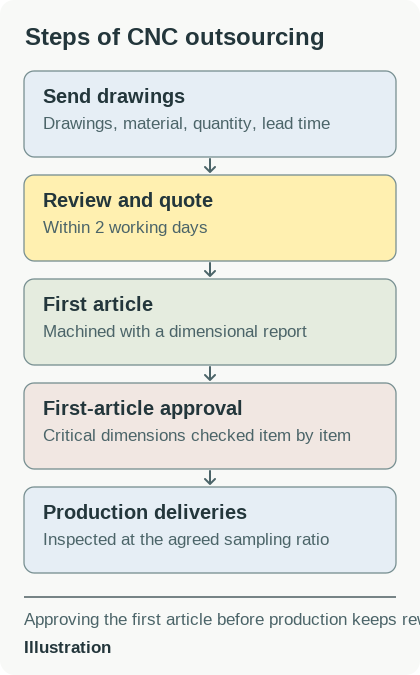
A practical rule: inspect critical dimensions on every part when the part is used for locating in assembly or in an inspection fixture. For general structural parts, sampling inspection is enough. Inspection fixtures need their own inspection reports, or results from parts checked on them cannot be traced.
Lead time and small batches
Parts for custom equipment are often few in number and needed quickly. Lead time follows each part's operations and quantity, and the shop explains it step by step in the review.
FUNYO responds within 4 hours of receiving drawings and returns a feasibility review with a comparative quote within 2 working days; it accepts STEP, IGES, DWG, PDF or photos. When parts are needed in batches, state the quantity and date of each batch in the order, so production can follow the assembly sequence of the machine. Tell the shop early about parts that may change after the first machine is built, so it can hold off on large batches of those until the design settles.
A practical rule: when urgent and routine parts are mixed in one order, mark priorities on the checklist. When every part matters equally, schedule deliveries in the machine's assembly order. Long part lists for a whole machine are easier to control when ordered in groups by assembly stage rather than all at once.
Why order with thermoformed parts
When a machine's thermoformed housing, its trimming fixture and the matching brackets and structural parts come from one plant, there are three benefits: fits are checked in-house, related brackets and fixtures can change together when the housing is revised, and one supplier is responsible for communication, logistics and lead time.
FUNYO's CNC machines already make thermoforming molds and trim formed parts, so a housing ordered together with its parts can be machined from the same datums. Trimming thermoformed parts is covered in trimming thermoformed parts, and fastening and assembly in fastening thermoformed parts.
A practical rule: when the housing and its parts are developed at the same time and will be revised together, ordering them together is simplest. When the parts already have a stable supplier, order only the housing and its trimming. When the housing is revised, update the drawings of related parts at the same time, so a new housing never meets an old bracket.
Put the requirements on a CNC order checklist
Collect the requirements above on one checklist, send it with the drawings and ask the shop to answer line by line. The last column is for your part's conditions.
| Item | Why it matters | What to specify | Your part |
|---|---|---|---|
| Part type | Sets the process and machine | Structural part, fixture, mold part or thermoformed part finishing | |
| Drawings and models | The drawing governs machining | File formats and which one governs | |
| Material | Affects tooling, lead time and price | Material grade, or ask the shop to advise | |
| Critical tolerances | Sets the inspection method and cost | Critical dimensions and tolerances marked on the drawing | |
| Surface requirements | Affects finishing | Roughness, deburring and surface treatment | |
| Quantity and batches | Sets the process and unit price | First batch and annual demand | |
| Inspection and reports | The basis for acceptance | First-article report and sampling ratio | |
| Lead time | Sets the production order | Required dates and delivery batches | |
| Packing | Prevents knocks and rust | Packing method and rust protection | |
| Fit with thermoformed parts | Buying together allows in-house checks | Mating thermoformed parts and assembly |
Download the cnc machining order checklist. You can send the checklist at any stage of completion; the review reply lists the items still missing.
When should you use a specialist machine shop?
Very large and heavy parts beyond the machines' travel, high-volume simple turned parts, parts that need casting or sheet-metal forming, and parts that need a full line of special heat and surface treatments are better served by specialist shops. FUNYO's CNC machining suits small batches of parts for custom equipment, fixtures, mold parts and the finishing of thermoformed parts.
Many equipment makers split the work: housings, fixtures and small-batch structural parts go to a plant that does both thermoforming and CNC, and high-volume standard parts go to specialist shops. Keeping a short list of qualified shops for each part type also protects the schedule when one shop is fully booked.
Next, send the part drawings, material, quantity and lead time to FUNYO. We will assign machines by part type and give the timing for the first article and production. For remote ordering from overseas, see sourcing thermoformed parts from China.