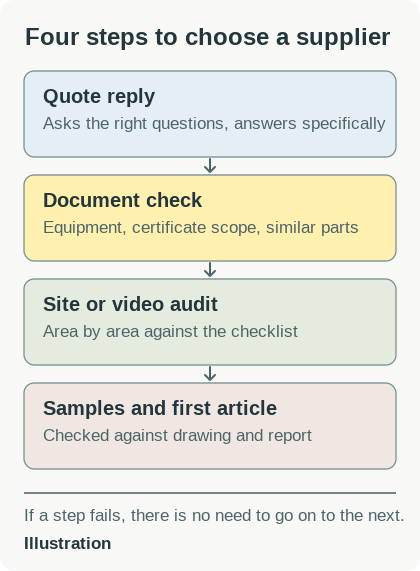
Choosing a heavy-gauge thermoforming supplier decides whether a housing project will be delivered on time and to standard. Heavy-gauge parts are large and pass through tooling and trimming steps, and suppliers differ widely: some only form and send tooling and trimming out, others can handle large parts but lack reliable inspection. This guide follows four steps, quote reply, document check, site or video audit, and samples and first article, explains what to look at in each and what good looks like, and ends with an audit checklist you can take to the factory. For what to prepare before requesting a quote, see the thermoforming RFQ checklist.
FUNYO was founded in 2004 in Doumen, Zhuhai, Guangdong, and has about 80 employees; heavy-gauge thermoforming, thin-gauge thermoforming and CNC machining are all done in-house, from design and tooling to production and shipping. The checklist below applies to any thermoforming supplier, FUNYO included.
Start with the quote reply: what a good reply asks
The quote reply is the cheapest way to learn what a supplier can do. Send the same drawing to several suppliers, and the content of their replies often tells you more than the prices.
| What the reply contains | What it tells you |
|---|---|
| Questions on annual demand, material, tolerances and appearance | The supplier is quoting your project rather than a standard price |
| A tooling plan with lead time | They know how to make it and how long it takes |
| Itemized price: tooling, samples, unit price, trimming, packing | Revisions and comparisons have a basis |
| Design risks: draft, radii, depth, gauge | Engineering capability that cuts rework before sampling |
| Lead time explained by step | The schedule is credible and can go into your plan |
A practical rule: a reply with a single total and no questions means the price is still an estimate, so ask for the breakdown and the assumptions behind it. When comparing several replies, list each supplier's questions and suggestions in one table; it becomes obvious which suppliers actually read the drawing. Suppliers who volunteer design changes in the reply usually have stronger engineering teams. Price structure and comparisons are covered in what drives thermoforming prices.
Forming capacity: maximum size, gauge and similar parts
The forming size of a supplier's heavy-gauge equipment decides which parts it can take. Check the maximum forming size and gauge range first, then whether they have made parts close to yours in size.
Ask for photos or videos of parts of similar size, ideally showing forming and trimming. FUNYO forms single parts up to 2600 × 1600 × 600 mm (102.4 × 63.0 × 23.6 in) from sheet 6–15 mm (0.24–0.59 in) thick, with 8–10 mm (0.31–0.39 in) common for housings; every supplier should be able to state numbers like these plainly.
A practical rule: when your part is close to a supplier's size limit, confirm that heating is even and the depth is sufficient, ideally with a sample first. When your part is well inside the limit, focus on trimming and inspection. Ask also how the supplier handles sheet that arrives warped or damp, because large parts magnify every sheet problem. Splitting and joining very large parts is covered in splitting and joining oversized parts.
Are tooling and CNC trimming in-house?
After forming, heavy-gauge parts are trimmed, drilled and slotted, and these steps decide both dimensional accuracy and how quickly revisions happen. Suppliers who make molds and CNC-trim in-house can handle a revision by changing a program or reworking part of the mold, which is the fastest route.
On site, look at three things: mold-making equipment, CNC trimming equipment and how trimming fixtures are managed. FUNYO uses 3-axis and 5-axis CNC machines for mold making, trimming and deburring formed parts, cutting openings and slots, and machining parts to drawing; a heavy-gauge mold takes about 1–3 weeks and costs about RMB 10,000. Mold types and lead times are covered in choosing a thermoforming mold, and trimming in trimming thermoformed parts.
A practical rule: when a supplier outsources tooling or trimming, add the outside shop's time to the lead time and expect an extra round of communication for each revision. For products that will still be revised often, favor suppliers with tooling and trimming in-house.
Inspection and the first-article process
The dimensions of large thermoformed parts depend on reliable measuring and a clear first-article process. A tape measure and a visual check cannot take responsibility for critical dimensions.
On site, look at the measuring equipment and gauges, and ask for a first-article dimensional report: which dimensions were measured, by what method, and how they map to the drawing. Tolerances for large parts are covered in tolerances for large thermoformed parts, and the sampling process in sampling and first-article approval.
A practical rule: when the part has several mounting holes and mating faces, require the first-article report to cover them and agree the measuring method. For mainly cosmetic parts with loose fits, focus on the appearance standard and how master samples are kept. If the supplier uses checking fixtures, ask who keeps them, how they are verified and what happens when the drawing changes.
Certificates and their scope
Quality and environmental management certificates show that a plant has a basic management system, but the scope matters more: each certificate states which products and processes it covers, and different product lines may fall outside it.
Check three things: that the certificate is valid, that its scope covers the products you are buying, and that the issuing body can be verified. Validity and scope can usually be checked on the issuing body's website, so do that before the visit and only compare the originals on site. Flame and environmental documents for the material come from the sheet maker, and the supplier provides the documents for the grade with each shipment; see flame-retardant thermoforming materials.
A practical rule: when the certificate scope leaves out your product, rely more on the processes and first-article records you see on site. When your own customer requires a particular certification from suppliers, say so in the request for quotation.
Capacity, lead time and spares
Look at capacity and lead time step by step: tooling, samples, first-article approval, production and shipping. FUNYO responds within 4 hours of receiving drawings and returns a feasibility review with a comparative quote within 2 working days; a heavy-gauge mold takes about 1–3 weeks.
Ask what share of the supplier's capacity your annual demand would take and how peak seasons are handled. When the product needs spares for many years, agree how molds are stored and for how long spares will be supplied. Once you start working together, agree a named contact and a response time, so someone owns each problem until it is solved.
A practical rule: when your demand would take a large share of a supplier's capacity, lead-time risk is higher and a second source is wise. When it is a small share, confirm that your orders will not be pushed behind larger customers.
What samples tell you: points to check at the sampling stage
An audit shows capability; samples show results. A supplier's samples reveal its forming, trimming and inspection standards directly.
| Point | What to look at | What it tells you |
|---|---|---|
| Wall thickness | Thickness at deep corners and side walls | Whether heating and forming are under control |
| Trimming and openings | Clean edges, accurate hole positions | The standard of CNC programs and fixtures |
| Show surface | Scratches, dents, specks | How tooling, sheet and handling are managed |
| Dimensional report | Item-by-item match with the drawing | Inspection capability and honesty |
| Packing | Protection on show surfaces | Delivery quality once production starts |
A practical rule: when the sample and the report disagree, remeasure before discussing the cause. When a sample looks good but comes without a dimensional report, ask for the report before approving. Judging cosmetic defects is covered in cosmetic defects and acceptance.
Ask for more than one sample where you can. Two or three parts from the same run show whether results are consistent or whether the best piece was picked for you, and consistency matters more for production than a single good part.
What to look at in a site or video audit
A site audit area by area is far more reliable than a brochure. When overseas buyers cannot visit, a video audit can cover part of the ground.

Walk the plant in this order: forming, tooling and CNC, inspection, then finished goods and packing. In the forming area, look at the machines and how sheet is stored; in tooling and CNC, whether molds and trimming are done in-house; in inspection, the measuring equipment and first-article reports; and in finished goods, labels, packing and surface protection. For a video audit, ask the supplier to show the same areas in the same order, then send samples and a dimensional report. The full remote buying process is covered in sourcing thermoformed parts from China.
A practical rule: for large, long-running projects, do at least one site audit. When a video audit raises questions, check them with samples and reports, and visit if needed.
Record the results on one checklist
Put the checks from each step on one checklist and record results item by item during the audit, so several suppliers can be compared side by side. The last column is for your notes.
| Audit item | What to look at | What good looks like | Your notes |
|---|---|---|---|
| Quote reply | Specific on size, gauge, tooling and lead time | Asks about quantity and tolerances; itemized price and design advice | |
| Forming size | Maximum forming size and gauge range | Covers your largest part, with photos of similar-size parts | |
| Tooling | Molds made in-house or outsourced | In-house, with mold material and lead time explained | |
| Trimming and openings | CNC equipment and trimming fixtures | In-house CNC trimming with programs managed by revision | |
| Inspection | Measuring equipment and gauges | First-article dimensional report with clear methods | |
| Certificate scope | Validity and scope of certificates | Scope covers the products you buy | |
| Material control | Sheet source, storage and batch tracing | Sheet stored dry, batches traceable | |
| Sampling process | Samples, first-article approval and master samples | Written process and retained master samples | |
| Capacity and lead time | Tooling and production lead times | Lead time explained by step, matched to your annual demand | |
| Packing and shipping | Show-surface protection and cartons | Film, interleaving and labels | |
| Communication | Response speed and contact person | A named contact and a stated response time |
Download the thermoforming supplier audit checklist. FUNYO accepts STEP, IGES, DWG, PDF or photos and can arrange a site or video audit against this checklist.
When is a lighter audit enough?
For one-off samples of small value, or for suppliers you have worked with for years with stable quality, a lighter audit is enough: review the quote reply and samples and skip the site visit. New long-term projects, parts close to the supplier's size limit, and projects where your customer requires audit records call for the full checklist.
Many buyers use tiers: a new supplier gets the full checklist once, then a lighter review every year, with a focused audit whenever a quality problem appears. Whatever the tier, keep the completed checklists together, so each supplier's history is at hand when a new project starts.
Next, send your drawings and this checklist to FUNYO; we will reply to the quote first and then arrange a site or video audit against the checklist.