Sourcing thermoformed parts from China means an overseas equipment maker, brand or trading company has heavy-gauge housings, covers or trays made by a Chinese plant and shipped by sea for local use. Buyers usually worry about the same things: whether freight eats the price difference, whether drawings and communication will go wrong, how to approve samples from a distance and who is responsible when something fails. This guide walks through the buying process step by step and ends with a sourcing checklist you can fill in.
FUNYO heavy-gauge thermoforming forms single parts up to 2600 × 1600 × 600 mm (102.4 × 63.0 × 23.6 in) from sheet 6–15 mm (0.24–0.59 in) thick and fits medium and large parts at a few hundred to a few thousand units a year, with molds in about 1–3 weeks. Whether the unit price beats a local supplier depends on the part, the quantity and your region; the most reliable test is to quote the same drawing with both and compare landed cost.
Compare landed cost before unit price
Landed cost is everything it takes for a part to reach your plant: unit price, tooling share, packing, sea freight, duties and local transport, plus the cost of handling any quality problem. Comparing unit price alone understates freight and packing; looking at freight alone ignores the difference in tooling cost.
| Cost item | Quoted by | Watch for |
|---|---|---|
| Unit price | Thermoforming plant | Whether trimming, openings and inspection are included |
| Tooling | Thermoforming plant | A heavy-gauge mold is about RMB 10,000, quoted by size and structure |
| Packing | Thermoforming plant | Export packing is more demanding than local delivery |
| Sea freight | Forwarder or plant | Full container or consolidated, by destination port |
| Duties and clearance | Buyer or forwarder | By destination rules |
| Local transport | Buyer | Distance from port to plant |
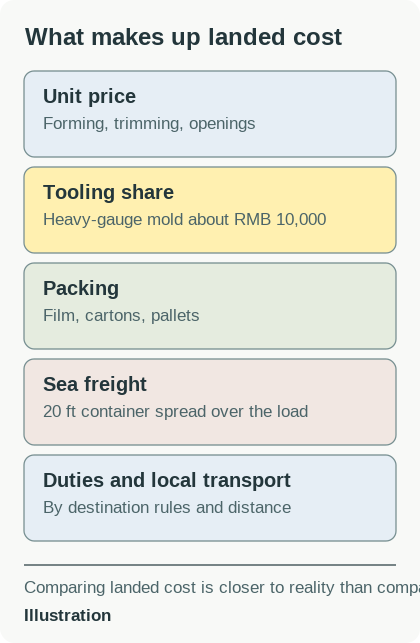
A practical rule: when parts are valuable and fairly compact, freight is a small share and sourcing from China pays off most clearly. When parts are bulky and low in value per piece, freight is a large share, so work out landed cost before deciding.
How freight spreads over each part
As a November 2026 reference, a 20 ft container costs about RMB 4,000–5,000 to Japan and about RMB 10,000 to Europe or the US. Spreading full-container freight over the parts adds an estimated 10% to landed cost for small parts and about 20% for large parts, and the actual share varies with how many parts fit in the container and their size.
Freight per part is the container rate divided by the number of parts it holds, so the fuller the container, the lower the freight per part. Example: at RMB 4,500 for a 20 ft container to Japan, 300 medium housings carry about RMB 15 of freight each; the same container holding 100 large machine covers carries about RMB 45 each.
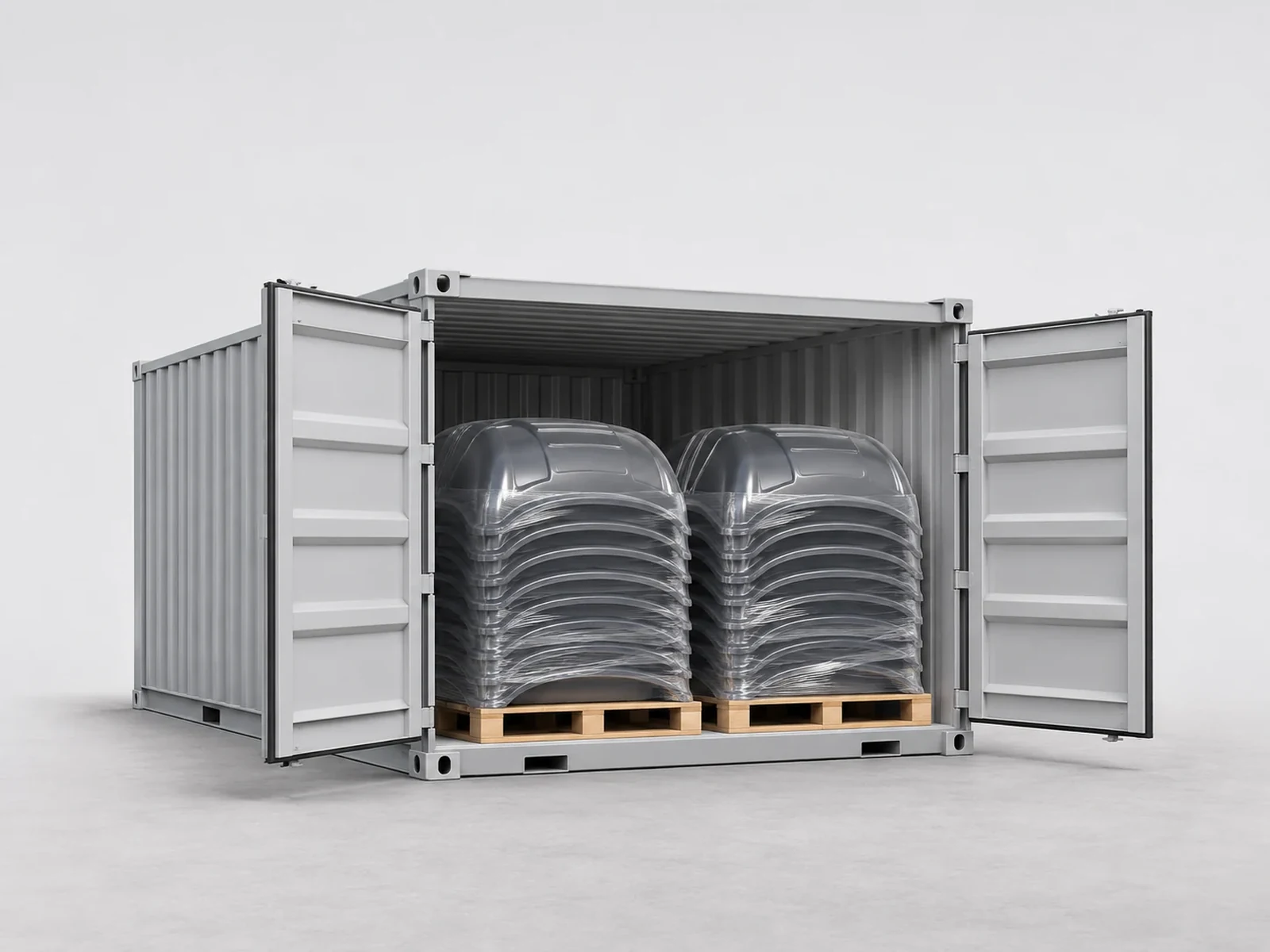
Thermoformed parts have draft, so identical parts can often nest inside each other and take far less space than parts packed as solid shapes. Say in the request whether the parts can nest and how many ship each time, and the plant can work out freight per part from a loading plan. When a shipment will not fill a container, compare consolidated freight or combine several batches into one container.
Drawings and units: get them right at the start
FUNYO accepts STEP, IGES, DWG, PDF or photos; without drawings, photos and key dimensions are enough to start a review. The most common rework in remote sourcing comes from units, datums and tolerances that were never written down.
State on the drawing whether units are millimeters or inches, mark the mounting datums and key dimensions, and separate tolerances by type: trimmed and machined positions, formed-surface profiles and overall size. If the 3D model and the 2D drawing disagree, say which one governs. Agree a single revision numbering scheme as well, so both sides always refer to the same version of a drawing in emails and on the shop floor. Writing tolerances for large parts is covered in tolerances for large thermoformed parts, and the full list of quote inputs in the thermoforming RFQ checklist.
A practical rule: when the part assembles with other locally made parts, send the mating parts' dimensions or models too, so they can be checked during sampling. For a cosmetic cover with loose fit requirements, key dimensions and mounting hole positions are enough to start.
Communication and samples: the remote approval steps
The key to remote sourcing is agreeing each approval step and how it will be done, so that time zones do not add waiting. FUNYO responds within 4 hours of receiving drawings and returns a feasibility review with a comparative quote within 2 working days.
Samples can travel by courier first, with photos, video and a dimensional report for remote approval; the report should name the measuring positions and methods and match the drawing callouts. After first-article approval, keep one approved sample at the buyer and one at the plant as the reference for later batches. Sampling and first-article approval are covered in sampling and first-article approval.
A practical rule: when appearance matters and color must match other local parts, approve a physical sample. For internal structural parts with low appearance demands, photos and a dimensional report can be enough and save courier time.
Certification and documents: who is responsible for what
Documentation for the housing material and certification of the finished product are two separate matters, and they should be separated in the request for quotation.
Environmental and flame documents for the sheet come from the sheet maker, and the thermoforming plant supplies the documents for the grade it uses with each shipment. Safety and electrical certification of the finished product is the equipment maker's responsibility, and the housing is one part of it. See flame-retardant thermoforming materials for checking ratings and documents, and outdoor thermoformed enclosures for weathering requirements.
A practical rule: when your destination has specific environmental or flame requirements for materials, list the documents you need in the checklist so the plant can confirm availability by grade. Without specific requirements, at least state the material type and color so documents can be supplied later.
Packing and sea freight: protecting parts on a long voyage
Sea freight takes longer and involves more handling than local delivery, so packing must do more. Put protective film on show surfaces, separate parts with interleaving sheets, and pack and secure them on pallets; on humid routes, add moisture protection.
Nesting saves space, but nested parts need interleaving so show surfaces do not rub. Photograph the container as it is loaded; if parts arrive damaged, the photos help trace the cause. For the first shipment, ask for photos of a packed pallet before loading, so packing can be adjusted before the container leaves. Ship spares in proportion to the quantity to replace parts damaged in transit.
A practical rule: pack high-value parts with strict appearance requirements individually in crates or reinforced cartons. Structural parts and parts with low appearance demands can be nested and packed by the pallet to cut freight.
Lead time: from order to arrival at port
Lead time has three parts: tooling and samples, production, and sea transit. A heavy-gauge thermoforming mold takes about 1–3 weeks, production starts after sample approval, and sea transit depends on the route.
| Stage | Timing | Notes |
|---|---|---|
| Review and quote | Within 2 working days | After drawings or photos arrive |
| Tooling and samples | About 1–3 weeks | Heavy-gauge mold |
| Sample shipping and approval | Courier time plus approval time | Remote approval |
| Production | By quantity | After first-article approval |
| Sea transit | By route | Full container or consolidated |
With stable annual demand, parts can ship in planned batches across the year, and free tooling can be negotiated per order when volumes and batches are stable. For cost and quantity calculations, see what drives thermoforming prices.
Handling quality problems: agree standards and remedies first
When something goes wrong in remote sourcing, the slowest part is rarely the problem itself; it is the two sides holding different ideas of what counts as acceptable. Writing the acceptance standard, the reporting method and the remedy into the order lets both sides act on the agreement when a problem appears.
| Item | What to agree | Benefit |
|---|---|---|
| Acceptance standard | The approved sample and the drawing govern | Both sides judge parts the same way |
| Reporting method | Photos, video and measurements | The cause can be judged remotely |
| Remedy | Replacement, rework or a price adjustment | Less back-and-forth negotiation |
| Prevention | Corrective action confirmed before the next batch | The problem is prevented in later batches |
A practical rule: judge cosmetic defects against the appearance standard and dimensional problems against the drawing tolerances. For damage caused in transit, compare the loading photos with photos taken on arrival to decide responsibility. Methods for judging appearance are covered in cosmetic defects and acceptance.
Keep the first few batches under closer watch: inspect a larger sample on arrival, share the results with the plant and agree any adjustment before volumes grow. Once several batches arrive without issues, inspection can move to a lighter routine.
Put the requirements on a sourcing checklist
Collect the requirements above in one checklist, send it with the drawings and ask the supplier to answer line by line. The last column is for your project's conditions.
| Item | Why it matters | What to include in the RFQ | Your project |
|---|---|---|---|
| Drawings and units | Unclear units and datums cause rework | File format, units and tolerance requirements | |
| Annual demand and batch size | Sets the container plan and freight per part | Annual demand and quantity per shipment | |
| Delivery point and trade terms | Decides who pays freight and carries risk | Destination port or delivery point and terms | |
| Packing requirements | Long sea transit needs protection | Protective film, cartons and pallets | |
| Nesting and container loading | Nesting cuts freight per part | Whether the parts can nest | |
| Sample approval method | Remote approval needs agreed standards | Courier samples, photos and dimensional report | |
| Material documentation | Who supplies environmental and flame documents | List of required documents | |
| Product certification roles | Housing and product certification are separate | Scope the housing supplier is responsible for | |
| Color and appearance standard | Color comparison across regions drifts easily | Standard reference and comparison light | |
| Schedule milestones | Sea transit time must be included | Required arrival date at port or plant | |
| Contacts and time zones | Approval steps should not wait on time zones | Contact person, language and response time |
Download the china sourcing checklist. You can send the checklist at any stage of completion; the review reply lists the items still missing.
When is a local supplier the better choice?
A local supplier fits better for urgent small batches needed within days, for very bulky parts with low value per piece, and for projects where the design still changes often and engineers need to meet on site every week. Sourcing from China pays off for parts with stable quantities, a settled design and deliveries planned in batches across the year.
Many buyers combine both: prototypes and urgent top-ups are made locally, and settled production parts come from China, each arranged by landed cost and lead time. To find where thermoforming and injection molding cross over, run your own numbers through the break-even calculator.
Next, send drawings or photos, annual demand, batch size and destination port to FUNYO. We will return unit price, tooling cost and a container loading plan; add freight and duties, and compare landed cost.