Thermoforming lead time is the whole span from sending drawings or an inquiry to receiving production parts. Many projects ask only how long the mold takes and then lose time in sampling, first-article approval or production scheduling. This guide breaks lead time into review and quote, tooling, samples, first-article approval, production and shipping, explains roughly how long each stage takes and what drives it, and shows how to shorten it, ending with a lead-time plan you can download.
FUNYO responds within 4 hours of receiving drawings and returns a feasibility review with a comparative quote within 2 working days. Its heavy-gauge thermoforming forms single parts up to 2600 × 1600 × 600 mm (102.4 × 63.0 × 23.6 in), with trimming and openings cut on 3-axis and 5-axis CNC machines after forming.
What makes up lead time
Thermoforming lead time has six stages, each with its own timing and drivers.
| Stage | Typical time | Main drivers |
|---|---|---|
| Review and quote | Within 2 working days | Whether the information is complete |
| Tooling | Heavy-gauge about 1–3 weeks; thin-gauge trays usually 2 days | Size, depth, structure |
| Samples | Scheduled by design | Amount of trimming and openings |
| First-article approval | Within the agreed approval time | Approval speed and number of changes |
| Production | By quantity and operations | Trimming, inspection, packing |
| Packing and shipping | By distance and mode | Local delivery or sea freight |
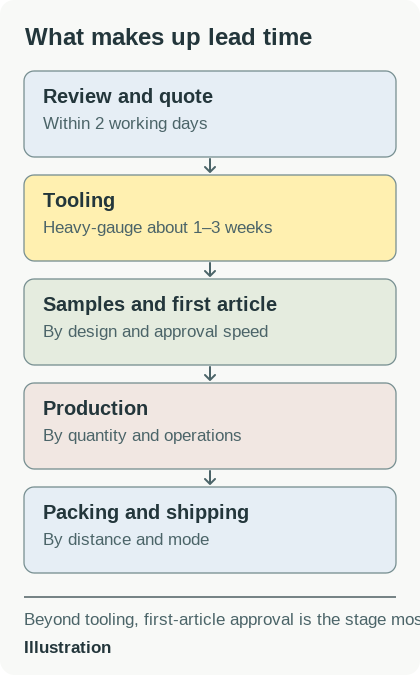
A practical rule: on tight projects, put all six stages into the plan, not just tooling. Tooling time is usually the most predictable; first-article approval and production scheduling are what tend to run long.
Heavy-gauge thermoforming: molds in about 1–3 weeks
A heavy-gauge thermoforming mold takes about 1–3 weeks, against about 6–10 weeks for a comparable injection mold. Heavy-gauge molds are simple in structure, which is the main reason thermoforming delivers quickly at the prototype and small-batch stages.
Mold time depends mostly on size, depth and structure: large, deep molds and those needing inserts or special features take longer. A heavy-gauge mold costs about RMB 10,000. Mold types and choices are covered in choosing a thermoforming mold, and the comparison with injection molding in heavy-gauge thermoforming vs injection molding.
A practical rule: when the part approaches the single-part size limit or has a complex structure, plan for the top of the mold-time range. For medium-sized parts with simple shapes, mold time is usually shorter.
Thin-gauge trays: molds usually in 2 days
A thin-gauge tray mold is typically 2 days’ work, and trays up to 500 mm (19.7 in) can be sampled in as little as 8 hours. Thin-gauge trial runs start at 50 pieces and production at 500 pieces.
Lead time for thin-gauge trays depends mainly on the number of cavities, the size and material requirements such as static control. When the material is special, include the time to prepare the sheet. Writing tray specifications and tolerances is covered in automation trays, tolerance, stacking and ESD.
A practical rule: when trays must suit a new line under commissioning, sample at trial quantities first and confirm location and pick-and-place on the line, then order production quantities. When the line is already stable, schedule production quantities directly.
First-article approval: the most underestimated stage
First-article approval is the stage most often underestimated. Once samples arrive, they must be assembled, measured and commented on, and any change means another round.
To shorten it, agree before sampling which dimensions and appearance points the first article will be checked for, and name the approver and the approval deadline. When samples arrive, assemble and test them promptly and give all comments at once. Comments with photos and markups help the supplier judge quickly whether the mold or only a program needs to change. The approval process is covered in sampling and first-article approval.
A practical rule: when many departments are involved and approval needs several sign-offs, write the approvers and deadlines into the plan in advance. When a single engineer is responsible, approval is usually quick.
Production: scheduled by quantity and operations
After first-article approval, production begins. Production time follows quantity and operations: forming, trimming, drilling, inspection and packing.
Heavy-gauge parts are trimmed and drilled on CNC machines, so the more operations, the longer each part takes. For large quantities, deliveries can be split so the first batch reaches assembly first. With stable annual demand, production can run in planned batches with material stocked ahead, which steadies lead time.
A practical rule: when final assembly runs at a clear pace, deliver in batches to that pace. When demand is unsteady, agree a minimum batch and a notice period in the contract. Inspection records shipped with each batch also speed up incoming inspection at your end.
Example: lead time for a heavy-gauge housing project
The example below shows how the stages connect on a medium-sized heavy-gauge housing project. Real timing depends on the part's structure, quantity and how quickly approvals come back.
| Time (example) | Work in progress | Key point |
|---|---|---|
| Week 1 | Drawings sent, review and quote | Everything sent at once; quote within 2 working days |
| Weeks 1–3 | Mold making | Heavy-gauge mold in about 1–3 weeks |
| Weeks 3–4 | Samples, trimming, shipping | Samples come with a dimensional report |
| Weeks 4–5 | First-article approval | Approver and deadline agreed |
| From week 5 | Production, delivery in batches | Deliveries follow the assembly pace |
In this example, tooling takes only about three weeks, while the project needs five weeks or more to reach production deliveries; every week of delay in first-article approval moves the whole project back a week.
A practical rule: when the project has a fixed date, such as a trade show or customer trial, plan each stage backward from that date. Without a fixed date, plan in the example's order and update the plan at the end of each stage.
What makes lead time run long
Lead time rarely runs long because one operation is slow; it runs long because of unplanned waiting. Spotting these risks early lets you prevent them.
| Risk | Cause | Prevention |
|---|---|---|
| Incomplete information | Quantity, tolerances or material missing | Send everything on the RFQ checklist at once |
| Repeated shape changes | Mold opened before the design was frozen | Settle the shape with 3D prints first |
| Slow sample approval | Unclear approver, several sign-off levels | Agree approver and deadline in advance |
| Special sheet | Color, flame or weather grades prepared separately | State material requirements in the inquiry |
| Holidays | Capacity is tight around long holidays such as Chinese New Year | Order early or build stock |
| Transport | Sea freight or long-distance trucking | Include transport time in the plan |
A practical rule: when two or more risks apply at once, build a buffer into the plan. When all are ruled out, the plan can follow the typical times closely. Review the risks again at each stage, because new ones, such as a late design change, often appear midway.
How to shorten lead time
The biggest time savings are usually decided before the inquiry is even sent. These four approaches work best.
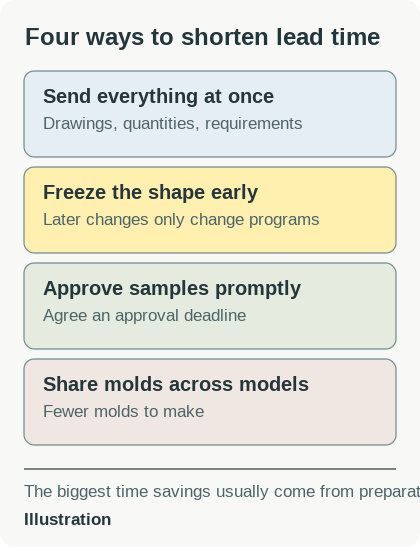
Send drawings, quantities and requirements in one go: FUNYO accepts STEP, IGES, DWG, PDF or photos, and complete information means no back-and-forth before the review and quote; the thermoforming RFQ checklist lists what to include. Freeze the outer shape early, so later changes to openings and connectors only change CNC programs. Approve samples promptly against an agreed deadline. Let several models share one mold to cut the number of molds; see one mold, many models.
A practical rule: on very tight projects, use all four at once. When the schedule has slack, at least send everything at once and approve samples promptly.
How revisions affect lead time
The effect of a revision on lead time depends on what changes.
| Change | How it is handled | Effect on lead time |
|---|---|---|
| Openings and connector positions | CNC program change | Very small |
| Local shape | Mold rework or an insert | Moderate |
| Overall shape | New mold | Same as a new mold |
| Material or color | New sheet and new samples | By sheet preparation time |
A practical rule: while the product is still changing, put the parts likely to change into openings and connectors and settle the outer shape first. When the shape must change, change it fully in one go to limit the number of new molds.
Lead time compared with injection molding and sheet metal
When choosing a process, lead time often matters as much as cost. The three common processes behave differently.
| Process | Mold or tooling | Lead-time character |
|---|---|---|
| Heavy-gauge thermoforming | Mold in about 1–3 weeks | Fast samples; most revisions only change programs |
| Injection molding | Comparable mold in about 6–10 weeks | Slow to tool, fast per part in volume |
| Sheet metal | Usually no dedicated tooling | Suits box shapes; curved styling is difficult |
Heavy-gauge thermoforming is strongest at the prototype and small-batch stages, with fast molds and flexible revisions. Injection molding is strongest per part once the shape is frozen and volumes are high. Process choice for prototype housings is covered in prototype housings: 3D printing or thermoforming.
A practical rule: when you need production-like prototypes within about a month, compare heavy-gauge thermoforming first. When the product is settled and annual volume is high, open the injection mold early to its cycle.
Put the plan on a lead-time sheet
Write each stage's typical time and your planned dates on one sheet and send it with the inquiry, so both sides work to the same plan. The last column is for your planned dates.
| Stage | Typical time | What affects it | Your plan |
|---|---|---|---|
| Review and quote | Within 2 working days | Whether drawings, quantities and requirements are complete | |
| Heavy-gauge mold | About 1–3 weeks | Size, depth and structure | |
| Thin-gauge tray mold | Thin-gauge typically 2 days; as little as 8 hours up to 500 mm (19.7 in) | Size and number of cavities | |
| Samples | Scheduled by design | Amount of trimming and openings | |
| First-article approval | Within the agreed approval time | Approval speed and number of changes | |
| Production | By quantity and operations | Trimming, inspection and packing | |
| Packing and shipping | By distance and mode | Local delivery or sea freight | |
| Revisions | Program changes have little effect | Openings, local shape or overall shape |
Download the thermoforming lead-time plan. FUNYO responds within 4 hours of receiving your information and returns a feasibility review with a comparative quote within 2 working days, with the timing of each stage stated in the quote.
When should you plan around injection molding or another process?
When annual volume is high, the shape has been frozen for a long time and the part is small with complex detail, injection molding fits better and lead time follows the injection mold cycle. Load-bearing structural parts and sheet-metal parts follow sheet-metal or machining lead times. Heavy-gauge thermoforming fits medium and large parts that need samples fast, are still being revised and are built at a few hundred to a few thousand a year.
Many projects work in stages: thermoforming delivers prototypes and pilot lots quickly, and injection molding is assessed once demand is stable. Overseas buyers also need to add sea transit; see sourcing thermoformed parts from China.
Next, send drawings, quantities and required dates to FUNYO. We will set out the timing stage by stage and state it in the quote.