A returnable tray cleaning service collects the thermoformed trays that electronics and precision-parts plants use again and again on their lines, then cleans, inspects and packs them so they can go back into use. With time, returnable trays collect particles, oil, fingerprints and label residue that affect the cleanliness of the parts they carry, while replacing every tray with a new one costs a lot and creates waste. This guide covers the cleaning process, cleanliness acceptance, ESD retesting, when to scrap a tray and how to plan the loop, and ends with a tray cleaning specification sheet you can download.
FUNYO set up its thermoforming division in 2013 and has made thin-gauge trays since then; its class 100 washing room covers 50 m² and its class 10,000 thin-gauge cleanroom 1,500 m², both completed in 2016. For writing cleanliness requirements for new trays, see cleanliness specifications for thermoformed trays.
Why returnable trays need cleaning
Returnable trays move between the line, the warehouse and transport, and every round brings new contamination: airborne particles, oil from gloves and equipment, fibers from packaging and adhesive left by labels. Put parts into a dirty tray and the contamination moves to the parts.
Cleaning and reuse brings two benefits: the tray returns to the agreed cleanliness so it no longer contaminates parts, and it can circulate many times, which costs less than buying new each time and cuts plastic waste. A practical rule: when parts have a cleanliness requirement and the tray itself is intact, cleaning and reuse pays off most. When a tray is distorted or broken, cleaning cannot bring it back, and it should be scrapped and replaced. Set the cleaning interval by how quickly trays get dirty: shorten it on lines where contamination builds fast and lengthen it where it builds slowly, so cleanliness holds without paying for unnecessary washes.
The cleaning process: eight steps
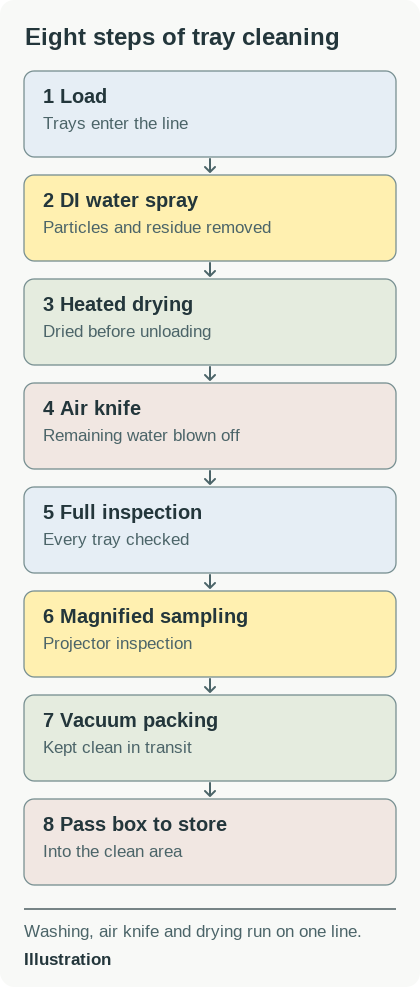
FUNYO cleans trays on a pure-water line of its own design, 20 m (65.6 ft) long with an effective cleaning width of 950 mm (37.4 in), combining washing, air knife and drying. The process has eight steps:
| Step | What happens | Purpose |
|---|---|---|
| 1 Loading | Trays enter the washer | Batches enter the line in order |
| 2 DI water spray | Spray with deionized water | Remove particles and water-soluble residue |
| 3 Heated drying | Dry before unloading | Avoid water marks and recontamination |
| 4 Air knife | Blow off remaining water | No water left in pockets and corners |
| 5 Full visual inspection | Every tray checked | Remove damaged and stained trays |
| 6 Magnified sampling | Projector inspection | Find fine foreign matter |
| 7 Vacuum packing | Vacuum-sealed bags | Stay clean in transit and storage |
| 8 Storage through a pass box | Into the clean area | Kept apart from general areas |
A practical rule: when trays carry only dust, the DI water wash meets the requirement. When there is oil or adhesive, say what kind of contamination it is so pre-treatment can be assessed before the trays enter the line. List the tray models and the order in which they run, so batches of different trays are kept apart on the line.
Which trays suit the cleaning line
Not every tray suits the same cleaning method. Sorting trays by type and contamination before they are sent avoids rework.
| Tray condition | Suits the line? | Notes |
|---|---|---|
| Thin-gauge trays with dust and particles only | Yes | Cleaned in the 8-step process |
| ESD trays | Yes, with sampled retesting after cleaning | Take particular care with coated trays |
| Returnable trays up to 950 mm (37.4 in) wide | Yes | Wider trays assessed per project |
| Oil or label adhesive | Assess pre-treatment first | Say what the contamination is |
| Foam, labels or fittings attached | Remove first, then clean | Assessed per project if they cannot be removed |
| Distorted or broken | Not sent for cleaning; scrapped | Unusable even after cleaning |
A practical rule: when one batch mixes trays with different levels of contamination, pack and label them separately so the cleaning method and cost are clear. When the contamination is unknown, send a few samples for a trial wash first.
How cleanliness is accepted
Cleanliness of cleaned trays should be accepted by a method agreed in advance; results only mean something when both sides measure with the same ruler.
FUNYO inspects cleaned trays under 20× magnification and traces the source whenever movable foreign matter is found, and the air in the class 100 room is monitored with a laser particle counter. A practical way to write acceptance is in three parts: appearance (conditions for visual and magnified inspection), particles or residue (sampling method and pass criteria) and packing (vacuum packing and trays per pack). Cleanliness criteria and sampling methods are covered in cleanliness specifications for thermoformed trays.
A practical rule: when parts are very sensitive to particles, agree how particles are sampled and counted. When the particle requirement is moderate, appearance and magnified inspection are enough, which keeps acceptance simpler and cheaper. Agree also who keeps the reference samples and how long batch records are kept, so a question raised months later can still be answered.
Should ESD trays be retested after cleaning?
It is advisable to retest the surface resistance of ESD trays after cleaning, by an agreed sampling plan. The effect of washing depends on how static control is achieved: a surface coating can weaken with washing and rubbing, while permanently antistatic material is more stable but still worth sampling.
FUNYO has focused on permanently antistatic trays since 2014. For the types of static control and material choice, see thermoformed tray materials; for surface resistance classes and test conditions, see automation trays, tolerance, stacking and ESD.
A practical rule: when trays carry static-sensitive parts, sample and retest after every cleaning batch and record the results with the batch, together with the test environment, because humidity and temperature affect surface resistance readings. When coated trays fail the retest, move to permanently antistatic trays.
When to scrap and replace
Cleaning removes contamination but cannot repair damage. With every batch sent for cleaning, sort out damaged trays first.
| Condition | Effect | Action |
|---|---|---|
| Cracks or tears | Shedding, parts may catch | Scrap |
| Distortion that upsets location | Automated pick-and-place errors | Scrap |
| Worn pockets | Parts loose or scratched | Scrap |
| Stains that survive washing | Fails appearance, may contaminate parts | Scrap |
| Failed ESD retest | Static risk | Scrap, or move to permanently antistatic trays |
A practical rule: when the scrap rate suddenly rises, look back at how the line uses the trays or how they are packed for transport. When it is steady, top up new trays in step with it so the loop never runs short. Photograph a few typical rejects for each scrap reason and attach them to the specification, so operators on both sides sort the same way.
Collection, cleaning, return: planning the loop
Tray cleaning is a loop: use, collection, sorting, cleaning and inspection, packing and return. Sorting and recording every round is what keeps the loop stable.
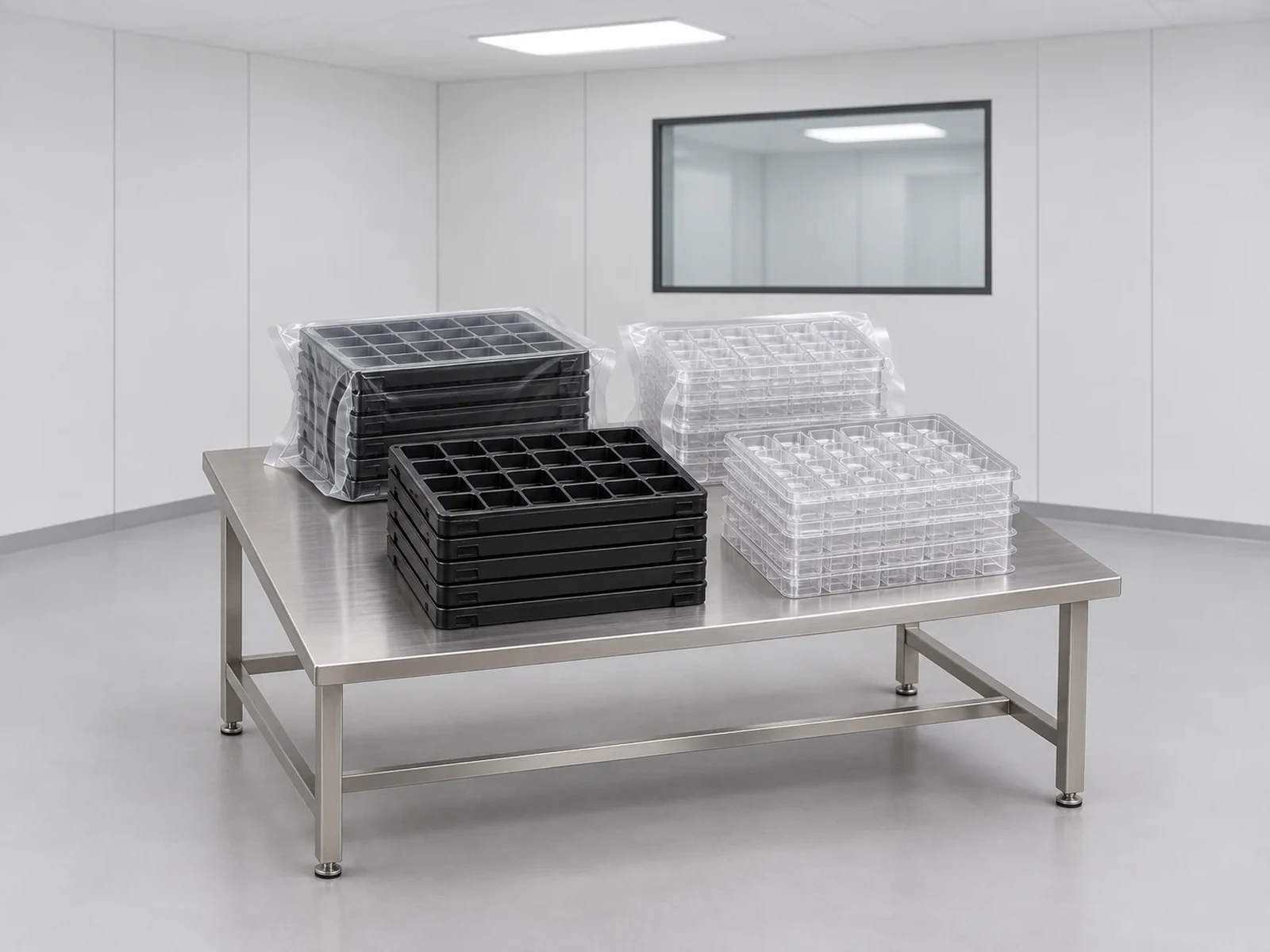
Pack trays for cleaning by batch with the quantity and tray model marked, and label them by batch after cleaning, recording the cleaning date, inspection results and scrap count. Wash-resistant numbers printed or labeled on the trays make it possible to count each tray's loops and spot trays nearing the end of their life. The total number of trays in the loop must cover those in use on the line, those in transit and those being cleaned, or the line will wait for trays. FUNYO responds within 4 hours of a request and returns a feasibility review with a comparative quote within 2 working days.
A practical rule: when the line uses trays every day, send them on a fixed schedule and keep a buffer stock. When use is irregular, send by batch and agree lead times in advance.
Clean or replace: comparing the cost
Whether to clean and reuse comes down to the cost of each loop: cleaning, inspection, packing and transport, plus the share of replacements for scrapped trays, compared with using a new tray every time.
The calculation: cost per loop = (cleaning and inspection cost + packing and transport cost) ÷ good trays per batch + new tray price × scrap rate. The higher the tray price, the more loops a tray can survive and the lower the scrap rate, the more cleaning pays. For heavy-gauge and large handling trays, see large thermoformed handling trays.
A practical rule: for very cheap single-use trays, cleaning may cost more than replacing. For more expensive custom trays with complex shapes, cleaning and reuse usually saves money. Include the cost of line stops caused by missing or dirty trays in the comparison, and the value of cleaning becomes clearer.
Starting out: trial wash first, then set the standard
For a first cleaning order, it is best to trial-wash a small batch and use the results to set the standard before regular loops begin.
| Step | Content | Result |
|---|---|---|
| Trial wash | Send a small, representative batch | Understand the contamination and the cleaning result |
| Inspection and report | Appearance, magnified checks, ESD sampling | A trial-wash report |
| Agree the standard | Acceptance method, sampling ratio, scrap criteria | Written into the spec sheet and contract |
| Regular loop | Scheduled cleaning, records by batch | A stable loop |
For the trial, include the most common kinds of contamination from your line, such as ordinary dust, fingerprints and label adhesive, so the trial report reflects real conditions.
A practical rule: when trays serve several lines with very different contamination, trial-wash each line's trays separately. When they serve one line, a single trial is enough. Keep the trial report with the contract, because it is the reference whenever a later batch looks different from what you expected.
Put the requirements on a tray cleaning specification sheet
Collect the requirements above in one table, send it with tray samples or drawings and ask the supplier to answer line by line. The last column is for your trays' conditions.
| Item | Why it matters | How to specify | Your trays |
|---|---|---|---|
| Tray size and material | Decides whether the tray fits the line | Overall size, material and gauge | |
| ESD type | Coated trays may weaken after washing | Permanently antistatic or surface-coated | |
| Cleanliness requirement | Sets the cleaning and inspection method | Particles, residue and appearance | |
| Acceptance method | Both sides judge by the same method | Inspection method, magnification and pass criteria | |
| Sampling ratio | Sets the inspection workload | Sample size per batch | |
| Packing | Cleaned trays must stay clean | Vacuum packing and trays per pack | |
| Scrap criteria | Damaged trays disrupt the line | Judgment of cracks, distortion and wear | |
| Loop quantity and frequency | Sets the cleaning schedule | Trays per batch and cleaning interval | |
| Collection and return | Logistics affects loop time | Pickup and delivery points, transport | |
| Batch records | Traceability when problems arise | Batch number, cleaning date and inspection results |
Download the tray cleaning specification sheet. FUNYO accepts STEP, IGES, DWG, PDF or photos; the line's effective cleaning width is 950 mm (37.4 in), and wider or unusually shaped trays are assessed per project.
When should you use new trays instead?
New trays are the better choice where parts demand the highest cleanliness and only new trays will do, for very cheap single-use trays, and for trays that are already distorted, broken or no longer antistatic.
Many plants combine both: new or high-grade cleaned trays for critical steps, routinely cleaned returnable trays for general steps, managed in tiers by process.
Next, send the tray model, material, quantity, cleanliness requirement and cleaning interval to FUNYO. We will assess the cleaning method, inspection and loop plan and send a quote.